




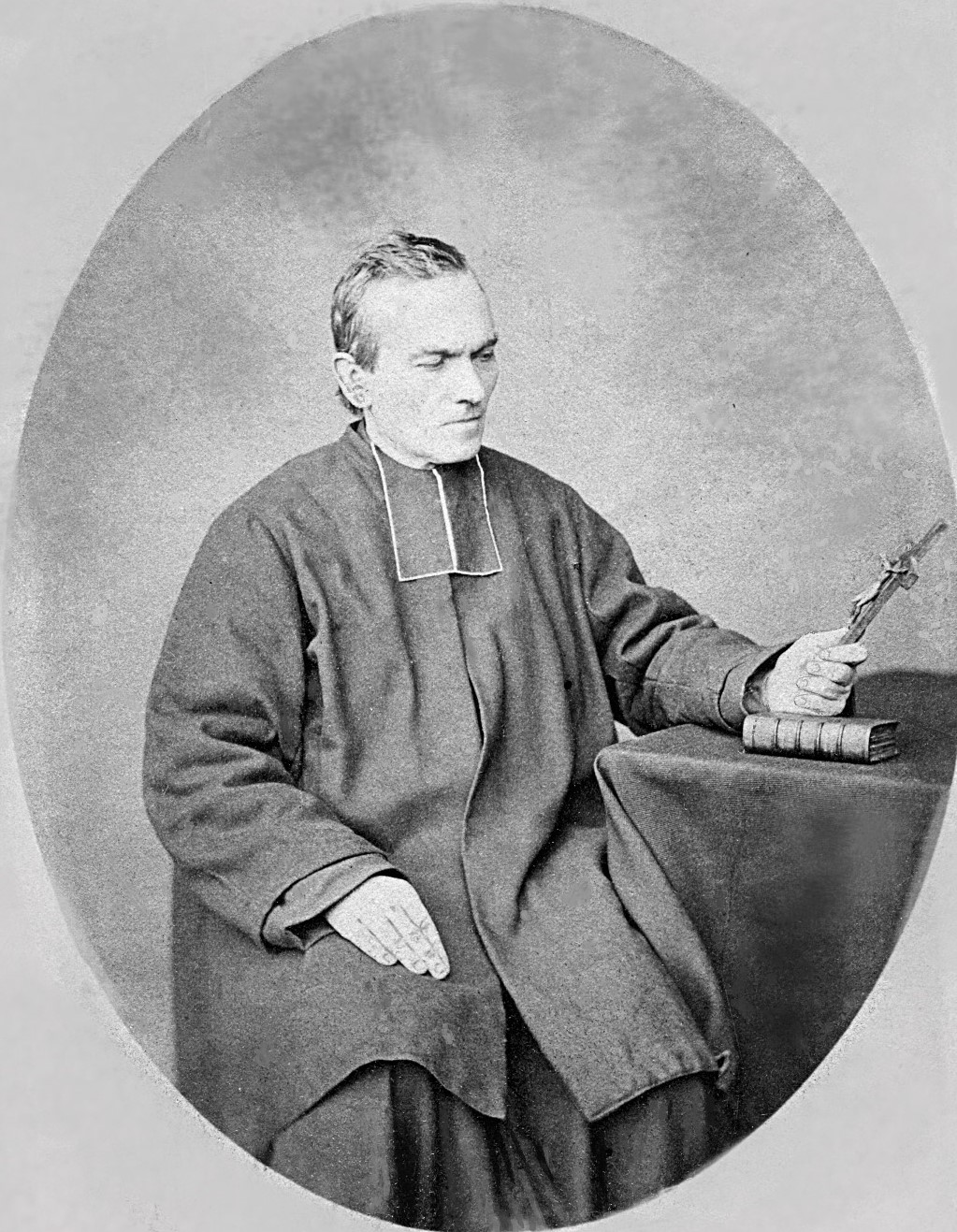
The whole Prado family is delighted to celebrate the bicentenary of Fr Chevrier’s birth in 2026.
Celebrating the birthdays of loved ones is a source of joy for all those invited. And, in many cultures, those attending a birthday party usually give a present to the guest of honour. It is with this in mind that I invite you to experience this time of grace: what gift might we offer to Father Chevrier on this occasion? Or, to put it another way, how might we mark the anniversary of his birth in such a way that Father Chevrier would be pleased with the celebration organised by his children?
First of all, he would ask us to fix our gaze on Jesus Christ (cf. Lk 4:20; Heb 12:2). We would be wrong to focus solely on the person of Antoine Chevrier and on the historical vicissitudes he experienced. For us, he is the guide, the beacon, who constantly leads us to the Gospel. He is aware that he is a labourer in God’s work, full of limitations, and would ask us not to dwell on him: « »And yet, on the other hand, I feel so powerless, so incapable, that I often say to my God: “My God, have you not made a mistake in placing such a frail and insignificant creature as myself at the head of such a great Work?”’ (L. 295. See also L. 93, L. 294…). He would ask us this year to turn to Jesus Christ with a renewed and strengthened love, not to take our eyes off him, so that we may come to know him and make him known to the poor: « »Are we not here for that reason alone: to know Jesus Christ and his Father, and to make him known to others?’ (L, 181).
In this year of grace, we should take a theological view of time: history, the present and the future. We must look back on the past with gratitude, for we have enjoyed God’s constant presence amongst us. It is not a matter of looking back on the past to discover our human glories, or the successes and failures we have accumulated in order to take stock; rather, we delve into our history with our hearts, to contemplate how God’s mark has been imprinted upon it: from the birth of the Prado on that blessed Christmas night in 1856 at Saint André, through the difficult early days, the period of 'internationalisation», and the deepening of the charism we have received… the Spirit of God has blown powerfully upon this Work, which is His own. And this is the reason for our gratitude: » »His steadfast love endures from generation to generation for those who fear him’ (Luke 1:50).
A cultivated and time-tested faith leads us to contemplate the present time with joy. Constant exposure to a culture of secularisation also affects the strength of our faith. In old Europe and in many other countries where the Church and the Prado are in decline, we may be tempted to think that the Lord is not walking alongside us, when in reality he is leading us towards a purification of our faith: « »I will preserve amongst you a remnant of humble and poor people; they will seek refuge in the name of the Lord’ (Zeph 3:12). Although circumstances are difficult, Father Chevrier teaches us to trust, to believe in the presence of Jesus Christ at our side: « »We are not people abandoned by God. We have a God who is truly a Father, who loves his children and wants to guide and save them.’ (VD 63).
Similarly, we must look to the future with hope, for to us it is neither uncertain nor threatening. In the future, God will continue to carry out his work in ways we cannot even begin to imagine at present. It is striking to see the hope with which Father Chevrier speaks of the Prado’s future at a time when he is facing a profound crisis caused, as we know, by the departure of his first collaborators: « God will prove to me, in a way that will be obvious at the time, that he needs no one to carry out his work (…), I think that after us, God will send others who will do better than we do » (L 153). The apostle of La Guillotière does not place his hope in material or human resources to carry out his own project, but in the work of God, which will not fade away in the future. God is the Lord of the impossible, capable of revealing new paths where they seem to have vanished: « »Do not dwell on past events; do not keep harping on about what happened long ago. For I am about to bring about something new, which is already beginning to take shape; will you not recognise it? Yes, I will make a path in the very heart of the desert.’ (Isaiah 43:18–19).
Finally, in this bicentenary year, we are invited to look at the world with compassion and without naivety, but through the eyes of the Father. Looking at the world in this way will make us even more aware of its contradictions caused by the presence of evil, but it will deepen our conviction that this is the world God loves, the world for which he gave his Son. We are called to carry on this current of God’s love, which today reveals his providence throughout the world through us. God wishes to love the present world through us, through the Prado family.
By looking at the world through the eyes of its Creator’s love, we will discover our brothers and sisters who are affected by the injustices caused by sin, both personal and structural. « »For you will always have the poor with you’ (Mk 14:7). Today, we encounter new causes of poverty to which we must remain constantly attentive: social media, artificial intelligence, the mistreatment of our common home, abuses of all kinds, migration… The faces of the poor today are varied and sometimes difficult to discern. The poor continue to call for the Good News of Jesus, which we are called to share with them, and they help us rediscover that our mission is, as always, necessary. Like Fr Chevrier, we are convinced that « »Training catechists must surely be what is needed today, both for our times and for the Church’ (L 153).
Lyon, 30 October 2025
A word of welcome from the Father Diego MARTÍN PEÑAS (General Director of the Prado Priests’ Institute) to the heads of the various divisions organising the bicentenary of the birth of Blessed Antoine Chevrier.
This text has also been published in the journal One of us (PRADO QPN No. 264 – Following on from Antoine Chevrier).