

The work of the Prado
Father Chevrier loves the poor so much and he loves Christ and his Gospel so much that he is constantly animated by this conviction that " the poor have a right to the Gospel, to the whole Gospel" .
He believes that young people, who started working at the age of 8 in glassworks, vitriol works and other factories in Lyon and who find themselves at 12 or 15 years old without knowing how to read and without having done catechism, are capable of experiencing great joy in knowing Christ.
In his attempts to translate what he has discovered into his life .
He devotes himself mainly to teaching catechism to children: many of them have been working since the age of 8 or 9 and have never been to school or catechism.
But he quickly realizes that they are left behind, misunderstood and mistreated, in this city supposedly built for the poor. He wants them to feel at home, welcomed, respected, listened to, loved: it is in this atmosphere that he intends to introduce them to Christ and his message.
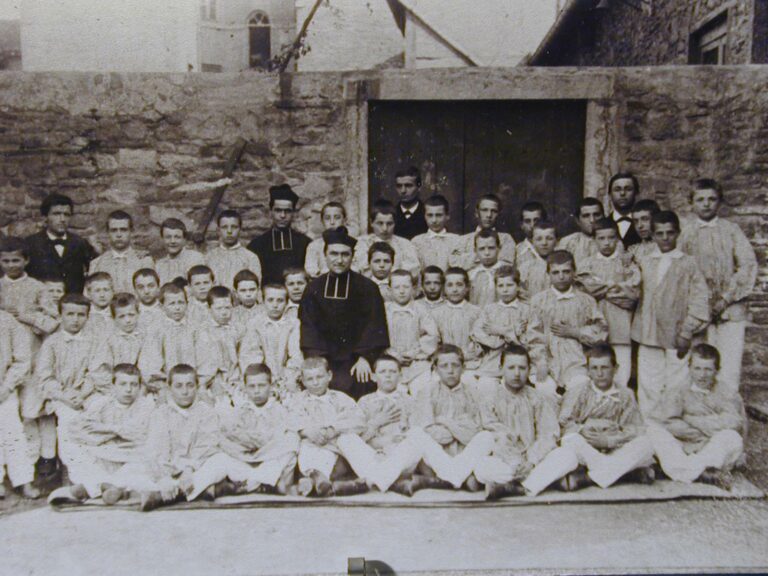
The Prado, a ballroom that becomes «the First Communion artwork»
He felt he would have to find them «a place all to themselves,» otherwise it would be impossible. However, he hesitated; he had absolutely no desire to take on the burden of a house… Finally, having become certain that God was calling him in this direction, he made up his mind. And so he created *The First Communion* at the Prado in 1860.
There was, in the suburb, a ballroom a very well-known and notorious venue where a thousand people could dance comfortably, which was called «Le Prado.». One day, Father Chevrier saw a «For Rent or For Sale» sign there. He moved in with «his children.» He kept them for six months and took full responsibility for them, then took in a new «batch» for six months… and so on.
They are between twelve and eighteen years old. It is «a small, diverse, and challenging world» that has already taught them a great deal through «the school of the streets» and workshops. Some parents send their children because they are delinquents; others ask Father Chevrier to go get them out of jail and bring them to the Prado. One witness recounts: « I have often seen tall young men between the ages of 16 and 20 preparing for their First Communion. Some of them had worked for traveling circuses; they were highly skilled in the acts of acrobats, boxers, rope-eaters, and occasional blackface performers. As a result, their recess activities were quite successful reenactments of carnival festivities.« .
He wanted to teach them and help them discover Christ in a warm atmosphere of trust and simplicity. Surprising transformations were taking place within them.
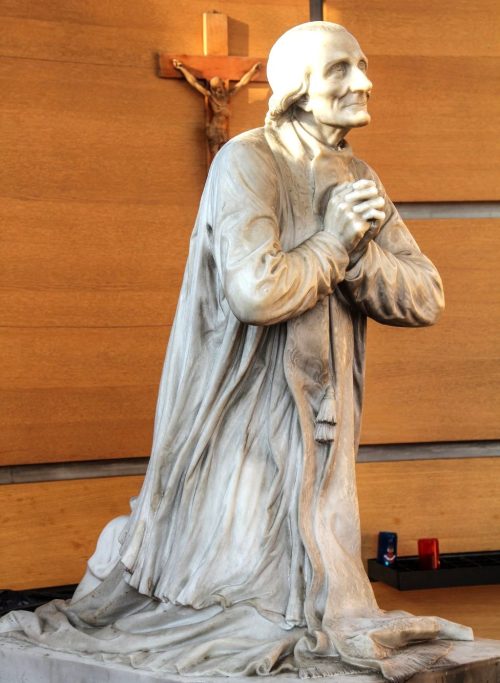
A tribute to the Curé d’Ars—whom he had met twice
« Love for God and for one’s neighbor—that is the principle and the life-giving force behind everything, which must bring everything to fruition within us; when this is present in a soul, it has everything it needs. Charity without outward appearance is better than outward appearance without charity. Disorder with love is better than order without love. This is what the Curé d’Ars expressed in a rather humorous way when, speaking of the little girls at his Providence school who were being raised according to these principles—since his daughter Catherine was unfamiliar with disciplinary methods— and speaking of that way of life and comparing it to the new approach being introduced at his Providence—after he had once been forced to hand over the helm to others, more skilled in worldly matters—he said that he was quite fond of his little ruckus from days gone by. » (VD, 223).
The Prado: One Name, Two Stories
LThe practical application of the spiritual insight received on Christmas Eve 1856 by Father Antoine Chevrier has evolved over the generations that followed the founding father.
How can we analyze the historical evolution of the First Communion ministry, which, from the very beginning, was deeply shaped by the pastoral urgency of evangelizing the poor? How does what we now regard as «the educational work of the Prado» remain faithful to the true vision of its Founder? What does it mean today for the Association of Prado Priests and their mission to evangelize the poor to draw upon that origin? We will attempt to offer some reflection on all these questions, thereby gaining a better understanding and situating ourselves in relation to the spirit of the grace that Father Chevrier received and that the Church has confirmed and entrusted to the spiritual family of the Prado.
The Creation of the "General Community"
In 1954, the Prado—which brought together priests from various French dioceses—asked the Holy See to recognize it as a Secular Institute of Pontifical Right. Its constitutions provided for the existence of a «general community,» taking the place of the former «corps franc,» whose members were incardinated into the Institute and thus reported primarily to the Superior General of the Prado—hence the name «general community»—while the other members of the Institute belonged primarily to their respective dioceses. Since the 1954 Constitutions had been provisionally approved in February 1957, from that date onward the Superior General of the Prado was able to incardinate members into the Institute and ordain them.
Among the members of the former «corps franc,» some chose to maintain the status quo; others asked to be incardinated into the diocese where they were located; and many joined the General Community.
Read More… The General Community, text written by Yves Musset.
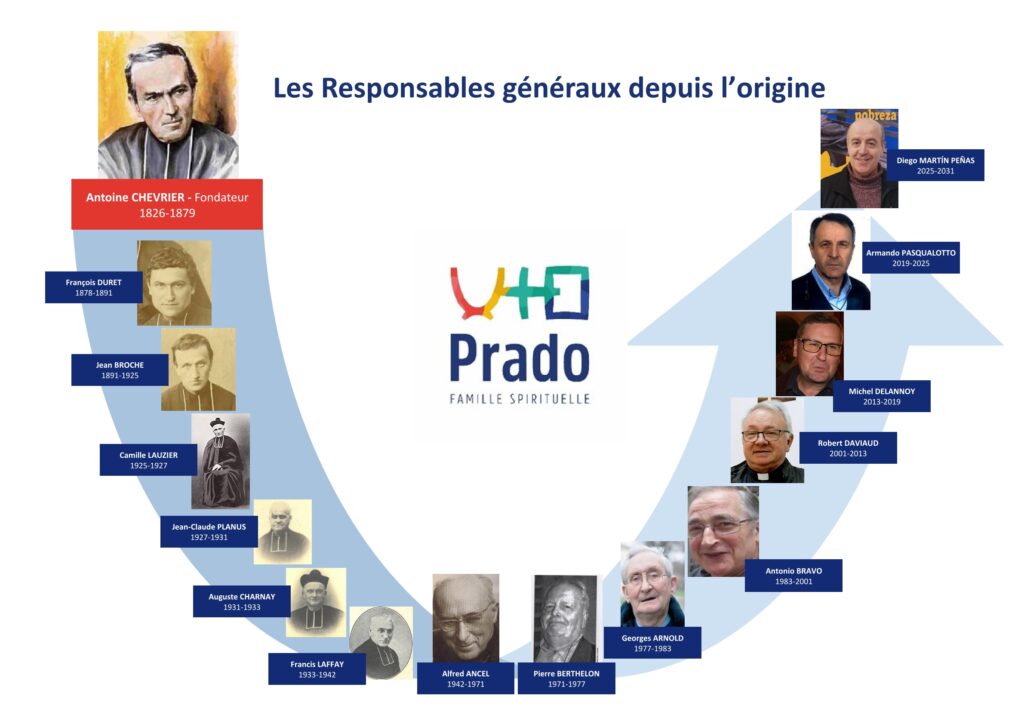
The General Superiors of the Prado Institute of Priests Since Antoine Chevrier
- François DURET (1878–1891),
- Jean BROCHE (1891–1925),
- Camille LAUZIER (1925–1927),
- Jean-Claude PLANUS (1927–1931),
- Auguste CHARNAY (1931–1933),
- Francis LAFFAY (1933–1942),
- Alfred ANCEL (1942–1971),
- Pierre BERTHELON (1971–1977),
- Georges ARNOLD (1977–1983),
- Antonio BRAVO (1983–2001 – 3 terms: 1983–1989, 1989–1995, and 1995–2001),
- Robert DAVIAUD (2001–2013—two terms: 2001–2007 and 2007–2013),
- Michel DELANNOY (2013–2019),
- Armando PASQUALOTTO (2019-2025),
- Diego MARTÍN PEÑAS (2025-2031).