


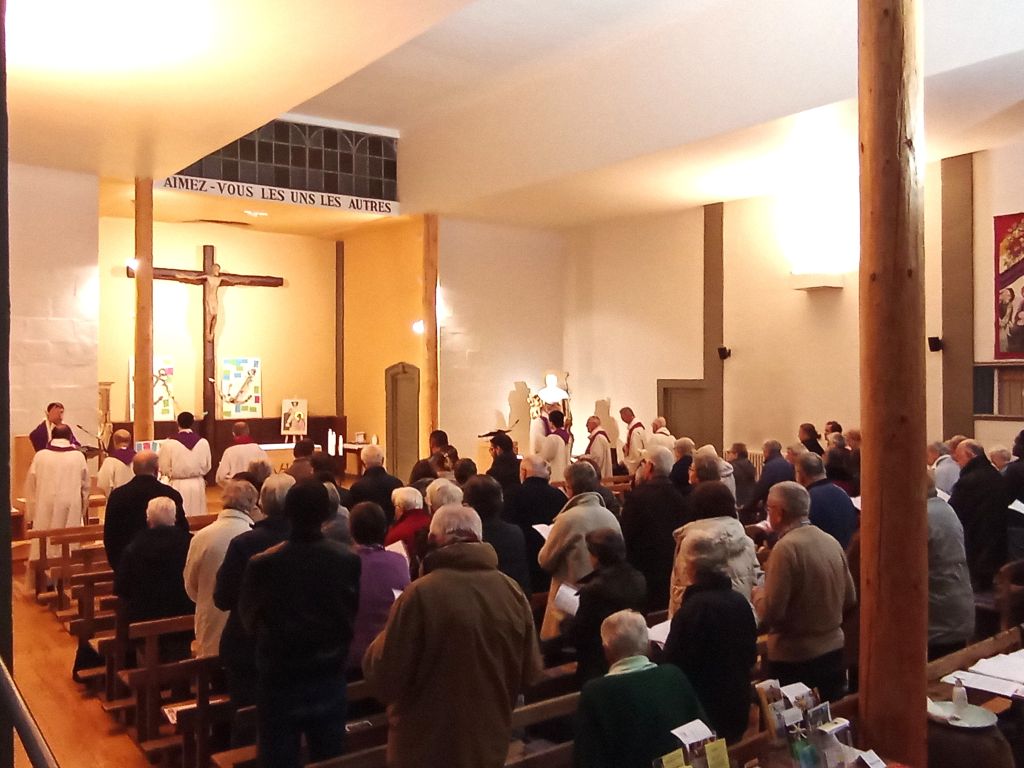
As every 10 December, the The Prado family met up at La Chapelle for a Anniversary Mass to mark the founding of the Prado.
“Not mere words about hope, but hope rooted in everyday life: this means that Christian hope must not remain merely fine words, but must become a concrete attitude that transforms the way we live each day, in the most ordinary of circumstances.”
In this Wednesday 10 December 2025, priests, nuns, consecrated lay people and lay friends of the Prado prayed together and shared a time to think on the theme of’hope.
- What is our hope today?
- The hope of the Prado family: how do we receive it, how do we uphold it today, and how do we share it with others?
Everyone was able to to reaffirm its commitments. The sisters and women of the IFP, the priests and consecrated laypeople of the Prado, as well as the deacons, the wives of deacons and all lay friends who wished to attend.
The celebrations continued in the ITEP restaurant with a convivial buffet.
For download the booklet for the Eucharistic celebration, click here or in the photo below.
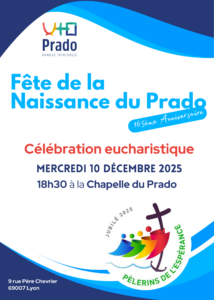
NO. 165th PRADO ANNIVERSARY
On 10 December 1860 – 165 years ago, therefore – a priest from Lyon, Antoine Chevrier, acquired a dance hall in the Guillotière district to take in and provide a Christian upbringing to children and young people in great difficulty. At that time, the Guillotière was a very poor neighbourhood that formed the industrial outskirts of Lyon. At that time, when free, compulsory state education did not yet exist, many children had to work from a very young age on the silk looms or in factories; they had received neither schooling nor religious instruction. With the help of lay volunteers – young men and women – Father Chevrier took them in, boys on one side and girls on the other, for a period of five to six months, so that, in this setting, they could prepare for their First Communion whilst learning to read, write and count. From 10 December 1860 until 2 October 1879, the day of Father Chevrier’s death, between 2,300 and 2,400 young people were welcomed there, two-thirds of whom were boys and one-third girls.
Who were these young people whom Father Chevrier welcomed in this way at the Prado? Where did they come from? Who directed them to the Prado, and how?
To answer these questions, Jean-François Six, in his biography of Father Chevrier, quotes the vivid accounts of those who, twenty years after the death of the founder of the Prado, gave evidence in Lyon during his beatification trial. Some witnesses describe these young people as « real savages », whilst expressing their surprise at having seen these « wild »to become something completely different: « After a while, they had completely changed. Little by little, they became endearing and likeable » (p. 231). Later, in the 1900s and beyond, albums were compiled of the children admitted to the Prado, listing their names; opposite some of these names, the following is written: « arrested for vagrancy », « accidentally drowned in the Saône », « died of asphyxiation », « death from tetanus », « murdered », « arrested for theft and aiding and abetting », « pushed by their father to commit murder alongside his brother », etc. So it wasn’t all success, and some of the Prado’s former pupils earned, in their own way, the honours of the press!
What does Father Chevrier himself say about the conditions for admission to the Prado? In a text from the very early days of the work – as it dates from the first few months of 1862 – Antoine Chevrier says of the « purpose of the work »that it is «" to prepare poor and elderly children who are unable to receive their First Communion in their local parishes ». « That is a large number, he wrote at the time, as 107 are enrolled, aged between 14 and 20. These are children who, for the most part, have been working since the age of 8 or 9 and whose parents have sent them neither to school nor to catechism classes; and once they have passed that age, they no longer dare to attend ordinary catechism classes » (Ms 10/15a).
In his 1877 regulations for the Prado, Antoine Chevrier makes a similar statement, saying that ’ We do not accept boys under the age of 14 or girls under the age of 12 », but an examination of the lists of children taken in at the Prado that have been preserved for us casts some doubt on these general assertions. Upon examining the lists of boys from 1968 to 1973, which specify the children’s dates of birth and places of origin, I made the following observations. Children under the age of 12 are indeed rare. The largest group consists of 13-year-olds, who make up an average of 41 per cent of the total. Fourteen-year-olds account for 20 per cent. Twelve-year-olds account for 14 per cent. Fifteen-year-olds account for 10 per cent, and those aged between 16 and 20 make up only around 8 per cent. Most of those we take in at Le Prado are therefore older children.
The lists of boys admitted between 1968 and 1973 also show that many came from various neighbourhoods in the Lyon metropolitan area, including La Guillotière; but there are also a smaller number of young people who, we are told, come from places close to Lyon: neighbouring departments or even – though these are only isolated cases – Creuse, Nièvre, Paris, Meurthe, Switzerland, Austria and Guadeloupe.
By whom, and in what way, were these young people guided towards the Prado? Jean François Six, citing eyewitness accounts, writes: « Some parents bring their children because they can no longer cope with them; others to get rid of them; still others come to ask Father Chevrier to have their children released from prison so that they can be taken to the Prado, and the courts agree to this » (p. 230). In fact, children were mainly placed at the Prado through the parishes, as Father Chevrier writes in his 1877 regulations: « The Prado Orphanage only admits children who are presented with a recommendation from the parish priest, certifying that there are grounds for admitting the child ». And Father Chevrier adds: « The daily requests we receive from parish priests, whether from the Diocese of Lyon or from neighbouring dioceses, show us just how valuable this work is, and we are unable to accept all the requests we receive ».
I shall now move on to the second question, which will take up a little more of our time, as it takes us more directly to the heart of the subject we are here to discuss this evening: the thinking and values of Father Chevrier. This second question is as follows: What exactly is Antoine Chevrier trying to achieve with these young people he is taking in at the Prado for just a few months?
If we are to understand, from a historical perspective, what Father Chevrier set out to do, we must go back to the period preceding the purchase of the dance hall on 10 December 1860, that is to say, to 1857 and the years that followed, when Antoine Chevrier, having left the parish of St André de la Guillotière, was living at Mr Rambaud’s Cité de l’Enfant Jésus. It was there, through his work with the children of the Cité, that everything took on meaning and shape for him, as well as for those who were his collaborators at the time.
Let me briefly recap the facts. In the aftermath of the 1848 revolution, Camille Rambaud, who at the time held a senior management position at one of Lyon’s largest silk firms, had become aware of the plight of the poor children who roamed the streets. Having rented a flat in the Brotteaux district, with the help of a few friends, he began by taking in a number of them on Sundays to take them to Mass at the neighbouring parish and to give them some catechism and schooling. The restless presence of these children in a block of flats and at the parish had caused a stir; so, when he left his professional job to devote himself to social work, Rambaud leased a large plot of land from the Hospices Civils de Lyon to build a building which he intended to turn into a school. The children would be housed there on a permanent basis and free of charge; they would be kept for six months, the time needed to provide them with a basic education and catechism; they would no longer cause a disturbance in the neighbourhood or at church. « The sons of the rich, he said, play happily in some lovely garden; my adopted children will also have their very own playground and place of fun all to themselves » (Auguste Body, A Wonderful Friendship: Camille Rambaud and Louis Potton, 1910). In June 1855, there were 35 children living in what was known as the Cité de l’Enfant Jésus (see Blanchon, Father Paul du Bourg, Lyon, 1915). The idea of taking the children aside and keeping them with him for six months – an idea that Father Chevrier would later adopt at Le Prado – therefore originated with Rambaud.
In May 1856, severe flooding ravaged the entire left bank of the Rhône. Many adobe houses collapsed. An entire impoverished population had to be rehoused. It was then that Camille Rambaud set about building a sort of emergency housing estate on his own land. The following year saw Father Chevrier arrive at the Cité to serve as chaplain. He devoted particular attention to the children’s education, preparing them for their First Communion within six months.
But alongside those who look after these children whom we wish to rescue from poverty – Pierre Louat, Amélie Visignat, Marie Boisson and Antoine Chevrier soon realised that it was not possible to have a building site and an educational project co-existing in the same place and under the responsibility of the same people. The forceful letter written in June 1859, in which Father Chevrier explains his position to Camille Rambaud, is particularly telling on this subject. I shall read you a few extracts, which clearly illustrate Father Chevrier’s view of the conditions necessary for the smooth running of an educational project:
« The work of First Communion and that of those who have persevered cannot go hand in hand with the work of the City; they are an obstacle to one another […] The main reason is that your brothers cannot do two things at once: they cannot respond to the residents of the City, collect the rent, take up the collection and teach the children […] The brothers responsible for the children’s education must be devoted solely to that task; they must concern themselves only with that, and think of nothing else; any other occupation is incompatible […]
How can you expect a Ménétrier, a Benoît or others to instil in them a love of work when, throughout the entire period of manual work, the children see them playing, reading or amusing themselves with things other than what they are supposed to be doing? Virtue is not instilled in this way. No, there must be brothers who love these children, who understand them and show them affection and devotion. If a child is thirsty or hungry and goes to ask for a piece of bread in the kitchen, he is met with a jug of water thrown in his face, called a fool, looked at with contempt, or simply ignored. How can you expect these children to love the home and be happy to come back here? And it will remain this way as long as you have only children in charge of other children. […]
Father Chevrier also points out that « The residents of the Cité do not take a kindly view of these children; they are annoyed by the noise they make, refer to them simply as «brats» and regard them with nothing but contempt. Indeed, these poor children, when they turn up in rags and looking as bedraggled as they unfortunately do, are not a pretty sight. Consequently, Mr Augier could not stand them, and when, on his departure, he gave me a few bottles of wine to help me recover and regain my strength, he said to me: ‘Make sure you don’t give any to your gang.’ […] How can you expect children to come into a world that despises and rejects them?
The caretaker, for his part, is forced to tell them off and even hit them. If a child climbs onto a stone, he must make them come down, the architect shouts. It is not the caretaker’s fault, but the stone’s. Why is it there? That used to be my home; that stone is robbing me of my freedom. If a child goes to play hide-and-seek in a new house, they must be chased out: they damage the plaster, the tiles, the brickwork; they must be forcibly removed. Poor little ones! They are truly to be pitied. The stones and the houses have taken their place, so they never come back; they go elsewhere in spite of us—or rather, we force them to go elsewhere, because we no longer make room for them. […] Children, like everyone else, like being at home; they like having things done for them; they like being left to their own devices. Yet here, one cannot say that they are at home; nor can they say that they are the sole focus of our attention, when they find themselves mixed in with so many other people ».
Father Chevrier realised that, in order to provide a proper education for young people in difficulty, trained staff and suitable premises were needed, and that it was important for these young people – whose home had been the street or the workshop – to have a place of their own where they enjoyed staying and to which they were happy to return. As Camille Rambaud prioritised housing at that time, they had to part ways, which led to the founding of Le Prado when Father Chevrier discovered the possibility of establishing the new organisation in the dance hall he had purchased on 10 December 1860.
In his writings, Father Chevrier sets out a number of educational principles which are particularly close to his heart. To summarise:
Never hit children.
To take them on again with patience and gentleness. « They can’t become well-behaved overnight ». Don’t be hard on them.
To love them. To care for them as a father and mother would, both for their bodies and their souls.
« Never leave them on their own; always keep an eye on them, whether in the classroom, the dormitory, the canteen or at break time ».
Respect them. We’re here for them. For example, « »do not treat them as servants’.”.
« Take great care to avoid any form of affection or familiarity with children.
Avoid any peculiarities or close friendships, which always attract contempt and discord », etc.
Given the teaching methods practised in many schools of his time, where order and discipline were prioritised, Father Chevrier believed that, with these children, it was not a question of training them or merely seeking to instil a certain outward propriety. It was their inner selves that needed to be touched, so as to awaken in them a different perspective on others, on themselves, and on life. In the A True Disciple, in this book which Father Chevrier wrote for the training of the priests of El Prado, he writes: « To teach, to correct and to put into practice, to get things done – that is life, its lifeblood and the means of communicating it: but to confine the world to a niche, to mould it into a form, is to force the world, to suppress its flaws rather than correct them. We must allow flaws to show so that we have the opportunity to address and correct them » (The True Disciple, p. 222).
Antoine Chevrier, a man of the people, drew from his personal experience of interacting with ordinary people, but also from his close study of the Gospels; Jesus’s teaching methods in training his disciples, which he studied at length, inspired his entire approach, both with the pupils at his seminary and with children receiving their First Communion.
A few closing words.
I shall simply quote Father Duret, Father Chevrier’s successor as head of the Prado, who summed up what we were seeking to achieve there in this lovely phrase: « 1. They were tamed; 2. They were civilised; 3. They were Christianised ». « We were taming them »: these children whom some people called « wild », the first step was to get to know them – or rather, to start by getting to know one another. « We were civilising them », which means that, little by little, they were learning – through a new way of relating to their educators and to one another – to live civilly, as citizens of the same city ought to behave towards one another, even though they saw themselves as excluded from civil society. « They were being converted to Christianity »: the aim was to help them become Christians, not only through catechism lessons, but also by teaching them how to pray, in order to awaken them to the possibility of a relationship with God.
Finally, it is worth noting that there was concern about what became of the children once they left the Prado. Many, it is said, returned there on Sundays, and towards the end of his life, Father Chevrier founded, near the Prado, a charity known as ‘La Persévérance’, where some of them stayed as boarders. Several years after his death, together with Father Perrichon, the organisation was to open a branch in the Guillotière district, taking the dual form of a youth club and a study circle, which appears to have been very active.
Father Guy ROUGERIE