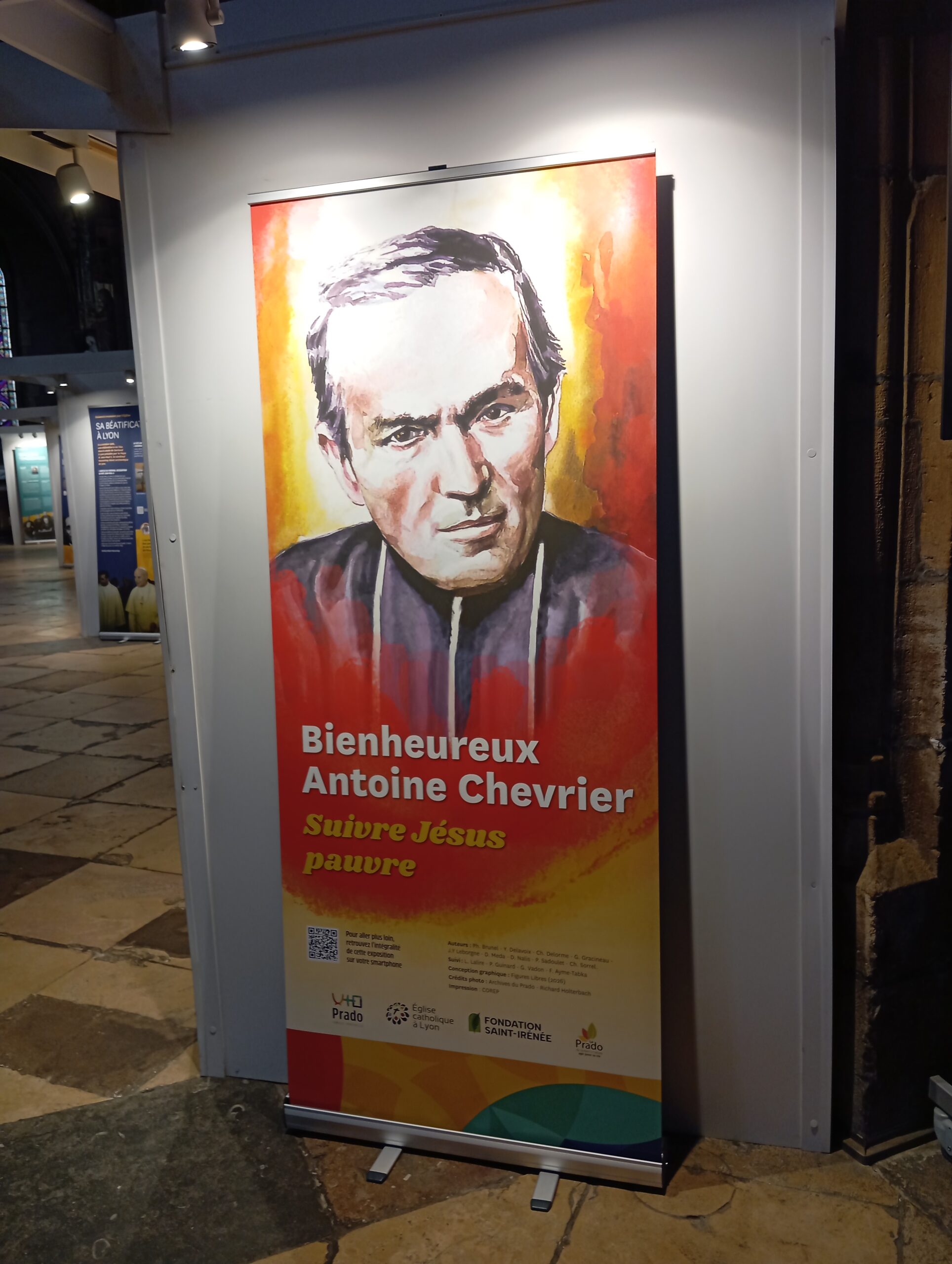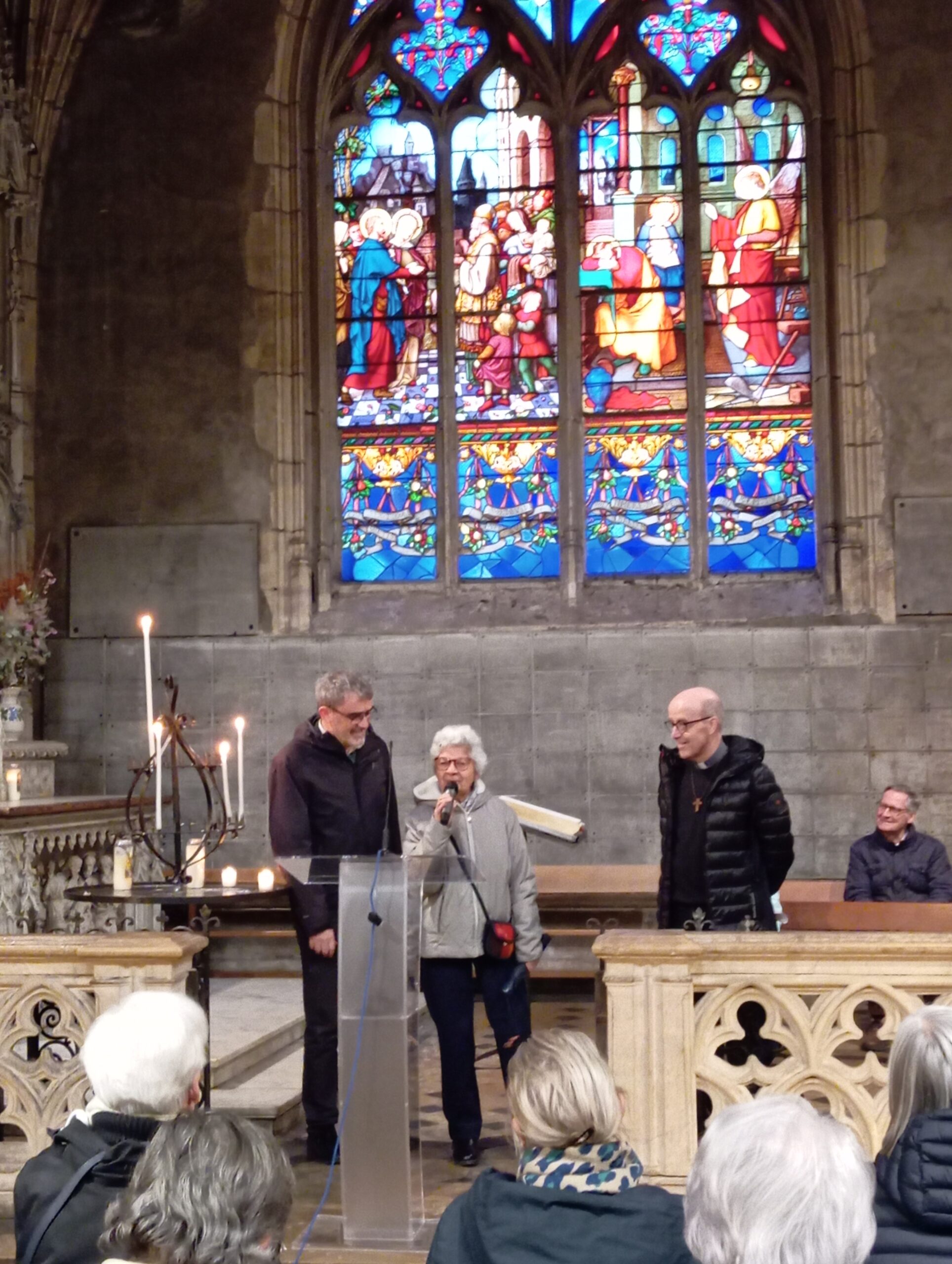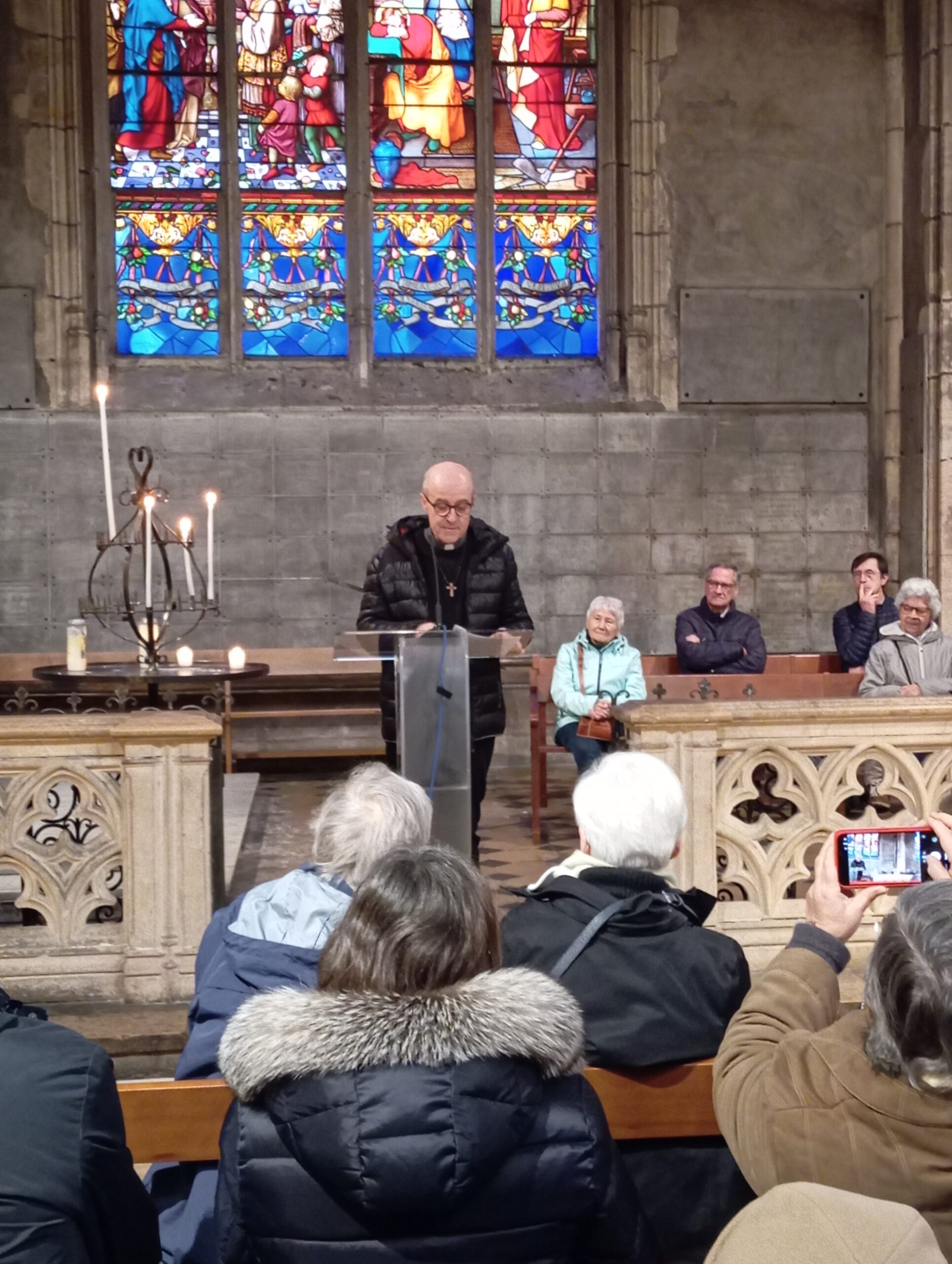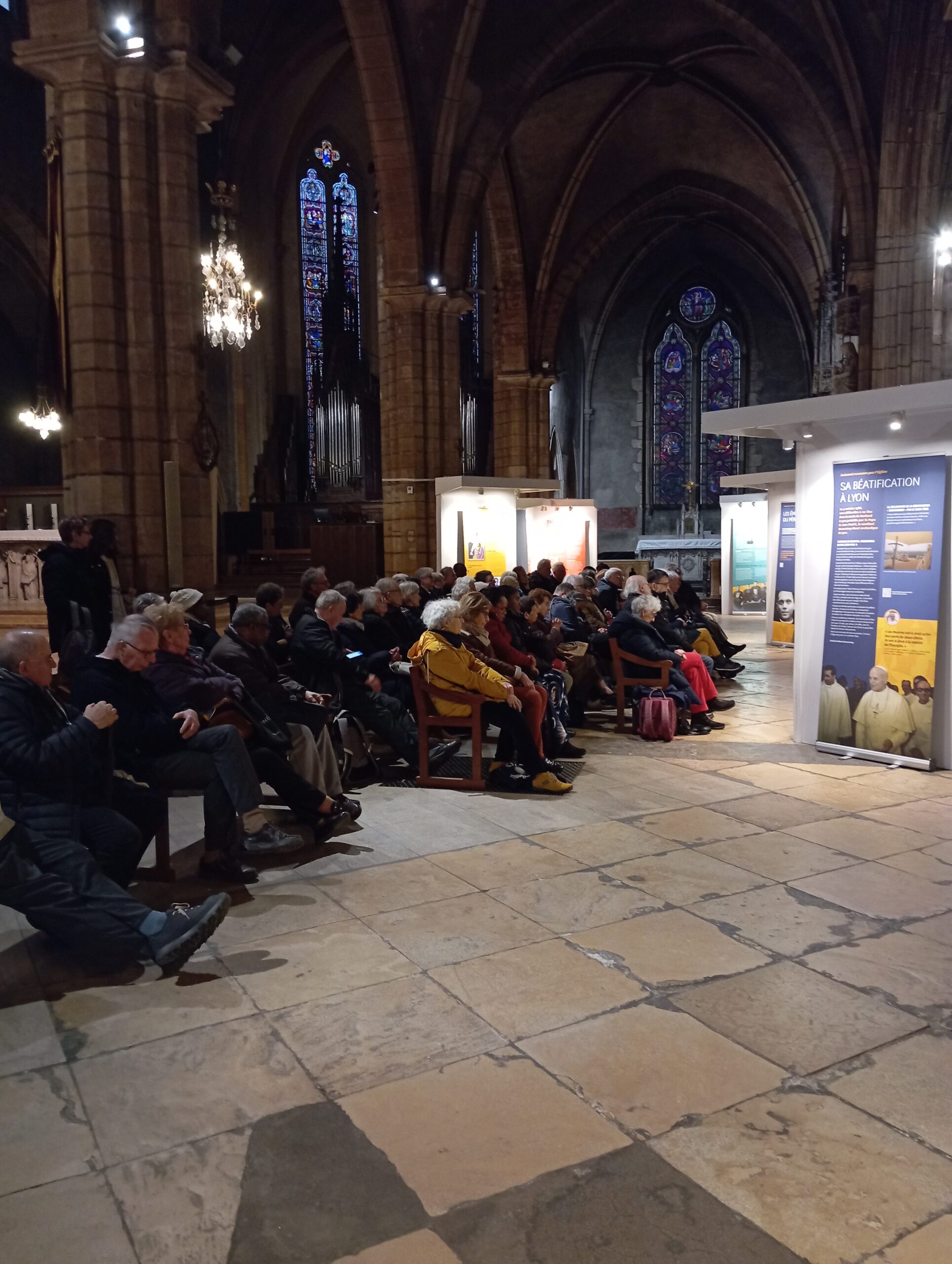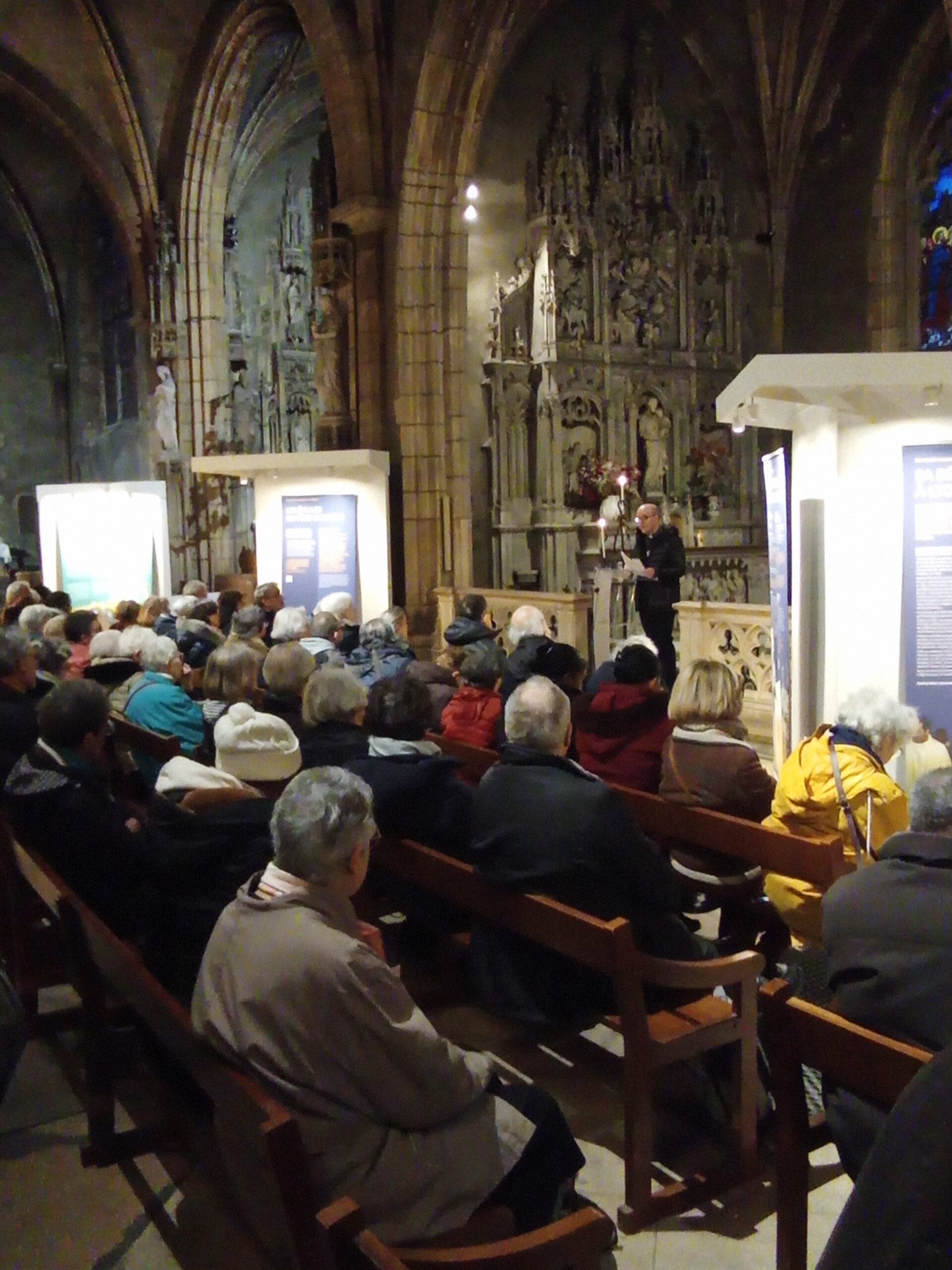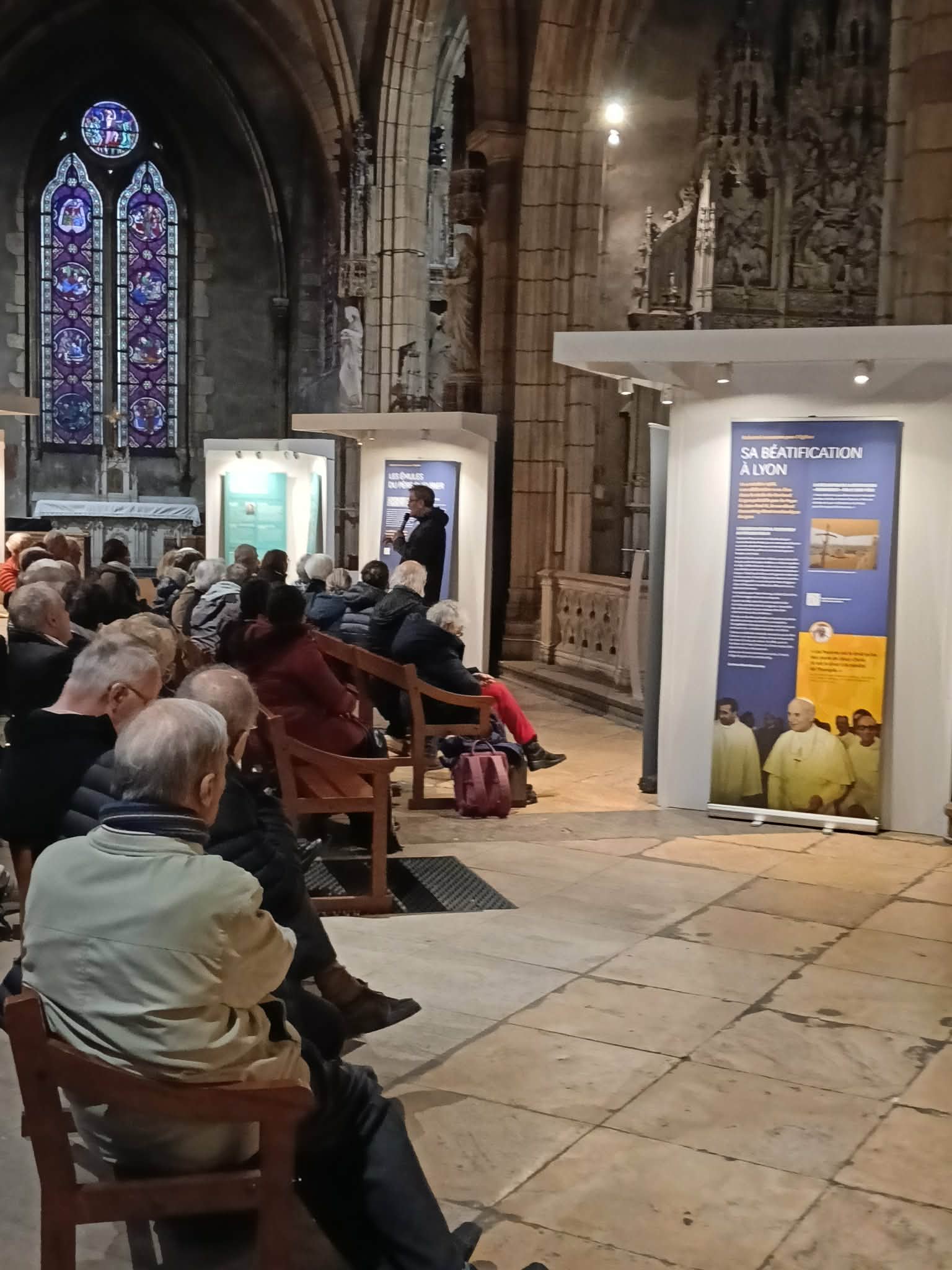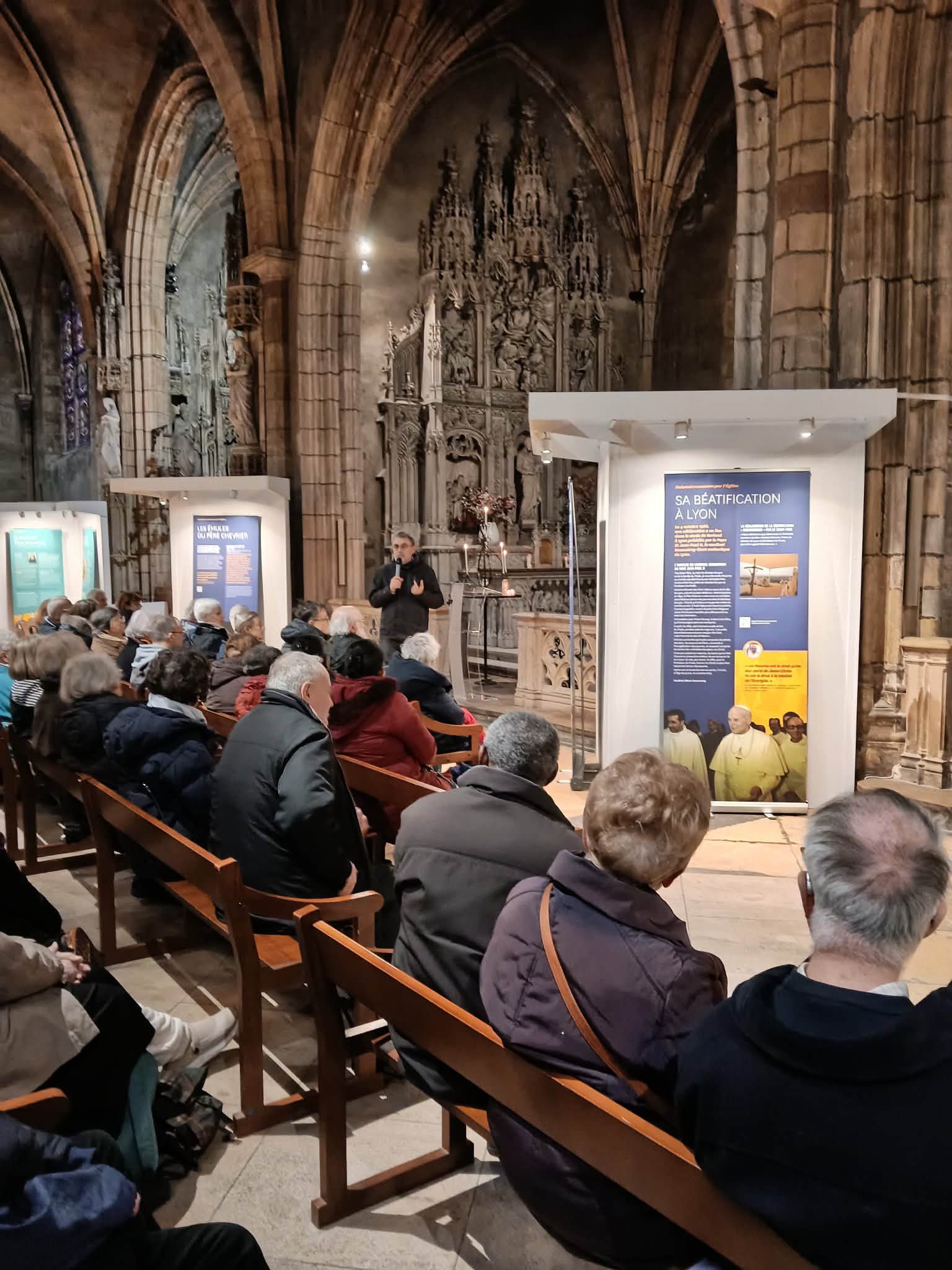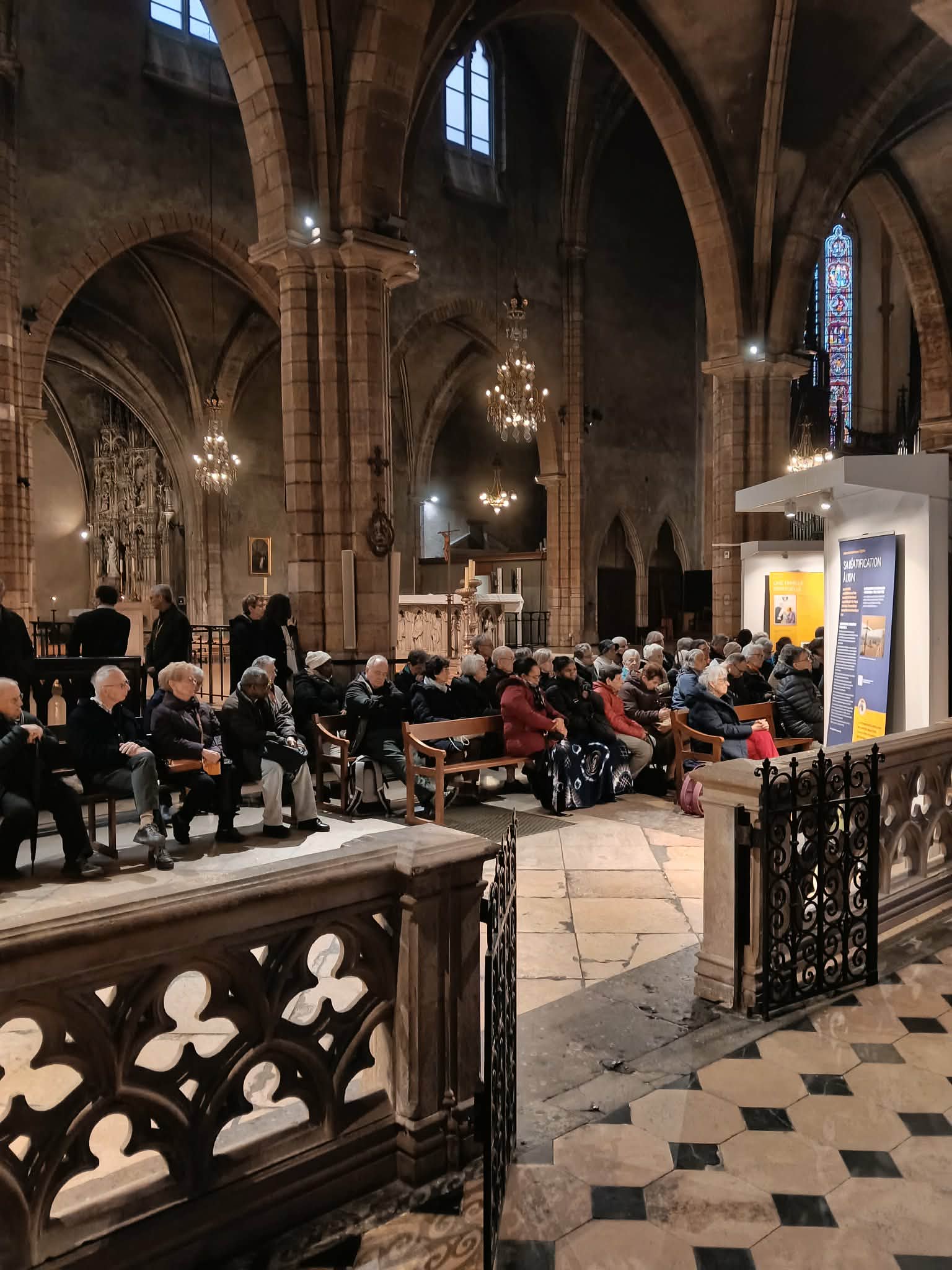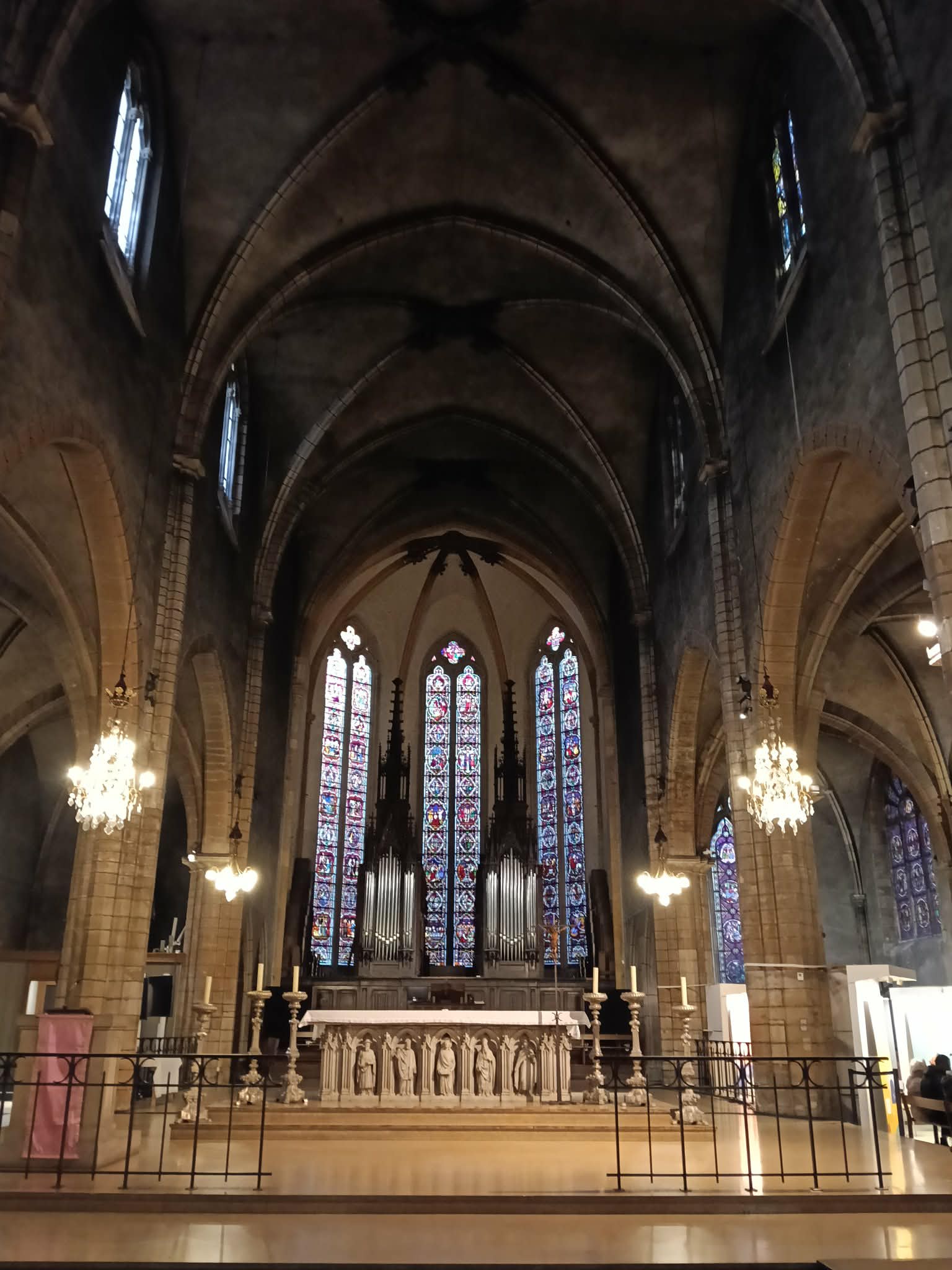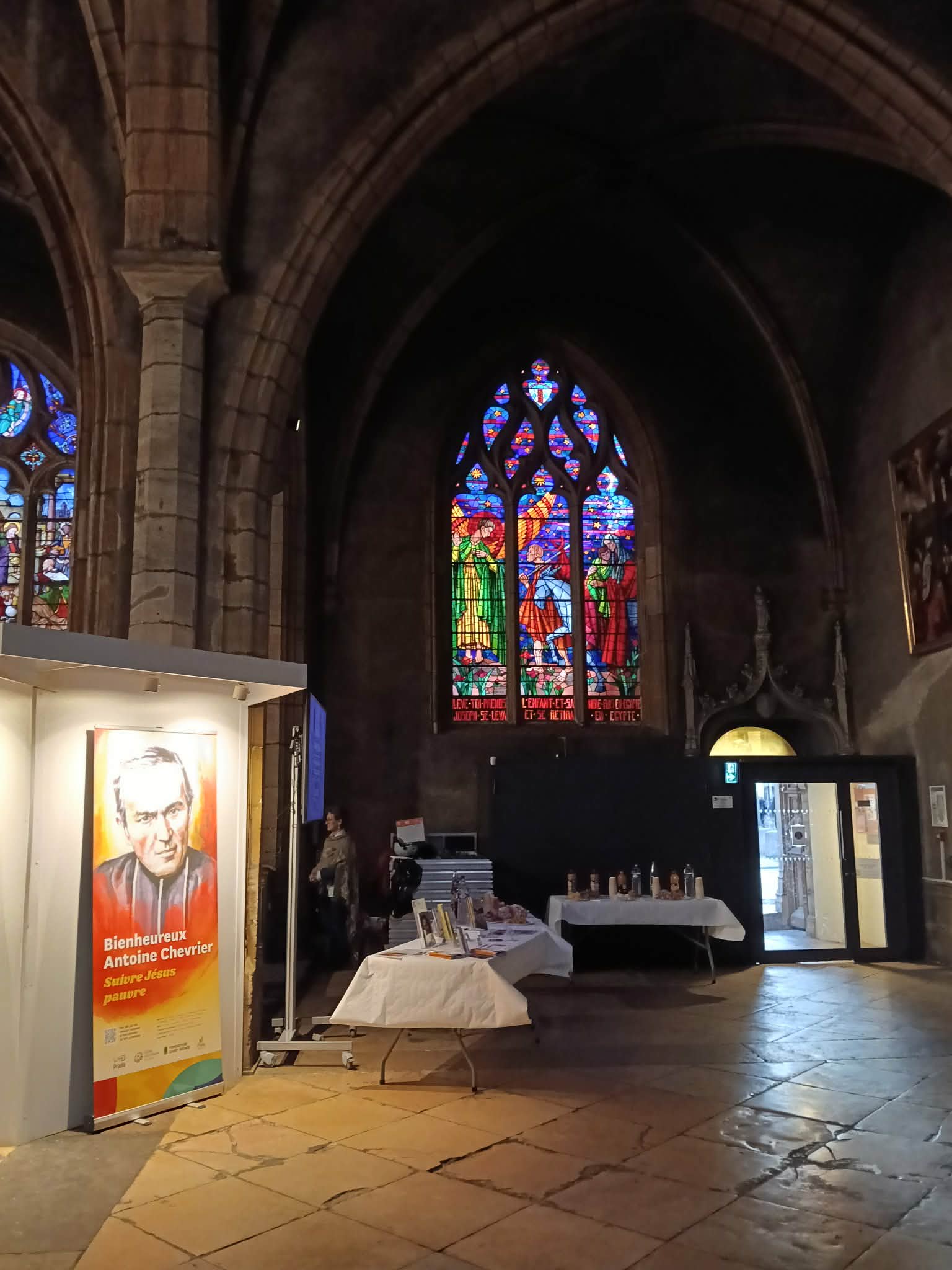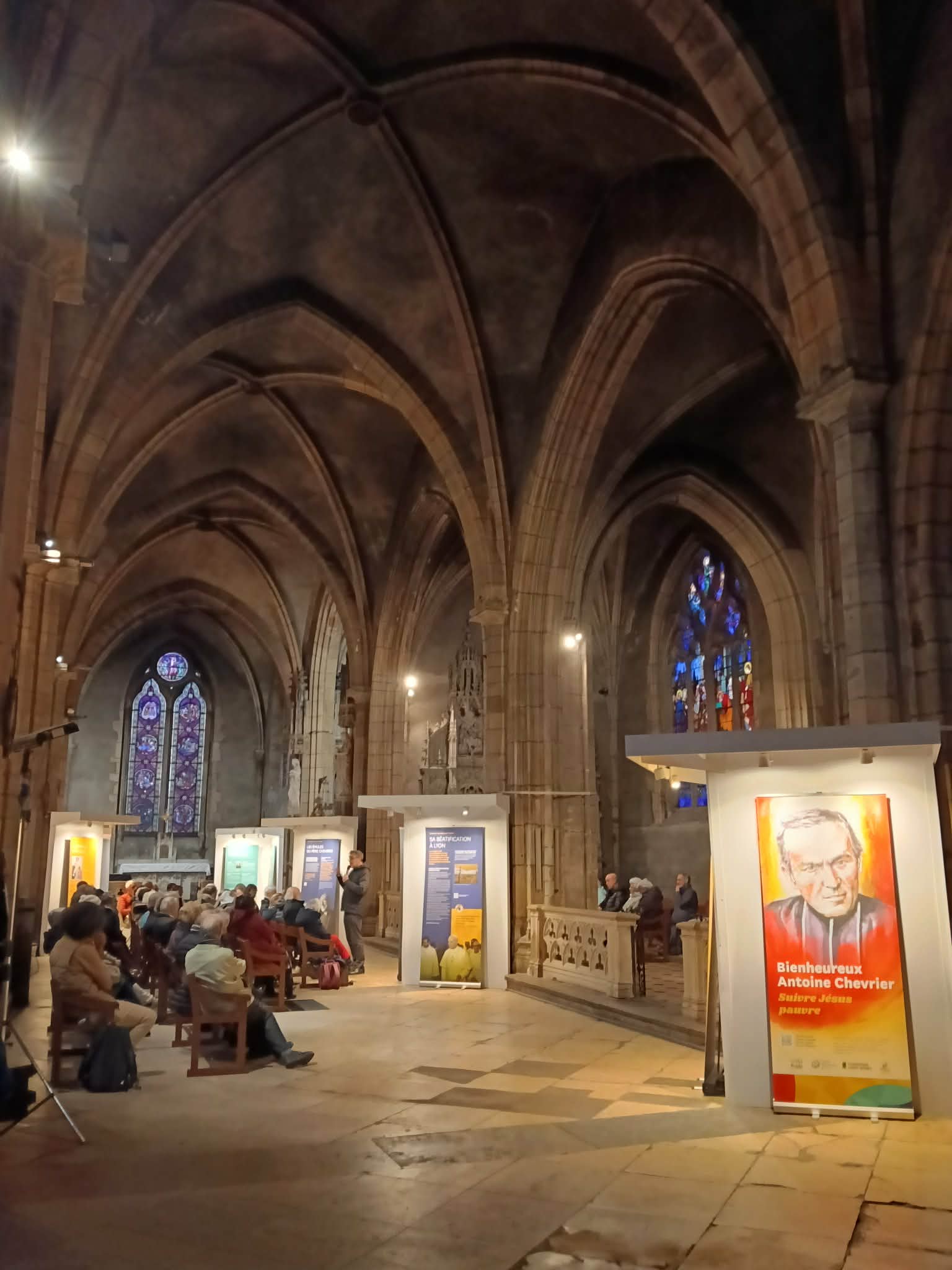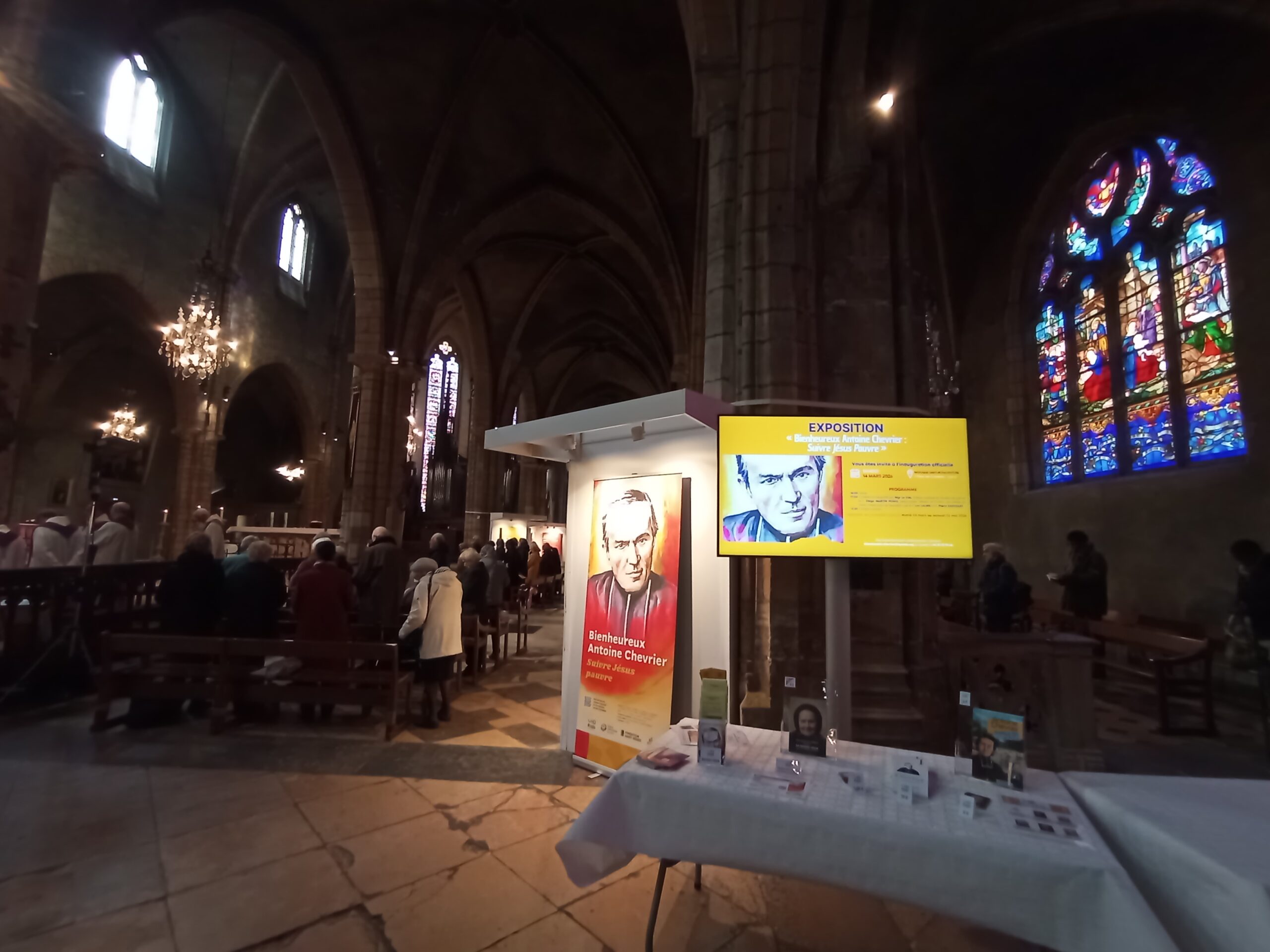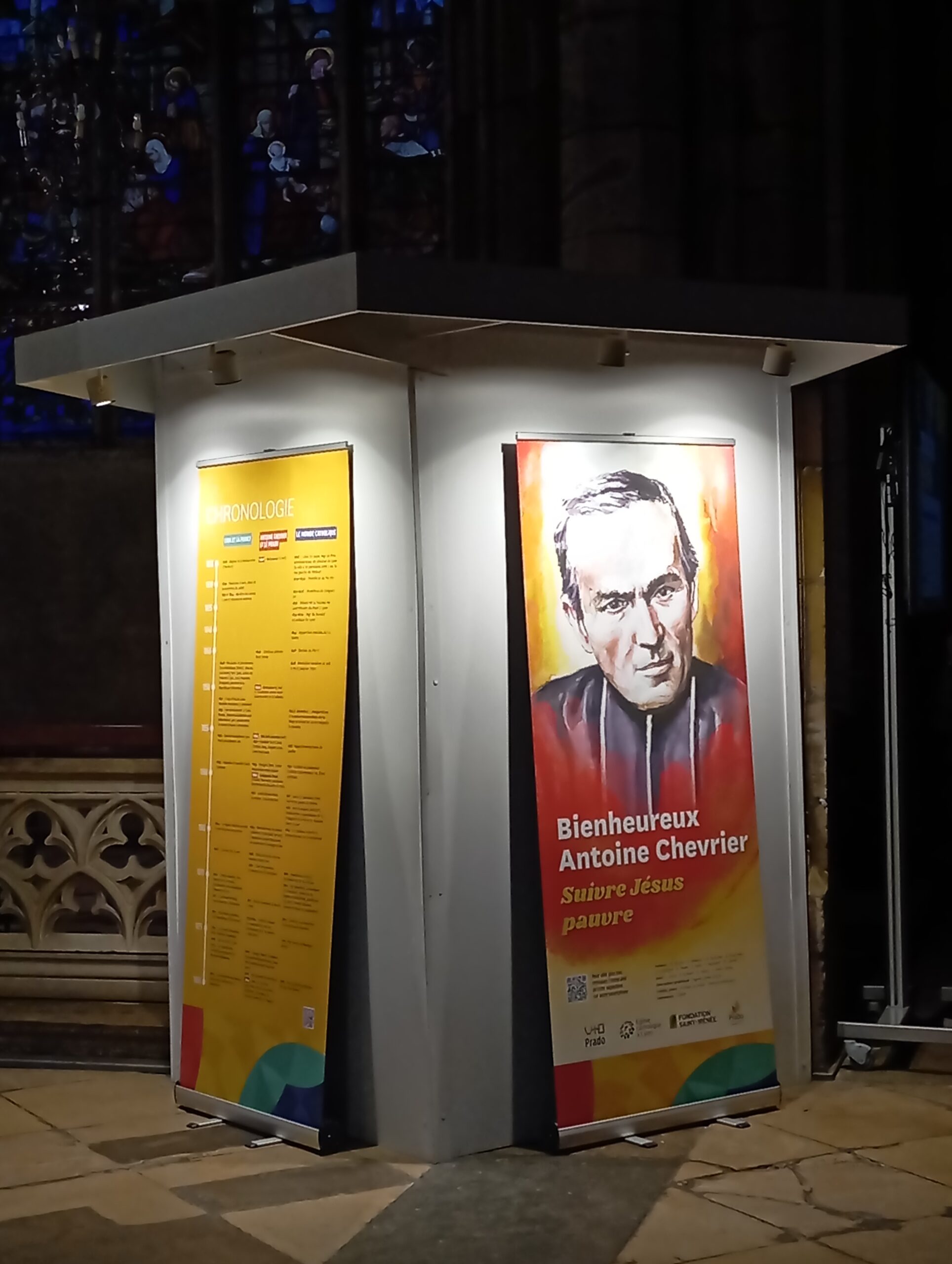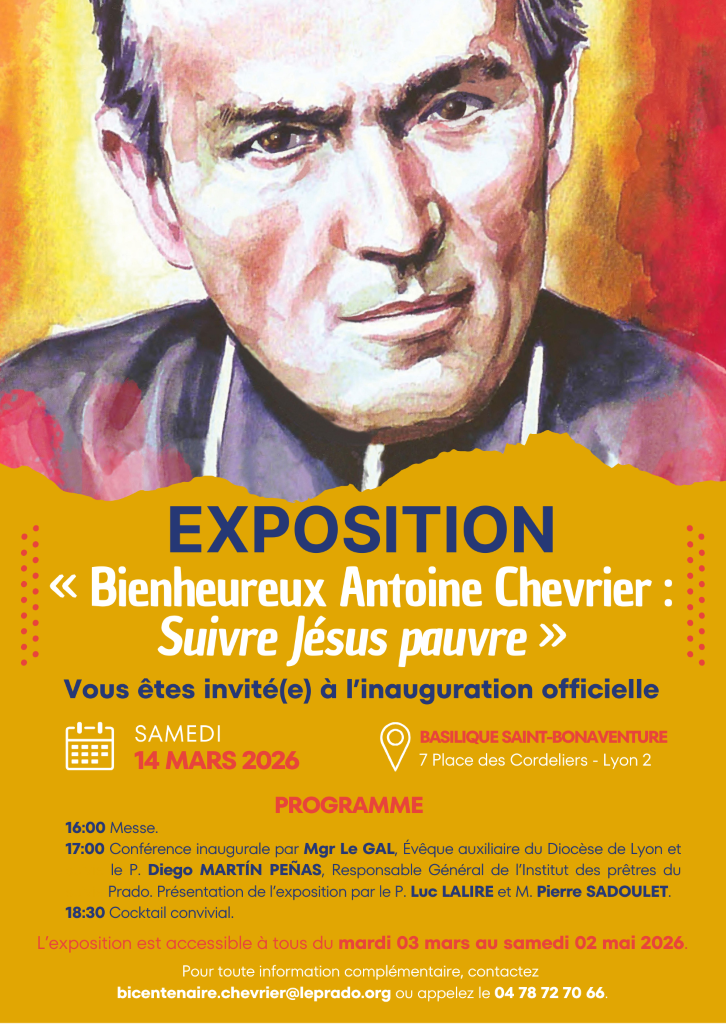
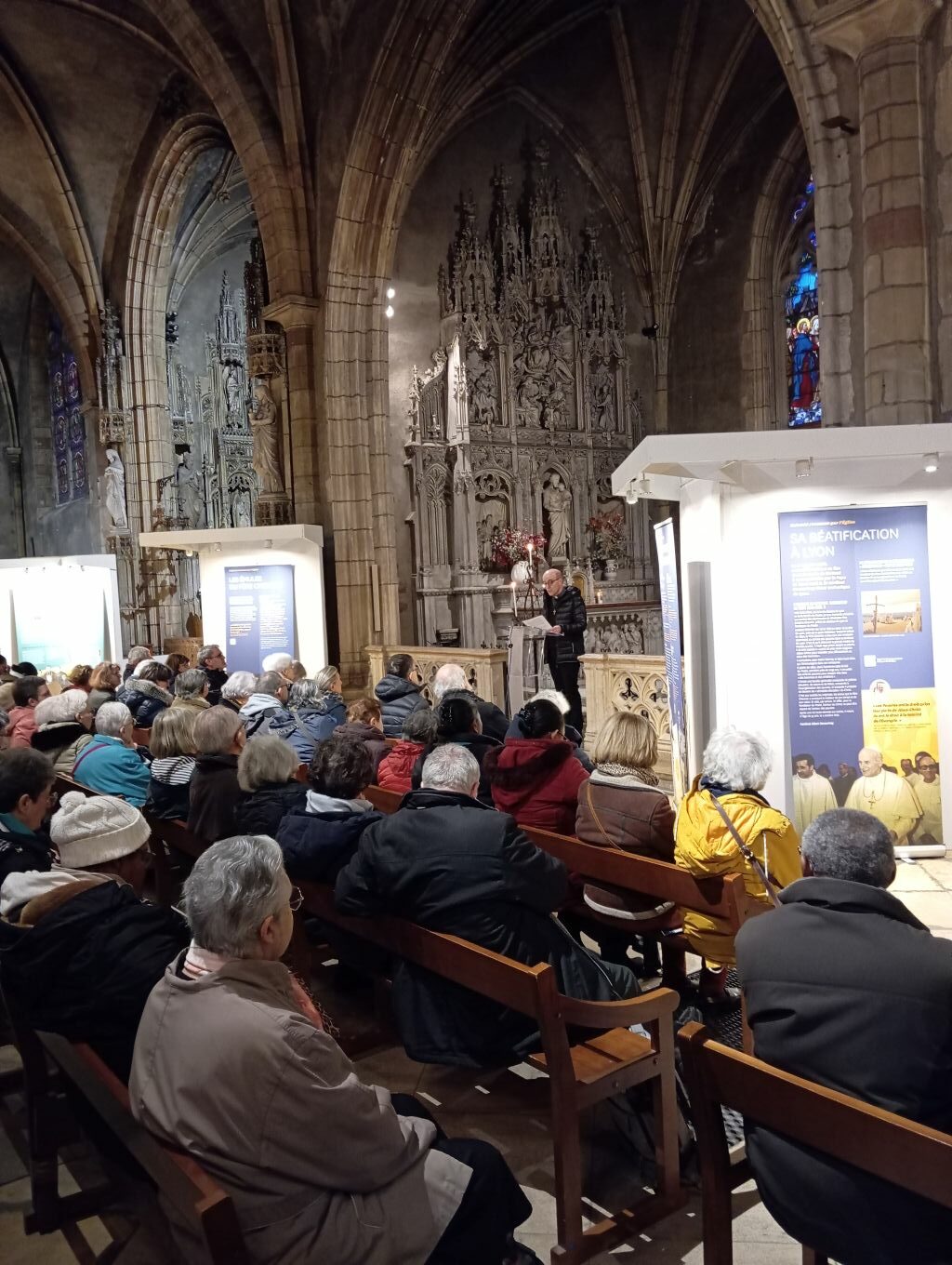
As part of the the bicentenary of the birth of Blessed Antoine Chevrier, the Prado family opened the exhibition « Blessed Antoine Chevrier: »Following Jesus in his poverty’, an initiative aimed at raising awareness of the life, spirituality and work of this priest from Lyon.
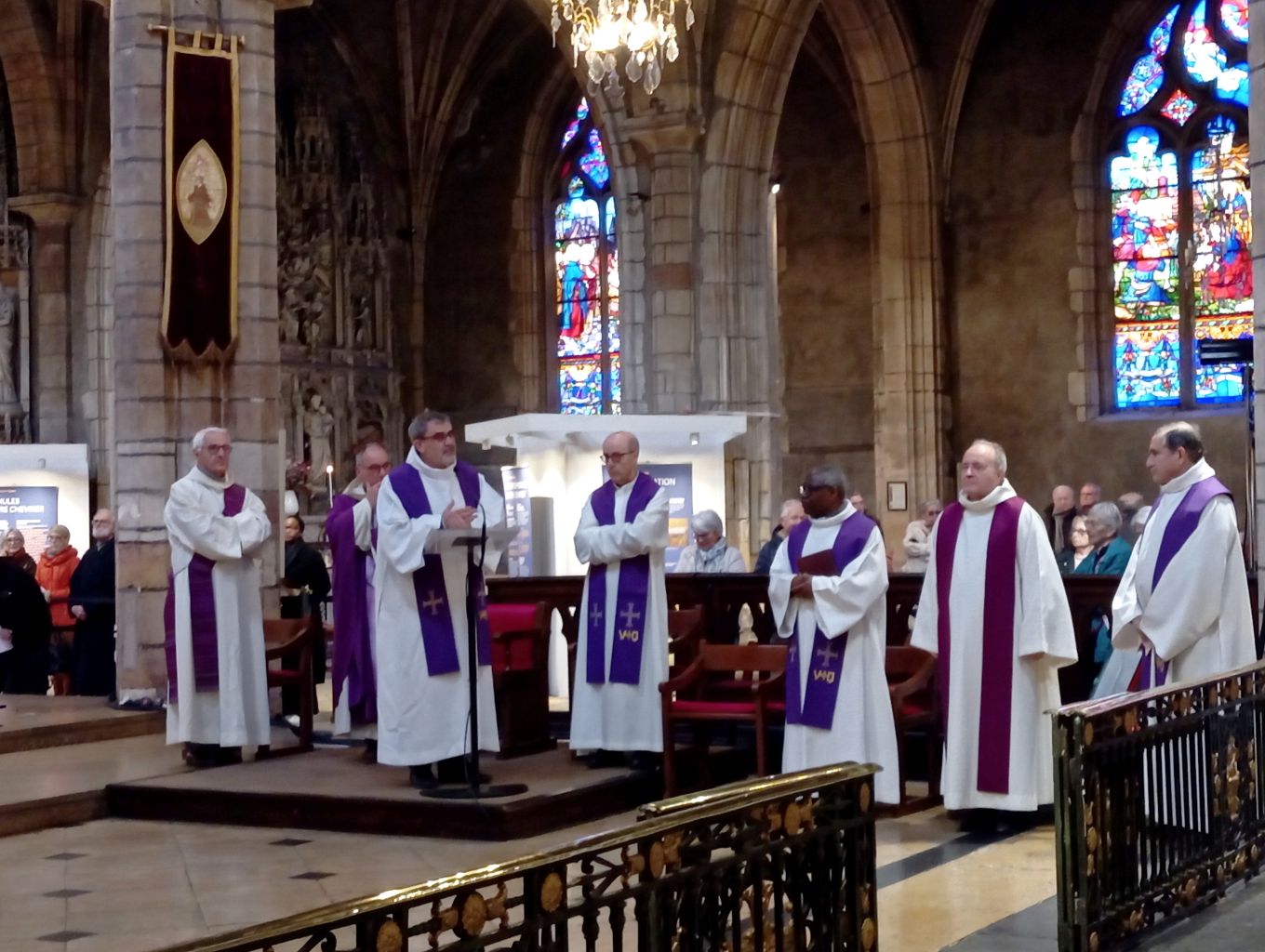
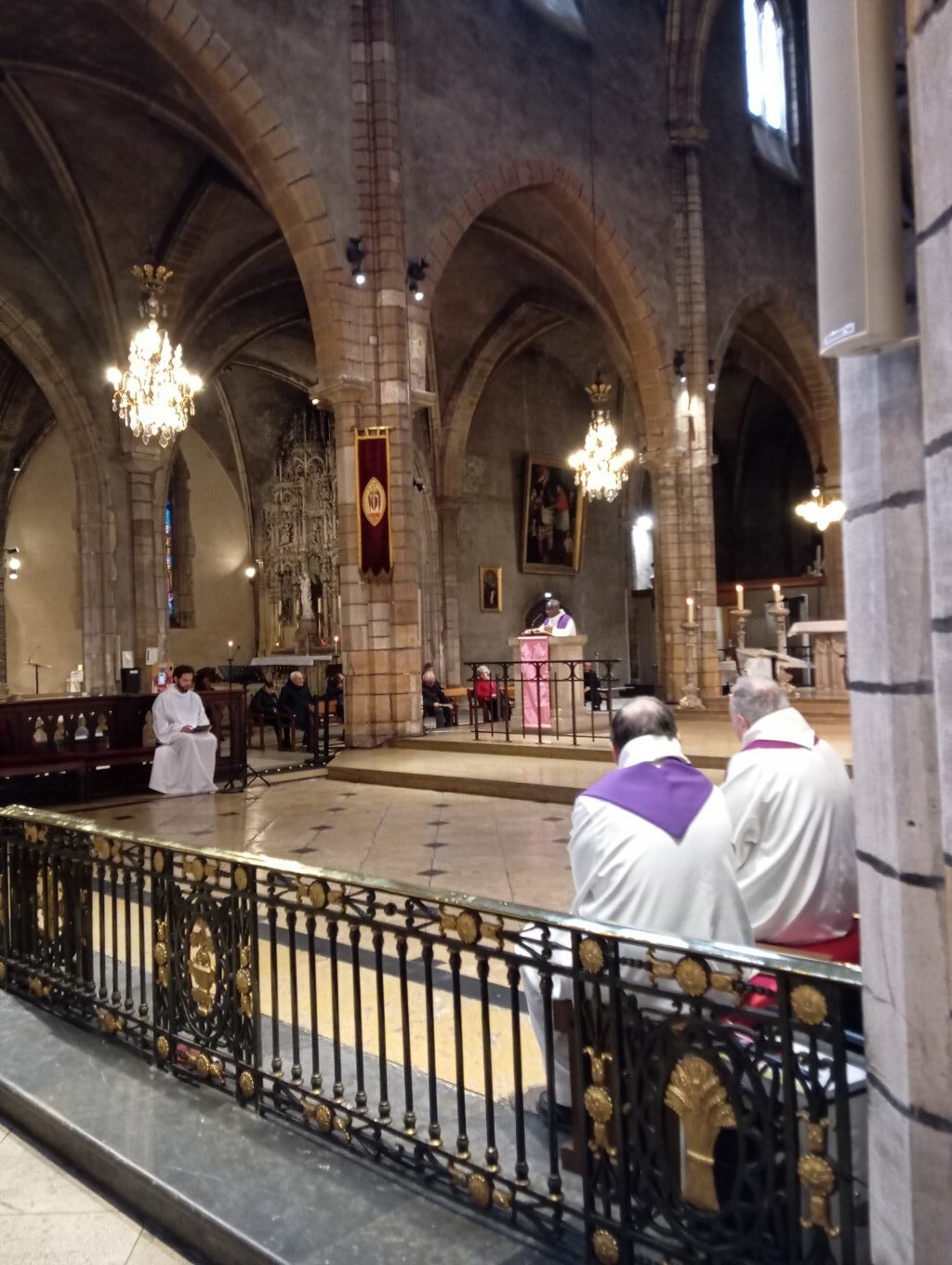
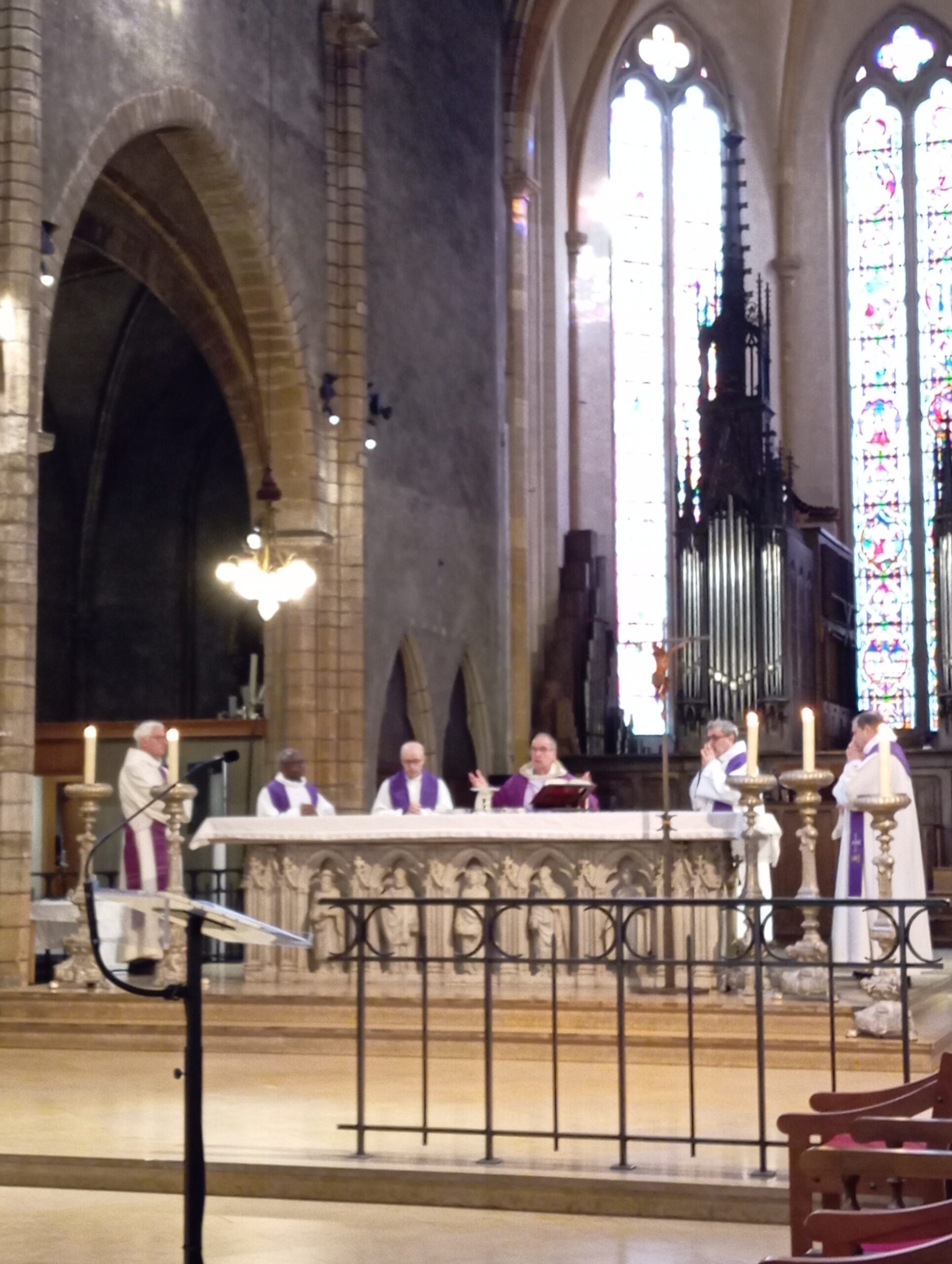
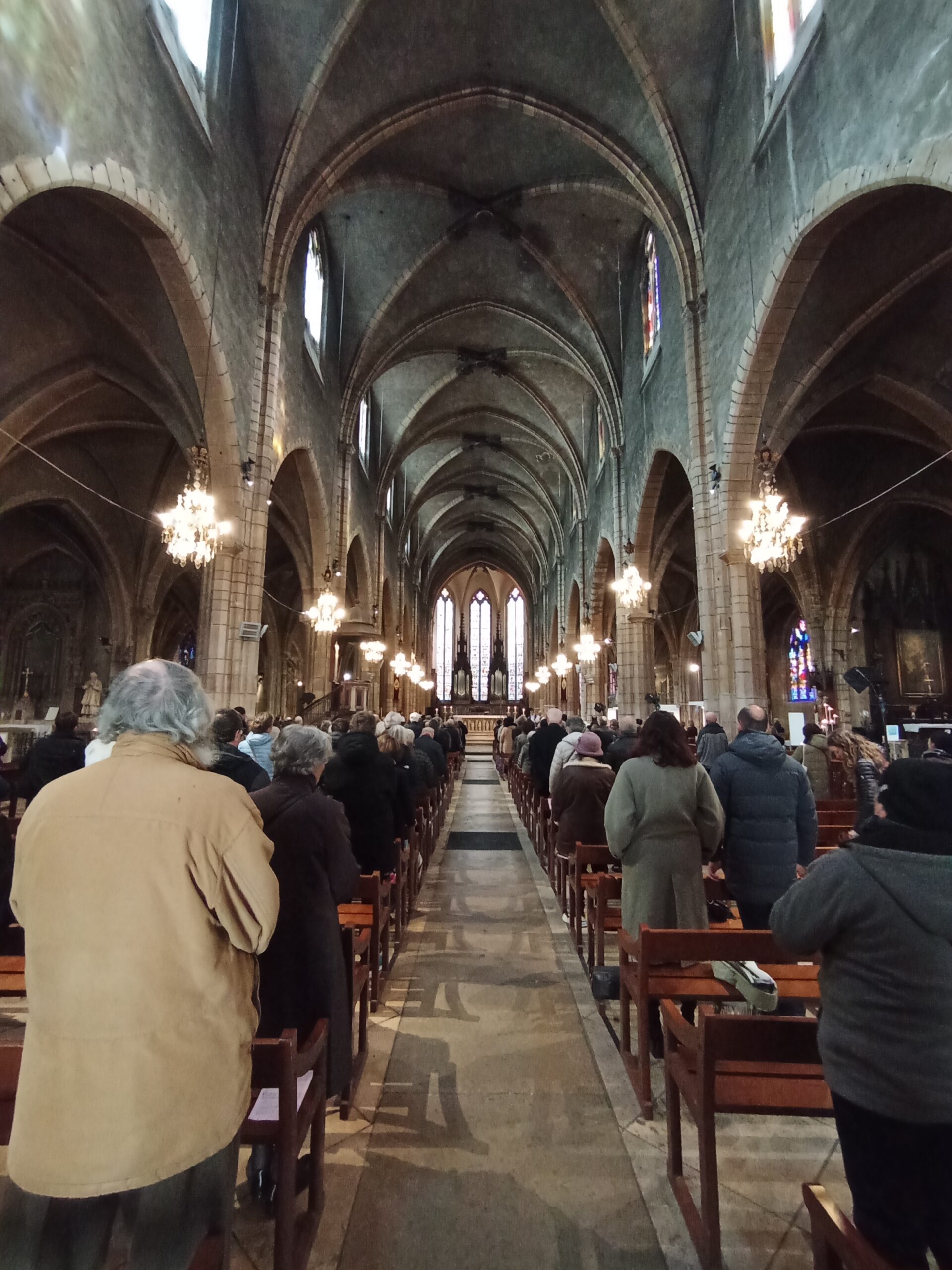
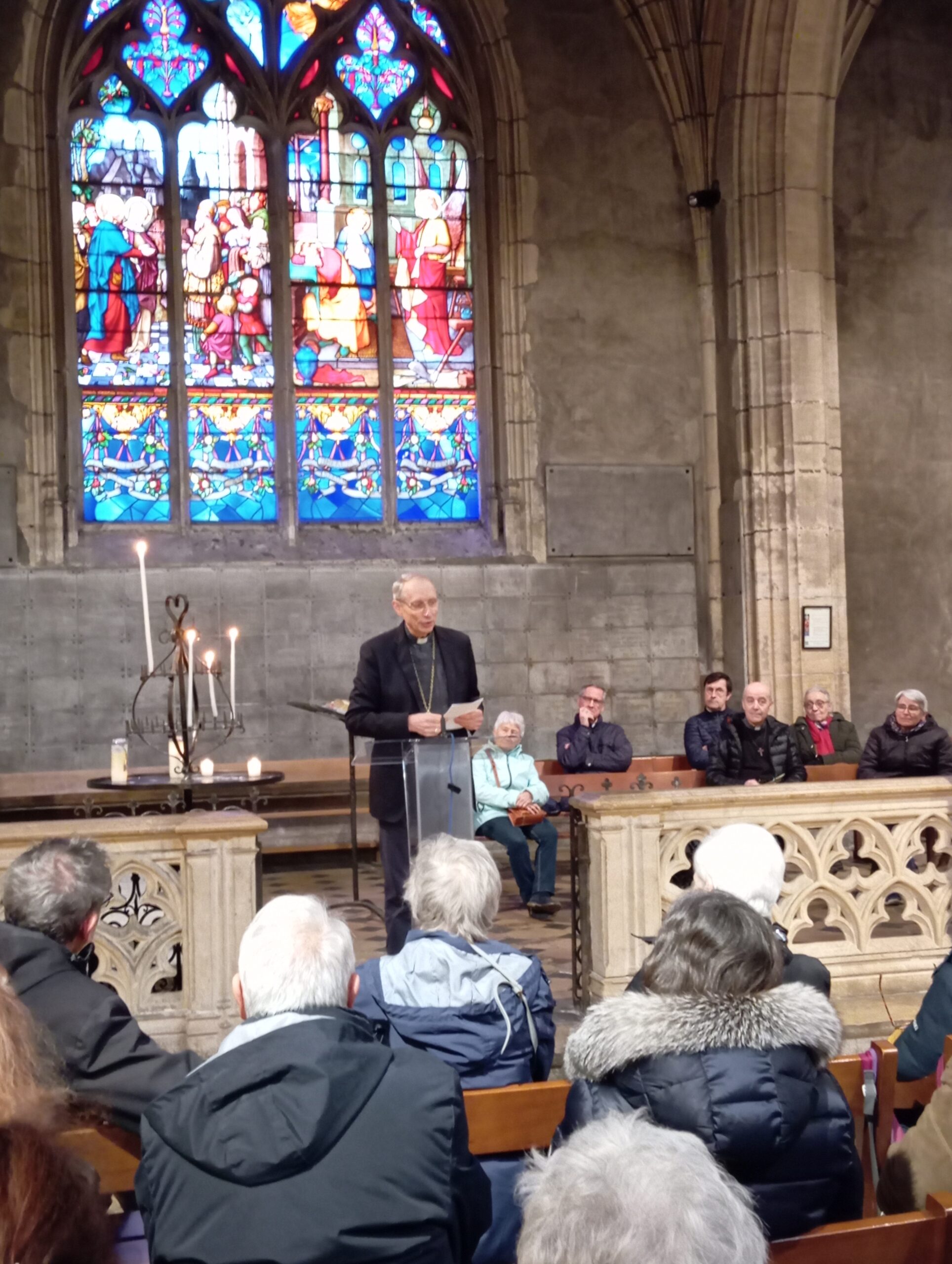
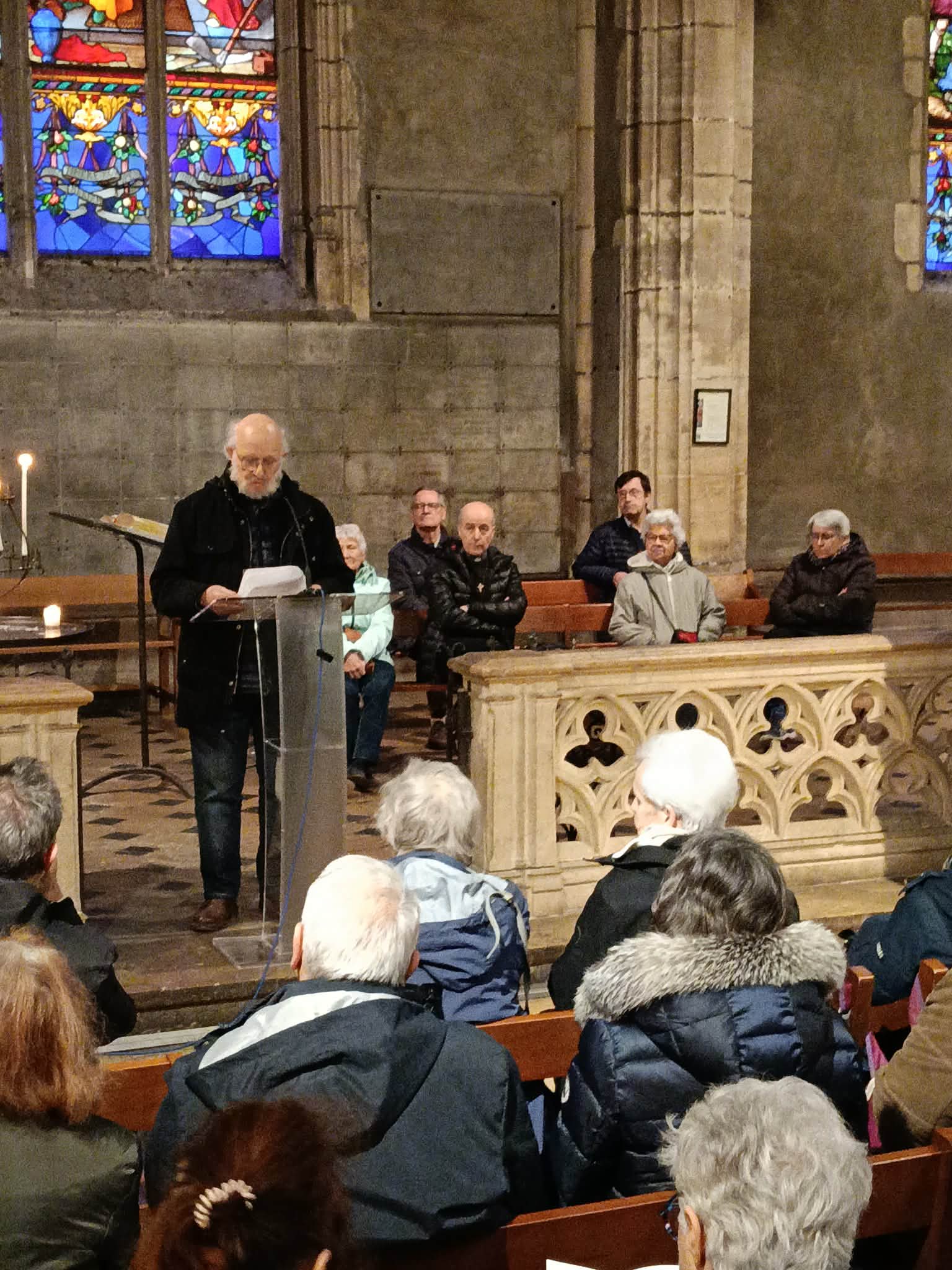
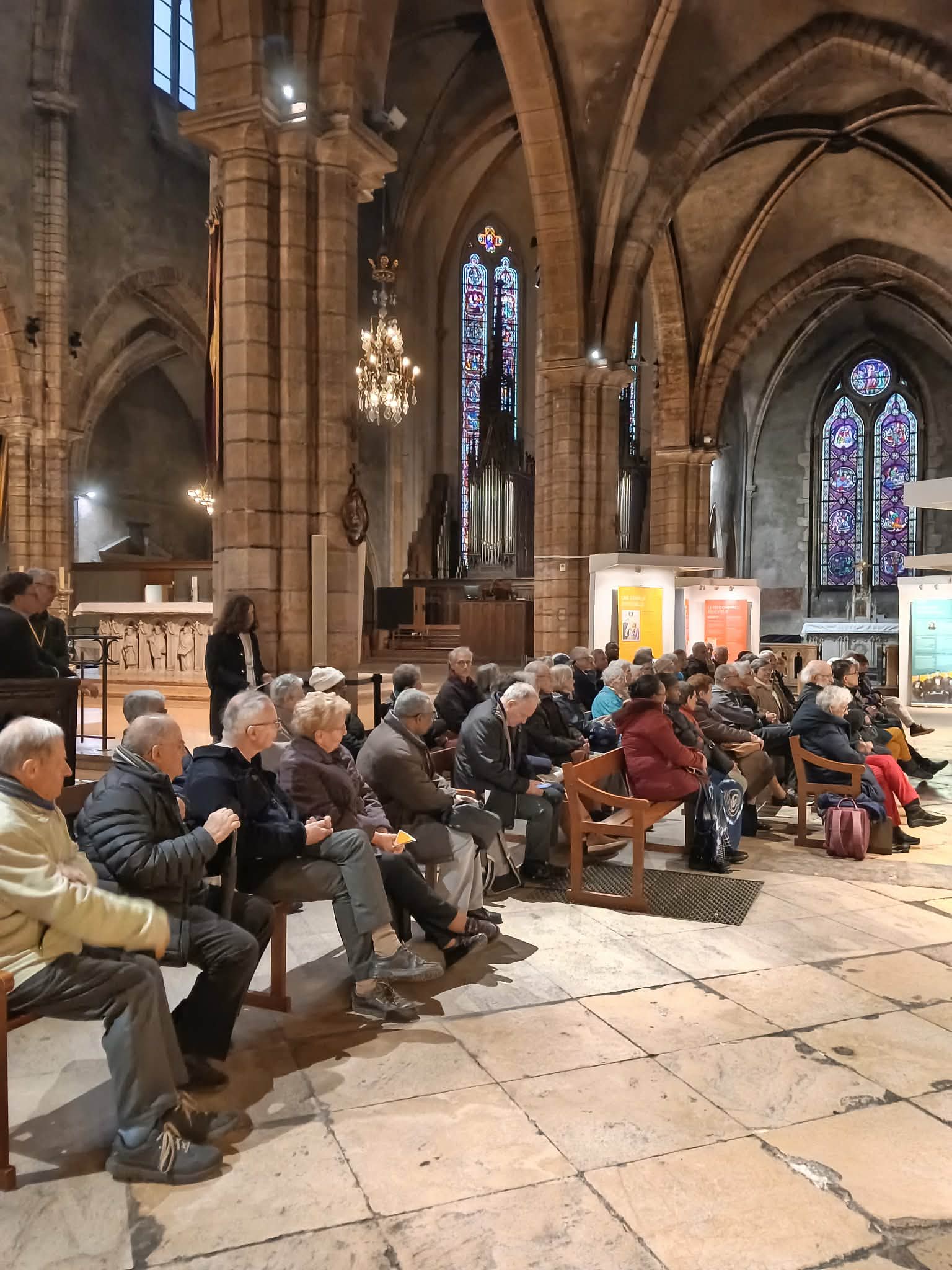
The opening ceremony took place Saturday 14 March 2026 in the presence of Bishop Patrick Le Gal, auxiliary bishop of the Diocese of Lyon, and Father Diego Martín Peñas, General Director of the Prado Priests’ Institute and Sister Nora Rocco Quintero, Superior General of the Sisters of the Prado. Many members of the Prado Family and friends were present, as well as parishioners who had stayed on after the 4.00 pm Mass presided over by Father Patrick Rollin, canon of the Primatial Cathedral, rector of the Basilica of Saint Bonaventure and of the Chapel of the Hôtel-Dieu.
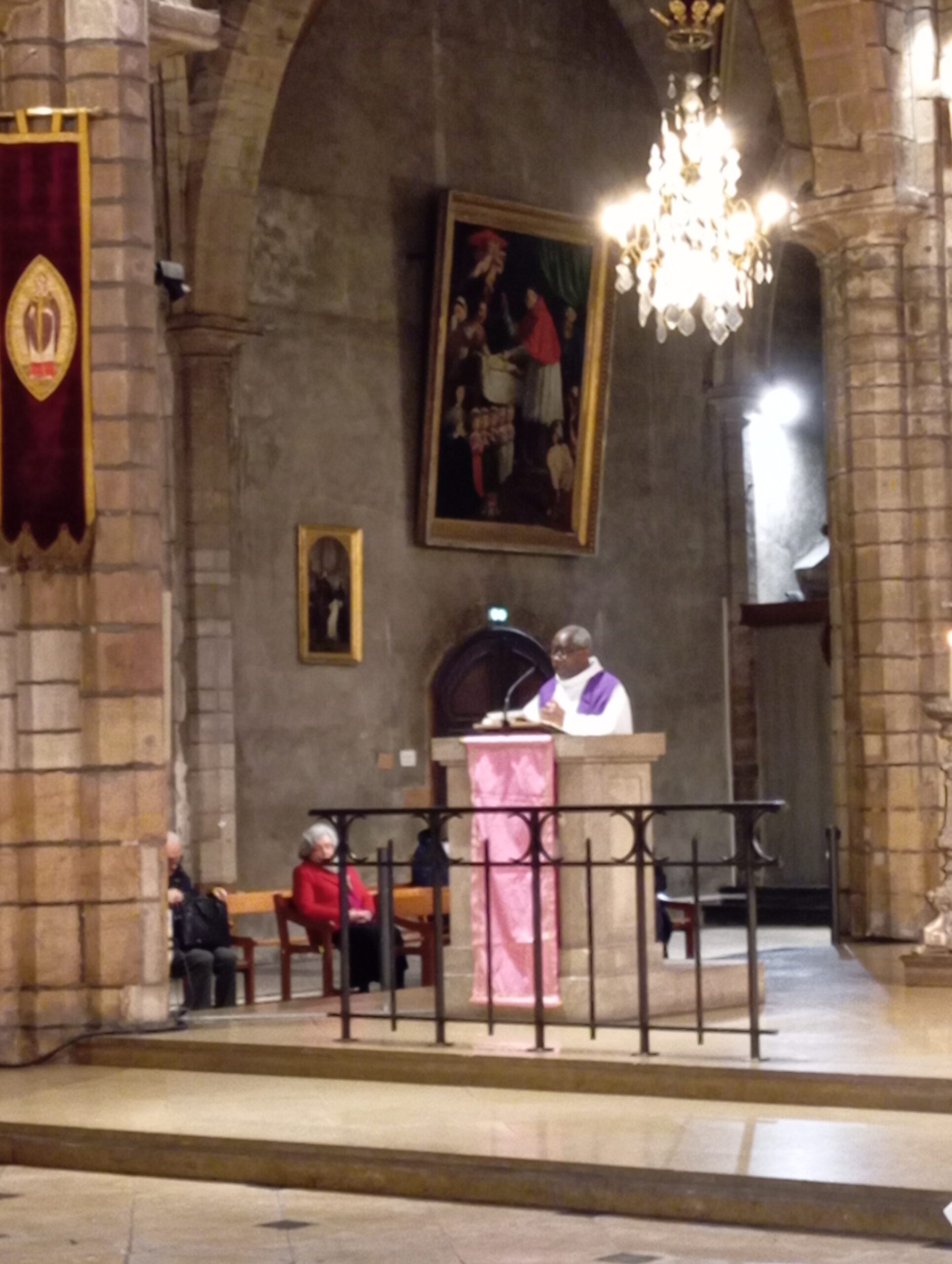
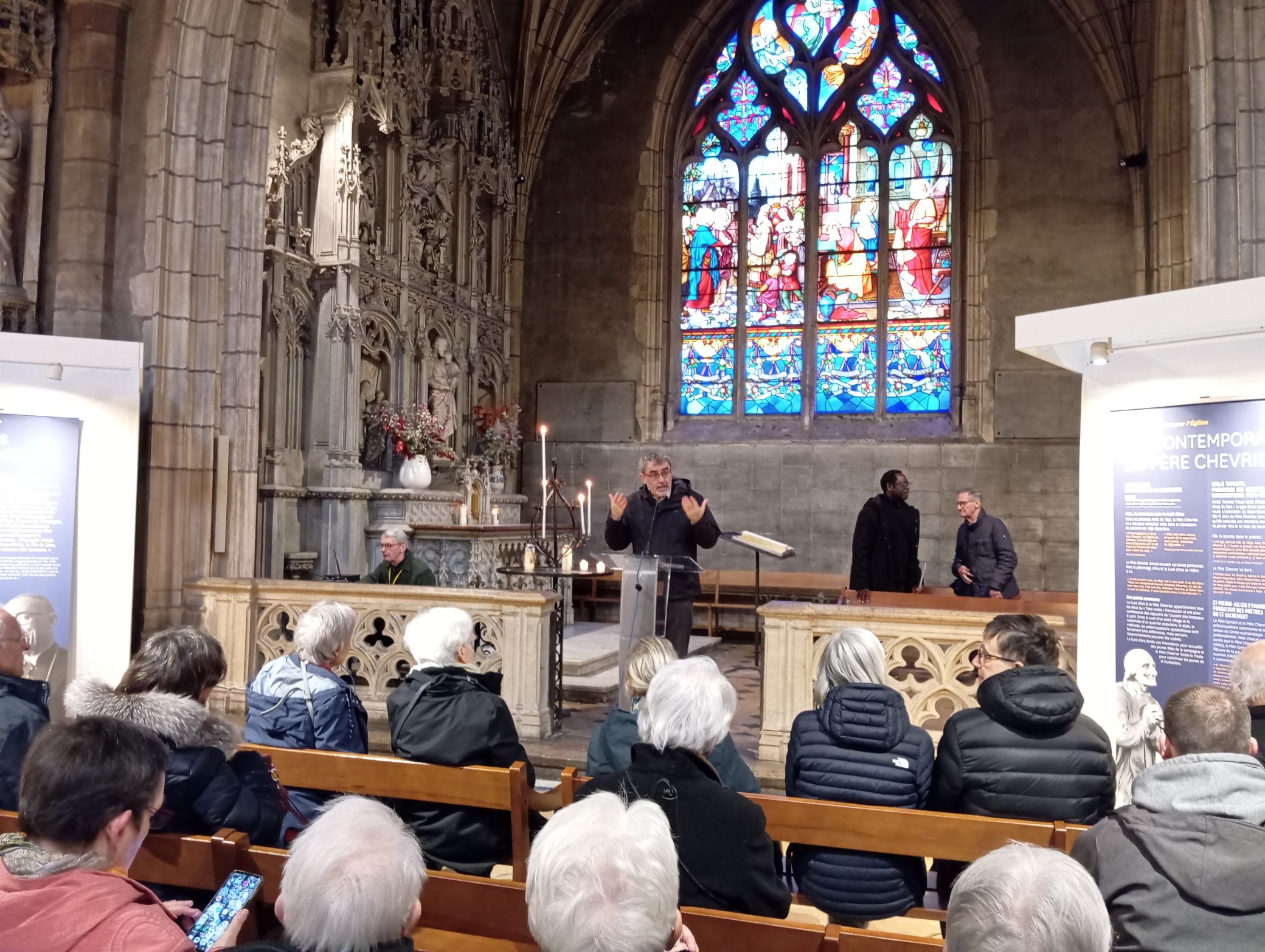
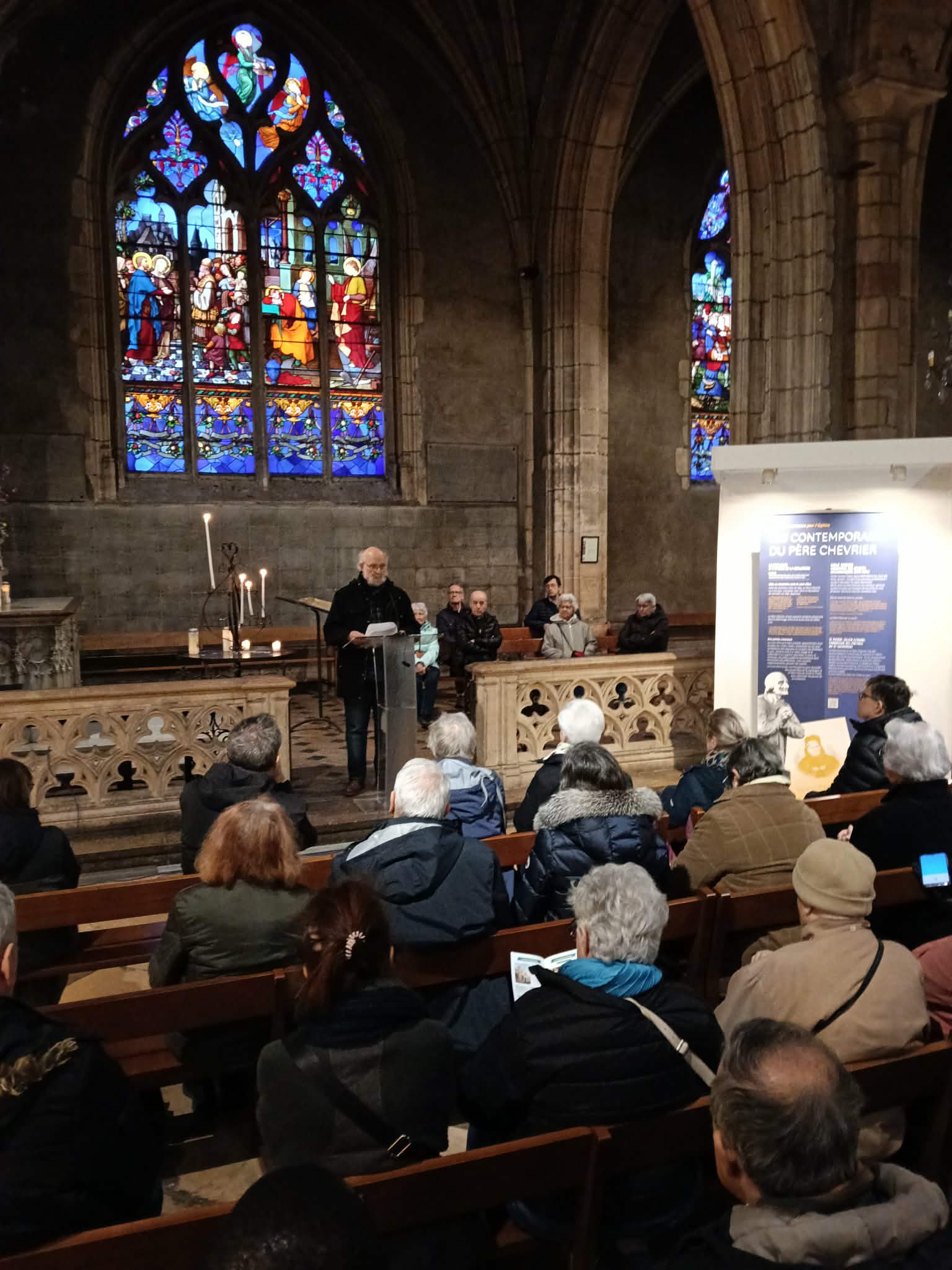
Several speakers took the floor, including Bishop Le Gal, the fathers Diego Martín Peñas and Luc Lalire (1er (Assistant to the General Manager) as well as Pierre Sadoulet who worked on the first-hand accounts from the beatification trial of Father Chevrier. Each of them shed light on the figure of Blessed Antoine Chevrier and on the significance of this exhibition.
The talks by Father Diego Martín Peñas and Pierre Sadoulet are available to download at the bottom of the article.
Designed as a means of exploring the life of a saint, the exhibition aims to appeal to a wide audience: residents of Lyon, but also people from all over the world, Christian communities and anyone keen to discover the life and spirituality of the man often referred to as The Apostle of La Guillotière.
It is worth noting that the exhibition is already being translated into several languages (Spanish, Italian, Portuguese, Korean, Vietnamese and Malagasy) and is eagerly awaited by many members of the Prado family around the world.
Raising awareness of a major spiritual figure
In his address (the full text of which can be downloaded at the end of the article), Fr Diego Martín Peñas, Director General of the Prado Priests« Institute, highlighted the profound significance of this initiative. An exhibition, he explained, involves »bringing to the fore’ what had sometimes remained hidden, so that everyone might discover it.
Even today, whilst the significance of his legacy is undeniable, it is regrettable that’Antoine Chevrier remains little known to many. Yet his life and his message have borne fruit throughout the Church: the Prado family is now present in more than forty-six countries.
To make Father Chevrier known is, therefore, to share a spiritual treasure that can illuminate the path for many men and women today.
A figure of great relevance today
The speakers all emphasised just how relevant the figure of Father Chevrier remains today. His example as a poor priest, close to the least among us and wholly devoted to the Gospel, still stands today as a prophetic sign.
In a world often driven by the pursuit of money and power, his life serves as a reminder of the power of Gospel values: simplicity, trust in God, charity and service.
His teaching also echoes the Church’s current calls: to reach out to the poor, to share in their lives, and to proclaim the Gospel with simplicity and brotherhood.
An exhibition that leads to Christ
Whilst the various panels trace the life of the Prado’s founder – his story, his relationships and the richness of his work – the real focus lies elsewhere.
As Fr Diego pointed out: Father Chevrier speaks, above all, of Jesus Christ. His whole life was devoted to this desire: that Jesus might be known, loved and followed.
Father Chevrier wanted to remain in the background so as to give Christ centre stage. His life can be summed up by these words of Saint John the Baptist: «He must grow, and I must shrink.»
Discovering the holiness of Father Chevrier
The exhibition also offers visitors the chance to discover Antoine Chevrier through the holiness that characterised his entire life.
- His holiness recognised by the Church by the bishops of Lyon, by Saint John Paul II at the time of her beatification, and by Pope Francis. His encounters with several spiritual figures of his time, such as the Curé d’Ars, St Jean-Marie Vianney, Mademoiselle Émilie Tamisier and St Pierre-Julien Eymard. The legacy he inspired in his disciples and those who carried on his work, such as Blessed Édouard Poppe and Alfred Ancel.
- Holiness in action as evidenced by a number of testimonies recorded in the four volumes of the canonisation proceedings (those of Sister Véronique Lheraud, Fathers Nicolas Delorme and François Duret, and Bishop Paul Pellet).
- His holiness as taught by him through catechesis. This involves « »Father Chevrier’s educational approach’ and « »Evangelical radicalism' , which features the Gospel Study and the Painting of St Fons. In his teachings, he urged Christ’s disciples to strive for holiness by following Jesus – who was poor, humble and close to the lowly.
For him, holiness is not an ideal reserved for a select few: it is an appeal to everyone, a path of grace and faithfulness to the Gospel.
An invitation to meet up
As they explore the display panels and personal accounts, visitors are invited to listen to the words of Father Chevrier and to rediscover the beauty of a life dedicated to the Gospel and to the poor.
It is an invitation to meet someone whose life still resonates today.
What I learnt about Father Chevrier whilst reading the trial records…
In his speech, Pierre Sadoulet*, shares what he discovered whilst re-reading the beatification proceedings of Father Antoine Chevrier, as part of a major digitisation project. This prolonged immersion enabled him to undergo a genuine spiritual experience, marked by an encounter with a figure of exceptional holiness.
It highlights several key aspects of Father Chevrier’s life: a constant pursuit of poverty and simplicity, a life deeply shaped by prayer and the Gospel, and a total commitment to serving the poorest of the poor. Driven by a desire to «do good», he gave selflessly, going so far as to forget himself.
Pierre Sadoulet also emphasises the demanding nature of this spirituality, which is founded on a radical commitment to the Gospel lived out in humility. Father Chevrier thus emerges as a witness to an ideal that is both absolute and profoundly human: following Christ in simplicity, whilst acknowledging one’s own limitations.
Ultimately, this talk invites everyone to rediscover the essence of Prado’s message: «Following Jesus Christ is all that matters», caught in a fruitful tension between the aspiration to holiness and an awareness of one’s own poverty.
And to quote the conclusion of his speech, « To live with this radical aspiration to become saints in the footsteps of Christ, whilst recognising that we are indeed poor and limited… This is one of the cornerstones of Prado’s radicalism: never to believe that we have already achieved it…
Luke 17:14: ‘Everyone who exalts himself will be humbled, but he who humbles himself will be exalted.’.
»I tell you this: … anyone who exalts himself will be humbled, but whoever humbles himself will be exalted.’
* Retired senior lecturer at Jean Monnet University (Saint-Étienne), a specialist in Ancient Greek (up to 1453) and Latin.
Authorised to supervise research in Linguistics and Semiotics.