

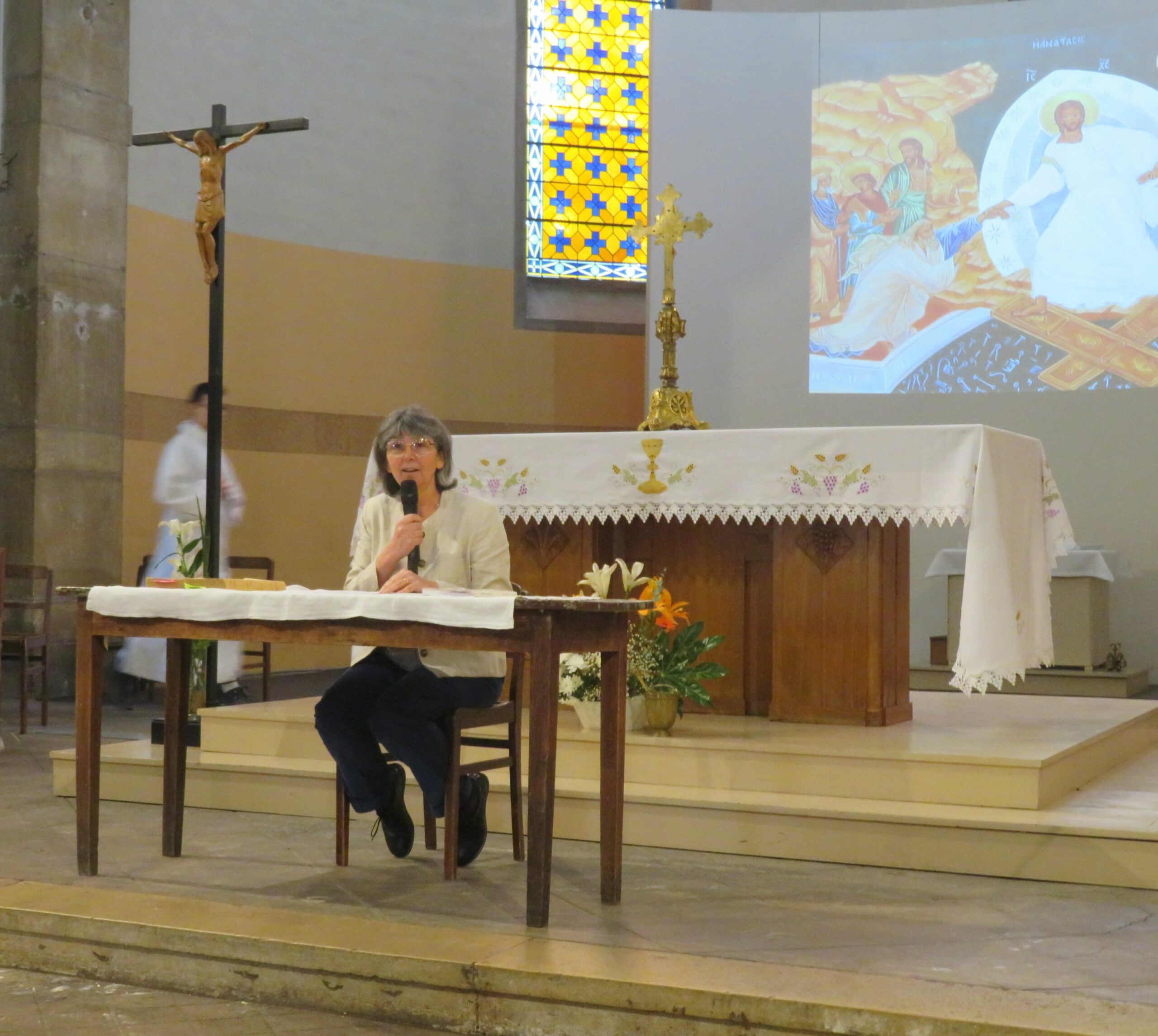
It is amidst the joy of the jubilee year, marked by the 200th anniversary of the birth of Blessed Antoine Chevrier and the 150 years of UCLy, that Marie-Hélène Robert, a nun of the Congregation of Our Lady of the Apostles (NDA) and lecturer in theology at the Faculty of Theology of the Catholic University of Lyon, gave a talk entitled: « Father Antoine Chevrier’s mission: “To make Jesus Christ known and loved” ».
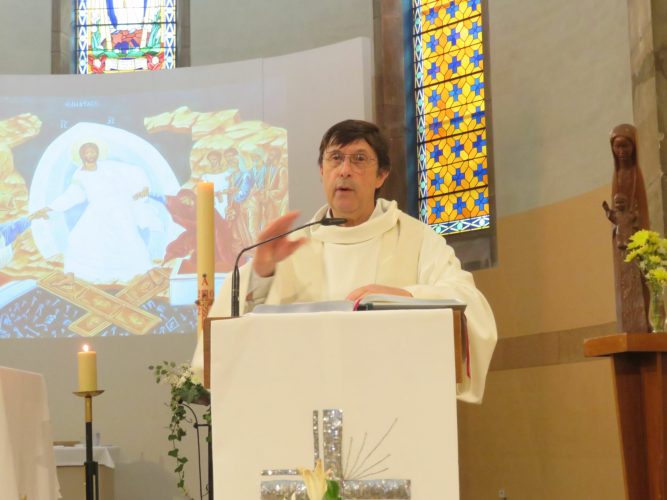
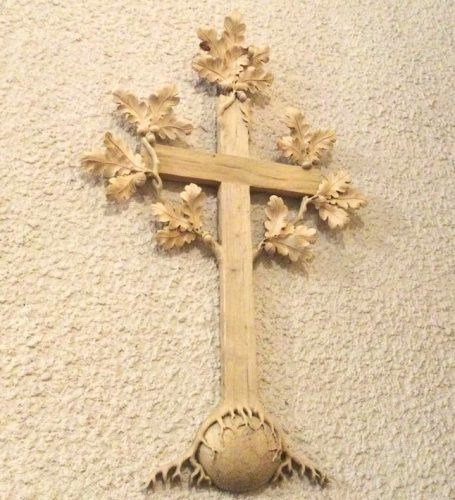
The conference took place on Sunday 19 April 2026 at the Church of the Immaculate Conception (Moulin-à-Vent Parish in Vénissieux) to mark the official inauguration of the’Tree of Life, a wooden sculpture created by Philippe Duret, one of the works commemorating Blessed Antoine Chevrier. A look back at Sister’s speech Marie-Hélène Robert who attended the Mass presided over by the priest Guy Rougerie , a priest at the Prado.
A mission born amongst the poor
Ordained as a priest in 1850, Antoine Chevrier was deeply moved by his encounter with the working-class people of La Guillotière, in Lyon. Faced with their material and spiritual distress, he realised that his vocation was to proclaim the Gospel by living out the poverty of Christ himself.
Christmas Eve 1856 marked a decisive turning point: as he contemplated the Incarnation, he chose to «leave everything behind» to follow the poor Jesus and bring the Gospel to the most destitute. This insight would give rise to the Prado.
A Christ-centred spirituality
Marie-Hélène Robert pointed out that Father Chevrier’s mission is based on a fundamental calling:
- Living a life of evangelical poverty, following in the footsteps of the humble and merciful Christ
- Giving one’s all, to the point of «dying to oneself»
- Proclaiming Jesus Christ to the poor, being a «living image» of Him
For Chevrier, «knowing and loving Jesus Christ» is both the source and the goal of all mission. This conviction was rooted in the missionary tradition of his time, but he embodied it with particular vigour.
Sustainable missionary fruitfulness
The conference also highlighted Father Chevrier’s influence beyond El Prado, particularly on the Society of African Missions. Figures such as Paul Pellet were profoundly influenced by his spirituality.
Even today, the Prado family can be found on every continent. Just as its founder had foreseen:
«The Prado is a great oak […] it will bear abundant fruit.»
This fruitfulness has been recognised by Pope Francis, who in 2018 praised a spiritual family «filled with the same love of Jesus, who made himself poor amongst the poor».
An invitation that remains as relevant as ever
This conference sheds light on the latest developments in the mission of the members of the Prado Family: to follow the poor Jesus, so that he may be known and loved, even today.
Please take the time to watch the video (15 minutes) on the’The story of Antoine Chevrier and the Moulin-à-Vent parish in Vénissieux.
A text by Mr Jean-Luc Nauche, read by Father Michel Durand.
Blessed Father Chevrier and the parish of Moulin-à-Vent (1865–1871)
From the early 19th century, the heads of households in Moulin-à-Vent sought permission to build a chapel, as the church in Vénissieux was 5 km away. This request went unanswered by the Prefect of Isère and the local council. In 1865, with the support of the parish priest of Vénissieux, the local people took matters into their own hands. Generous local residents, the Montagneux and Gonnet couples, donated plots of land to the Bishop of Grenoble so that a church could be built at the expense of the residents of Moulin-à-Vent.
Father Robin, Archpriest of Villeurbanne, and Mr Veyre, parish priest of Vénissieux, wished to establish two new places of worship, one in Saint-Fons and the other in Moulin-à-Vent. They held Father Chevrier in high regard, as he had chosen to spend his periods of retreat in their area. They would have liked Father Chevrier, together with his colleagues, to take charge of Moulin-à-Vent – a rapidly growing market-gardening area – and perhaps also Saint-Fons. A letter dated 5 December 1865 from Father Chevrier to André Gourdon details the discussions he had with Father Robin regarding this mission and confirms that he had accepted the post.
The mission was taking shape for Moulin-à-Vent. Although this place was only a few kilometres from Le Prado, the area fell within the diocese of Grenoble. Mgr Jacques Ginouihac, then Bishop of Grenoble, listened to Mr Robbin and asked Cardinal de Bonald, Archbishop of Lyon, to grant Father Chevrier authorisation to take on this role. It was Vicar-General Pagnon who gave a positive response to the request to entrust Father Chevrier with «the duties of parish priest on a temporary basis».
It was with great enthusiasm and joy that Father Chevrier embarked on this mission, delighted to put into practice a set of parish guidelines he had written for other diocesan priests wishing to live by the same grace as he did, in which he set out missionary guidelines and a way of life for poor parish priests.
Father Chevrier went to build a temporary church in Moulin-à-Vent.
The Brothers of Saint John of God came to supervise the building work. Devout Catholics and local residents lent a hand. The foundations were laid in the spring of 1866 by patients at the Saint-Jean-de-Dieu psychiatric asylum, after which a mason from Vénissieux, Joseph Forest, built the rammed-earth walls. The new church received its bell, cast by Morel of Lyon; this bell still rings out from the bell tower of the present-day church.
The Church of the Immaculate Conception was consecrated on Sunday 9 December 1866. Father Chevrier set up a nativity scene there, just as he had done at the Prado…