




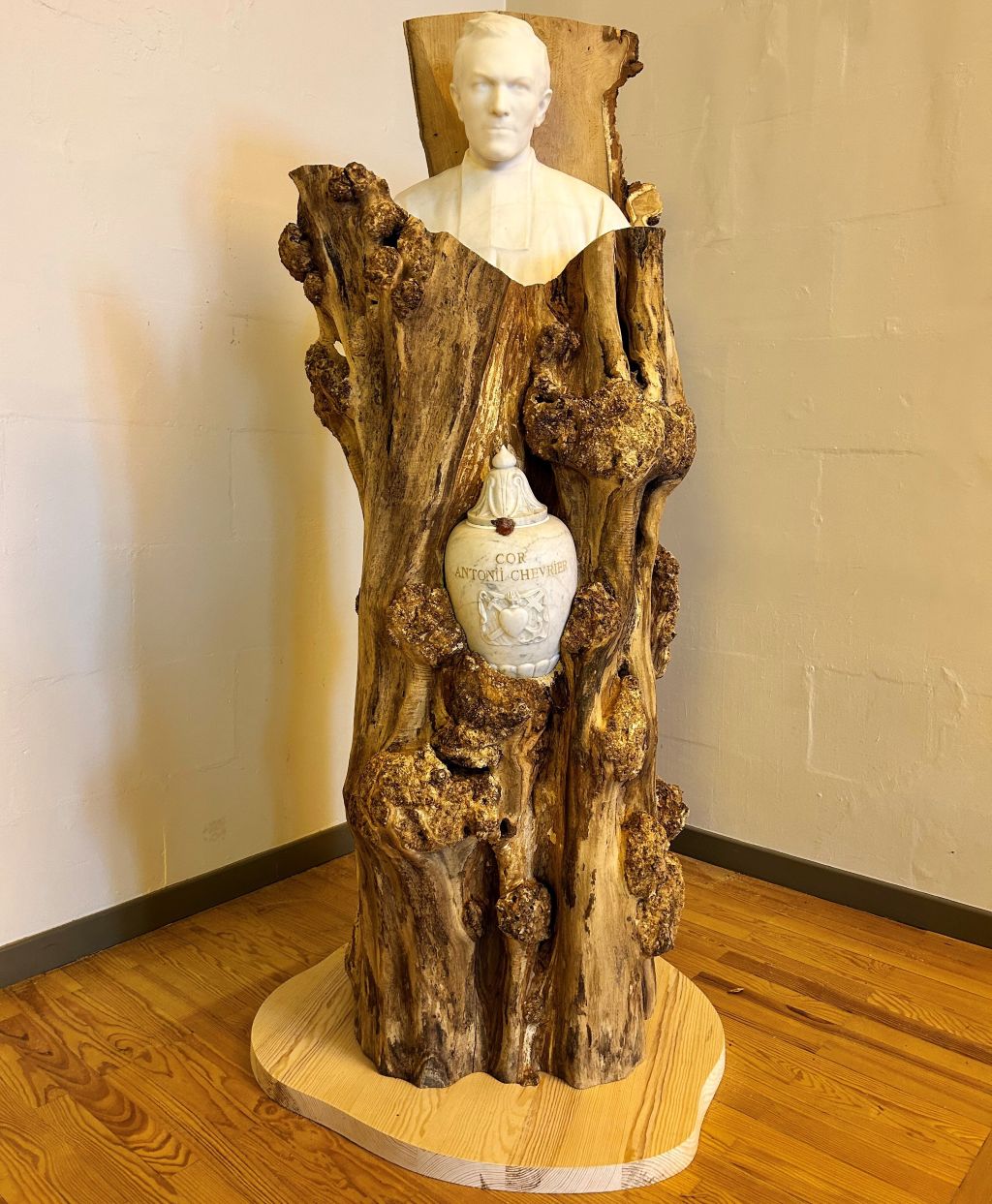
THE TREE OF LIFE – Prado Chapel (9 Rue Père Chevrier – Lyon 7)
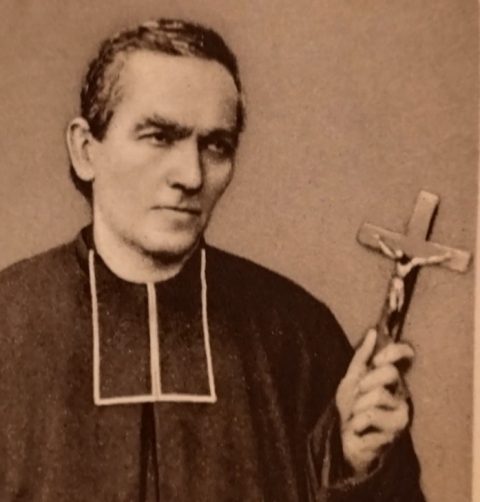
A work by’André Vermare (1930 – Bust) & Alain Dumas (2023 – Acacia wood).
A marble bust and reliquary urn containing the heart of Blessed Antoine Chevrier.
I. Antoine Chevrier, a leading figure among diocesan missionaries
That is the first thing worth noting about Blessed Antoine Chevrier.
- Even then, as a very young diocesan priest aged 24, having been newly ordained in 1850, he harboured this missionary aspiration: he agreed to with joy to «cross the bridge», to be appointed on the other side of the Rhône, in the town of La Guillotière which did not yet belong to the city of Lyon.
It was right opposite his home neighbourhood, yet it felt like a completely different world! Because agreeing to be posted there meant accepting that he would find himself in a very difficult ecclesial and human context, a far cry, in any case, from the comforts of life and ministry enjoyed by priests at that time in most other parishes in Lyon.
One of his fellow seminarians had, in fact, turned down this appointment, which he considered too difficult. Antoine Chevrier, on the other hand, said his joy to go there, repeating to anyone who would listen: « There’s good to be done everywhere! » (I believe that for many priests at the Prado, this quote from Father Chevrier often serves as a guiding principle when they are reassigned … helping them to agree to go even to neighbourhoods or parishes that do not always have many facilities or pastoral resources).
- It must also be said that, at the end of his seminary studies, Antoine Chevrier had taken steps to join the Foreign Missions of Paris, dreaming of travelling far afield to proclaim Christ. This was not to be for him, mainly because his physical constitution was deemed too frail… and also, it must be said, due to the fierce opposition of his mother, who, having learnt of these plans by chance, made a memorable scene and told him sharply: « As for savages, there are plenty of them in Lyon! ». And ultimately, one might say that Mother Chevrier had a fairly accurate view of things, even if one need not necessarily agree with her use of the term «savages»: her son Antoine was to become a true missionary here in France, working amongst a population that was already distanced from the life of the Church.
In fact, in the Guillotière neighbourhood, residents were not only overwhelmed by the material deprivation. But it is clear that this kind of poverty brought with it its share of moral misery (violence, crime, prostitution, …) which was having an impact even on children and young people, alongside a spiritual and cultural impoverishment.
Antoine Chevrier does not, in fact, speak only of the «poor». He quite often speaks of the «the poor» (= material deprivation), of «sinners» (= moral misery) and «ignorant» (= spiritual and cultural deprivation). Indeed, upon arriving there, many found themselves cut off from their rural Christian roots and, as a result of their new living conditions and, above all, their working conditions, were led to drift away from regular religious practice. All the more so as this left bank of the Rhône, with its factories, was at that time also swept by all manner of anti-clerical, free-thinking and revolutionary currents … Antoine Chevrier was already lamenting the low church attendance among the residents of La Guillotière and the small number of children attending catechism classes. For six years, as a simple curate, he worked tirelessly to try to remedy this situation… But this did not yield many results. Until he had a life-changing experience, a moment of spiritual enlightenment, which led him to take a completely new direction: he himself speaks of his «conversion»!
- A grace of personal conversion : As a diocesan priest in a parish, Father Chevrier felt called to make profound changes to the way he lived out his priesthood, by converting more radically to Jesus Christ. He was already a very good priest! He carried out all his duties very well indeed, and even went above and beyond with great generosity. But on Christmas Eve 1856, it could be said that he came to understand two profoundly moving truths about Christ, as he had undoubtedly never done before:
- the divinity of Jesus Christ (and the movement (from the Word of God to us)
- the kenosis, the humiliation of the Word (his how to get there (contact us)
Standing before the nativity scene, Father Chevrier realised, as he had probably never done before, not only « which »Is he really Jesus Christ?«, but also ‘ how »Is he?'".
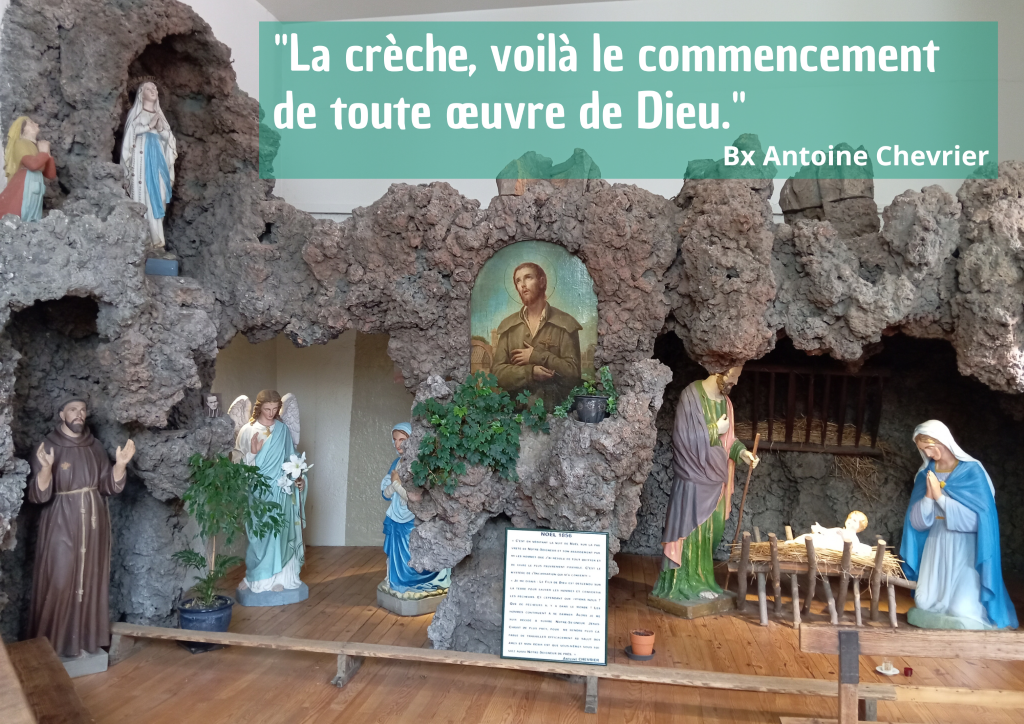
1) The first light, or joy
That night, Antoine Chevrier realised more than ever that Jesus Christ is indeed the Word of God. He reflects on the Prologue of St John and meditates on it deeply, whilst contemplating the infant Jesus. He looks upon Jesus Christ, the Word who comes from God.
Jesus of Nazareth is number 2e person of the Trinity ! It is God Himself, who came in the flesh of our humanity and went out to meet mankind; it is the eternal Word of God, who came down from Heaven to walk upon the earth as a man.
So, Antoine Chevrier understands more clearly that God has «come out», that he has set out towards us. And he has done so without fear of lowering himself to our level (what is known as kenosis). Yet here is the consequence: it is no longer merely for humankind to turn to God, but it is God himself who not only «goes out of his way» but also «humbles himself» to come to us (who takes on our human nature).
>>> It is therefore understandable why Antoine Chevrier, too, would want to «go and live amongst the people» in his neighbourhood, leaving behind the somewhat bourgeois comforts of his presbytery in St André, where he had been a curate for six years. «I shall go amongst them and live their lives; these children will see at first hand what a priest is like, and I shall instil the faith in them.»
2) But that’s not all!
For, standing before the Nativity scene, Antoine Chevrier’s understanding of Jesus goes even further. One might say that, on that evening, Antoine Chevrier was not merely looking at the Baby Jesus… He also looks at the straw in the manger. So, he is affected by the way from which this Word came. That evening, the Holy Spirit made him realise – as he had no doubt never realised before – that in order to come to us, The Divine Word truly chose and decided to come into poverty, as a poor man ! His poverty is therefore neither a matter of chance nor a historical accident: it is a divine choice!
>>> That is why Antoine Chevrier resolved within himself that very night to follow the same path. That is the meaning of his words: «Following Jesus more closely’ ». Like St Francis of Assisi, Antoine Chevrier decided to to experience, in a sense, the same process of impoverishment, the same self-emptying, the same self-denial (the same kenosis) as the Word of God! From that moment on, he resolved to live more simply and more humbly, like Jesus. And for him, this will mark the beginning of a journey of self-denial that is both outdoors (in very concrete, material terms: the left-hand column on the St Fons painting) and interior (humility, modesty, self-denial…: right-hand column).
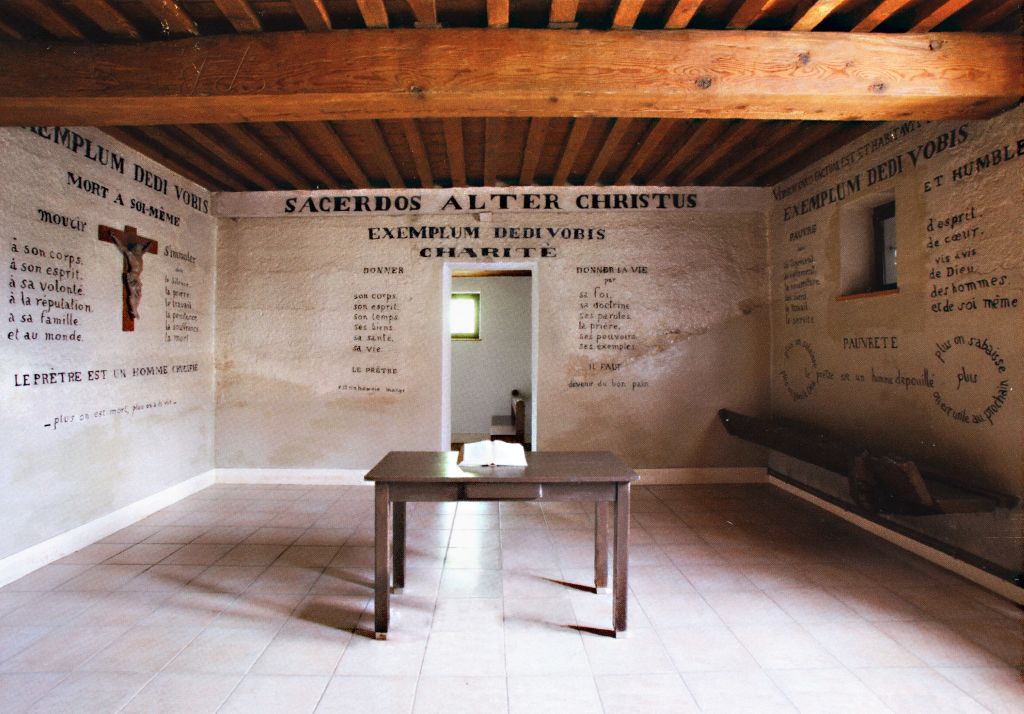
But I really want to emphasise that the missionary (or apostolic) dimension of this conversion. Indeed, if Antoine Chevrier decides to live more simply and more modestly, it is because to be more credible and more effective, particularly amongst the poor and those who are distant from the Church.
This means that Father Chevrier’s pursuit of simplicity and poverty was not, first and foremost, for his own sake, to work on himself through ascetic practices… Or, to put it another way, his path to holiness was not motivated by a mere desire for «personal development». No. Rather, it was to be more credible or more «effective» in the manner of Jesus Christ.
He sort of says to himself: «If Jesus Christ went about it that way, then I must do the same!»; «When it comes to proclaiming the Good News, there will never be any means more effective than those chosen by the Word.» In other words, to truly evangelise, to be a true disciple and a true Apostle of Jesus Christ (a missionary disciple), one must use the same means as he did: the manger, the cross and charity.
And indeed, that is exactly what Jesus told us in the Gospel of Luke 9:23: «Whoever wishes to be my disciple must deny themselves, take up their cross daily and follow me.».
Today, we certainly still need to reflect on this within the Church: it is fashionable to say that, in order to proclaim the Gospel today and be effective, we must know how to use the communication and management techniques that are appropriate to our modern world … Why not? We undoubtedly need to do so… But I believe we can still ask ourselves two questions:
- Are we sure that these choices do not, in fact, reflect our current cultural landscape, or even that of certain circles which are more at ease with, more accustomed to, and more receptive to all these methods? Do we not then run the risk of neglecting to evangelise other groups, for whom appeal and credibility rest on other factors? For example: the simplicity of direct, personal relationships; the opportunity to speak and be listened to just as we are, with our faults, and with respect.
One might say that on Christmas Eve 1856, Antoine Chevrier realised that the Gospel could never be proclaimed in the world’s way, through mere activism (he who had been so generous and devoted in his early years of ministry, but who had undoubtedly relied more on his own strength than on God).
But we must, above all, spread the Gospel by putting the «virtues» of the Gospel into practice, that is to say, by converting to how to’to be of Christ and in poverty :
« Religious men observe the evangelical counsels; why should secular priests not observe them? (…) In their ministry, ought not priests to draw closer to Jesus Christ just as much as others? Indeed, ought they not to do so even more so, they who are in the midst of the world and who must carry the sweet fragrance of Jesus Christ everywhere and be the living light that must shine amongst mankind? » (Antoine CHEVRIER, *The True Disciple*, p. 121) - And, above all, the second question: What are we doing today with the a divine choice of simplicity, poverty and humility ? What are we doing today within the Church to reflect this choice of the Word of God, as contemplated by St Francis of Assisi and Father Chevrier? The eternal Word who chose to humble himself and allow himself to be seen first by shepherds, to come down to the lowest of the low, to ensure that none would be forgotten… not out of indifference or contempt for others, but to ensure that none would be forgotten?
See Pope Francis: «I want a Church that is poor for the sake of the poor».
In any case, Antoine Chevrier realised the’the importance of poverty and simplicity in being a credible witness. A poverty and simplicity that is neither solely internal nor solely external, but which touches both the inner self and outdoors.
At a time when, in seminaries in France, future priests were routinely taught «good manners», to «behave in a manner befitting their station» and «not to soil their cassocks or their hands», Father Chevrier realised that, In poverty and simplicity, there is a true apostolic strength, because that is how God himself went about it when he sent his Son to us. « I have set an example for you ».
So, what about today? How can we still heed this call to the humility of the manger – to simplify our lives so that we may be more credible and effective?
A Call for Humility
Is there not a missionary challenge at the heart of the crisis of trust and credibility currently affecting our Church? How can we regain the trust of those to whom God sends us, and who may doubt the Church’s sincerity? By what attitudes How can we regain their trust? What is it about us that will touch people’s hearts, because they will recognise in it something of our Master and their Master: Jesus Christ?
The call to live more simply, to «live with less»
I believe this is another missionary challenge that is highly relevant today. As Christians, as priests, do we not also need to bear witness more effectively, through the very fabric of our lives, to the joy of a simple, unpretentious life, in the midst of a society that still gives many people the illusion of happiness through the idea of «always more»? Not only in our personal lives, but also in our pastoral work and in our approach to society? Do we not have something to reveal that might strike a particular chord with quite a few people today: a «Good News of simplicity», which runs counter to a certain «worldly» vision of happiness or efficiency …
In any case, the light of faith that Antoine Chevrier received whilst gazing upon the Child in the Manger led him – rather boldly – to resolve to live out that same experience himself vote-counting process that the Word became flesh (kenosis) and this as part of an apostolic or missionary endeavour.
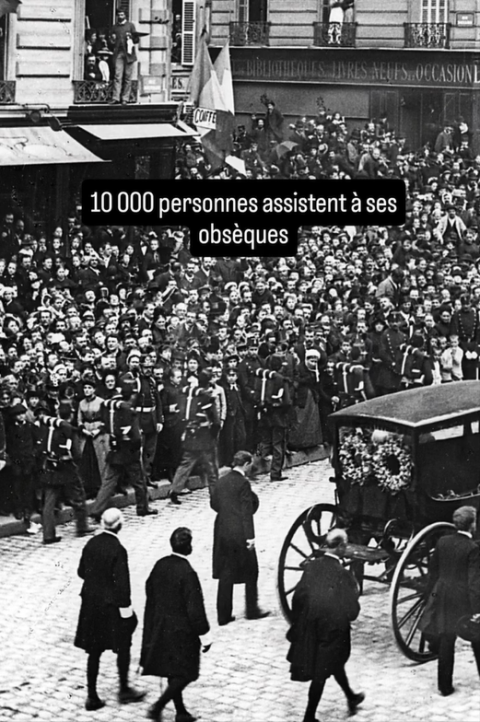
N.B.: And yet this approach has proved successful! More than 300 priests from Lyon and about 15e parish priests and canons have attended Father Chevrier’s funeral on 6 October 1879 and, above all, that there was almost 50,000 more people gathered in the streets, between St Louis’s Church and the Prado Chapel, to watch his coffin pass by (including 10,000 who were following the procession, according to the newspapers Progress and Le Nouvelliste). That’s significant and it’s incredible! It really says something about the influence of Antoine Chevrier’s holiness, because he hadn’t been able to benefit from all the media and commercial hype that someone like Johnny Halliday enjoyed! They were mainly workers and people who didn’t go to church very often, but also many people from Lyon, some from the Moulin à Vent parish, others from «the right bank of the Rhône», and no doubt from much further afield too!
So, to summarise: here is a diocesan priest who is driven by a deep missionary zeal. He lived out this missionary zeal to the full, whilst remaining fully a diocesan priest. And I believe we should highlight two aspects which gradually made him a true missionary priest:
1/ He came to understand people’s real-life circumstances more and more clearly:
It is in the very exercise of his diocesan ministry that his congregation enabled him to truly become a «good shepherd». Reading his early sermons on the neighbourhood, delivered whilst he was a young curate, one can see that he gradually moved away from a somewhat harsh criticism of the religious weakness of the people of La Guillotière, to a realistic understanding of their living conditions. Thus, as he began to visit the residents in their homes, he gained a deeper appreciation of the practical realities of these people’s lives (their living conditions, the length of their working hours, their fatigue, but also the richness of their family and social lives…). A severe flood in the neighbourhood in the spring of 1856 enabled him to get to know them even better and also to become better known to many of them.
2/ He even went so far as to admire their way of life, and sometimes their faith:
His judgement became more refined through his contact with these so-called «savages» of La Guillotière, in the sense of a growing compassion and even, to a certain extent, admiration for the meaning of faith of many of them. He «immersed himself in their culture», as we say today; in other words, he managed to get to know them properly and to discover the value of their lives and their culture, moving beyond the negative judgements he had initially held.
He sometimes went so far as to hold them up as examples to his future priests:
- « Bricklayers work hard all day long, as do carpenters, joiners, farmers, tailors, and so on… All these people work all day long, and sometimes even at night, to earn a living for themselves and their children; so will the priest have an easier life than the rest, he who holds a position far more exalted than theirs? (…) Is his work really so important for him and for others? »
- «God has endowed certain souls with a spiritual and practical insight that contains more common sense and divine wisdom than can be found in the minds of the greatest scholars. Witness to this are certain good farmers, a few good male workers, a few good female workers – women who grasp the things of God at once and know how to explain them better than many others.» (VD, p.218)
This «inculturation» will always remain essential if one is to become a truly authentic missionary.
II. The Prado’s charism is a gift to the whole Church for the sake of the Church’s mission
Beyond his person, what Antoine Chevrier received from God has been recognised by the Church as a true charism … a charism of the Church and for the Church. I would like to highlight four aspects of the Pradosian charism, which I believe can form part of the Church’s treasure:
- It is a charism capable of continually reawakening a genuine missionary zeal within the Church.
The grace of Father Chevrier can reawaken in us the longing, the desire and the passion to give everyone the Life of God in Christ. We must never resign ourselves to the idea that this life is reserved for a select few. Let us not choose to go only where it is easiest, most comfortable, or best equipped in human and pastoral terms. Nor where people are kindest towards the Church.
- It is a charism that can help the Church to remain a Church for the «masses», for the multitude, and not a Church for a «small remnant of the perfect», turned in on itself.
- It is a charism that can help to to train true missionary disciples based on the Gospel.
For example, on the subject of «the Cross and suffering» – who dares to speak of it? Antoine Chevrier does not extol suffering. But neither does he deny it. In his approach, there is no denial of reality. He is a spiritual realist. And he is a formator with his feet firmly on the ground…
Today, how could we claim to be training «missionary disciples» without also preparing them to bear «the Cross»? That would be irresponsible, and it is not how Jesus trained his disciples: he warned them and prepared them. Antoine Chevrier saw this in the Gospel and is not afraid to tackle this difficult subject; the question that interests him is: «When the cross comes our way, how can it become a path to Life?’ »What example did Jesus Christ set for us?’”
The beauty of his approach is that he never tackles any subject through theoretical teaching: he always takes the Gospel as his starting point, because his aim is to train ’other Christs« rather than mere theorists or »sales representatives of the faith«.
- It is a charism that can help the Church to be more credible by practising simplicity and humility.
The grace of the Prado reminds us that we never bear effective witness to Christ through grandeur, magnificence or splendour, but through an authentic, poor and humble presence amongst people. The Church and Christians must become like the Eucharistic sign itself.
- It is a charism that can help diocesan priests (including fidei donum priests!) to retain their secular or diocesan identity.
What does it mean to be a diocesan priest? It is not simply a matter of being hierarchically attached to a bishop, nor geographically to a diocese within the Catholic Church. It is so much more than that!
To be a diocesan priest is to be sent out to the whole population, far beyond those who gather in churches. A diocesan priest is a secular priest, «in the world», that is to say, right at the heart of society. This world as it is, which we must reach out to in God’s name, for He wishes to leave no one by the wayside.
The charism of the Prado can help us, as a Church, to remain constantly «concerned and engaged», not only with the smooth running of our parish communities, but also with the other «sheep» who are not yet gathered together – those who are out in the wider world.
A diocesan missionary priest cannot be content merely to look after his parish well. He must «go out» to seek to love and care for all the people whom God seeks; and he must take an interest in the issues affecting the proper functioning of the human world, with all its poverty and wealth.
Fr Philippe BRUNEL
Priests’ pilgrimage in the footsteps of Antoine Chevrier
(Nov. 2019)
Please feel free to share this text