





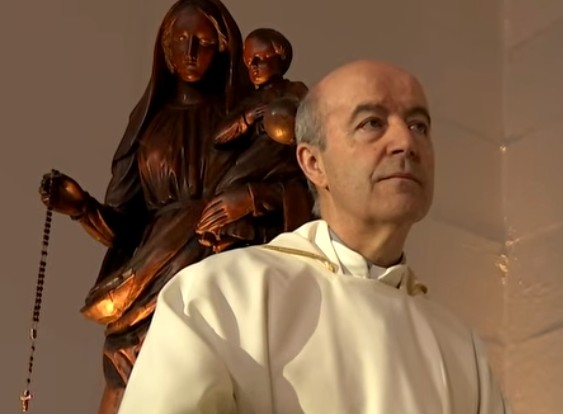
Translation of the priest’s homily Diego Martín Peñas – MEaster Sunday – Sunday 5 April 2026
The resurrection of Jesus is a cry of joy that pierces the darkness of our night: « Hallelujah, the Father has raised Jesus from the dead! ». The Word of God we have just heard fills our hearts with joy and invites us to reflect on this event that changed the course of human history. Today, we too can walk with the Risen One, and to this end, I suggest we cultivate certain attitudes that will enable us to benefit from his presence.
1. To reflect on the signs of life that appear all around us
In the Gospel account of the Resurrection, there is mention of numerous signs of life that the three disciples who went to the tomb were able to observe: the stone that had been rolled away, the empty tomb, the linen cloths lying there, the shroud rolled up… The three disciples had experienced Jesus« friendship, but it was the disciple »whom Jesus loved’ who was the first to come to faith after contemplating the signs.
In our daily lives, we must be attentive to the signs of life that the Lord offers us: people who build peace in the midst of violent situations; words of encouragement and comfort in the face of death; a willingness to serve selflessly in such a selfish world; a warm welcome for the poor amidst so much indifference… To see and learn to interpret these signs, we must cultivate the experience of Jesus’ love through prayer. And, at the same time, as the great mystic of the last century teaches us, Madeleine Delbrêl, we must learn to look beyond the surface of reality to find God in every situation, however small, in our daily lives.
2. Running alongside others
We can draw near to the Risen One through fellowship: « Where two or three are gathered in my name, I am there amongst them » (Mt 18:20). It is curious to see how Mary Magdalene rushes about in search of Jesus and cannot find him. Her weak and «isolated» faith leads her to interpret the sign of the rolled-away stone superficially: Jesus’ body has been stolen and no one knows where it is.
The other two disciples ran together, each at his own pace. They arrived at the tomb, looked inside, and John, the beloved disciple, finally believed: «He saw and he believed». Today, we must fight against the individualism that pervades our culture and renders us incapable of living in brotherhood. Life with others is not easy and involves a dimension of the cross, but this is what we are called to as children of the same Father. Brotherhood is both a prerequisite for and a gift of the experience of the Paschal Mystery.
3. Allowing ourselves to be nourished by Jesus
Just like the first disciples, we are called today to «eat and drink with Jesus after the Resurrection». The Eucharist is the place where we truly encounter the risen Jesus. The bread and wine are given to us as nourishment so that we may live in the world as a sign of his loving presence. In the Eucharist, Jesus transforms us into himself; he makes us «good bread» to nourish the lives of those around us.
Anyone who has encountered the Risen Lord in the Eucharist makes this sacrament the centre of their life; they long with all their heart to partake of it, to savour the love given by the One they love. Anyone who has had this experience counts the hours and minutes until their next meal with Jesus and their brothers and sisters. Teresa of Ávila longed ardently for the Eucharist because, in it, she saw Christ entering her life and transforming it: « No sooner had she received Holy Communion than she pictured the Lord of that inn so vividly that her soul seemed to be torn apart, consumed by Christ » (Life 18:8).
4. Entering the tombs dug by injustice
We may refer, in a metaphorical sense, to the living conditions endured by many of our brothers and sisters as a «tomb», as they erode or destroy their dignity. We are all aware of these situations of poverty referred to by Leo XIV in his recent exhortation: « The poverty of those who lack the means of material subsistence; the poverty of those who are socially marginalised and lack the means to assert their dignity and capabilities; moral and spiritual poverty; cultural poverty; the poverty of those who find themselves in a state of personal or social weakness or vulnerability; and the poverty of those who have neither rights, nor space, nor freedom » (Dilexi te 9).
Entering the «tombs» means sharing the lives of the poor, working alongside them on the journey that leads them to overcome the injustices that disfigure their faces and, at the same time, to be for them witnesses to the Risen One, who restores in every person their true dignity—which consists in being made in the image and likeness of the Creator, and in being his beloved child.
Diego Martín Peñas
Priest from El Prado (Diocese of Ávila)
General Director of the Association of Priests and Consecrated Laity of El Prado (Term of office: 2025–2031)