
Alfred Ancel and the Communists, by Pierre Crépel
The perspective of *La Revue du Projet* (French Communist Party, Left Front, European Left)
Alfred Ancel (1898–1984), born in Lyon to a middle-class family in the textile industry, enlisted as a volunteer in 1915, ordained a priest in 1923, Superior General of the Prado (1942–1971), auxiliary bishop of Lyon (1947–1973), a bishop working amongst the working class but not a ‘worker priest’ (1954–1959), an active and influential figure at the Second Vatican Council (1962–1965), and a prolific writer. He was one of the key figures in the dialogue between communists and Christians in the 20th century.
The Association of Priests of the Prado was founded in 1860 by Father Antoine Chevrier (1826–1879), a priest of the Diocese of Lyon, with a view to evangelising «the poor, the uneducated and sinners», for God became poor in Jesus Christ, born in a stable; Jesus Christ remained poor until his death on the cross; it is a matter of truly living this out. Whilst the Prado has its origins in Lyon, its priests now minister in many countries around the world.
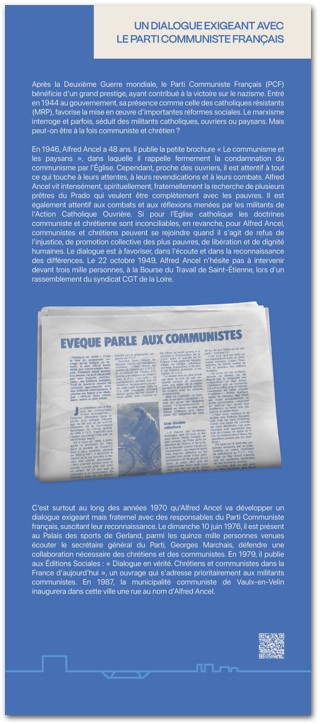
In 1946, Alfred Ancel was 48 years old. Christians and Communists had been united in the Resistance; the French Communist Party (PCF) enjoyed great prestige; it was part of the government and was introducing measures that were widely welcomed, such as the social security system and the legislation governing tenancy and sharecropping. Christians, including peasants, were therefore often considering the possibility of a rapprochement with the Communists, joint action, or even more. It was then that Alfred Ancel published the short pamphlet *Communism and the Peasants*. Among the conclusions, on p. 83, we read:
«Consequently, communists should not be surprised when the Church says:’
- A Christian must not be a communist.
- A Christian is forbidden to be a member of the Communist Party.
- A Christian must not vote for the Communists.
»So, she isn’t involved in politics; she doesn’t concern herself with economic doctrines. She’s involved in religion.’
As for the possibility of collaborating with the Communists on an ad hoc basis, he admits that a «temporary alliance» might be possible in «a specific case», but «we must still be very careful». He adds, however, that ’we must not form an anti-Communist front « (pp. 88–89). He reminds us that we must love our enemies (p. 7) and also writes: »If the Communists shake us up and force us out of our routine, so much the better!« (p. 87).
Why and how could a man who was regarded in the 1970s as the champion of dialogue between communists and Christians express himself in this way in the aftermath of the Liberation? Did he subsequently make a complete U-turn? To answer this, let us first examine the nature of the criticisms he levelled at the Communists (in France and around the world) in 1946.
«According to communist doctrine, there can be no justice, no happiness for the working class as long as the capitalist system endures. […] Consequently, only one thing matters: capitalism must be overthrown. Nothing else matters» (p. 21). Communists are sincere and selfless, but in their own way, the end justifies the means; they may lie, kill, and so on: «it depends» if it helps to destroy capitalism; «nor do they believe in human conscience». Atheist communism fights against religions; «the success of communism would lead to a terrible persecution of [religion]» (p. 83). Communists want to nationalise everything; their temporary allies (particularly small farmers) must be aware of this. Communists deny the individual and wish to see only the collective. Alfred Ancel draws on examples from the USSR to support his analysis.
With the benefit of hindsight, we can better appreciate this contradictory reality: the PCF reached out to Catholic workers in 1936, it showed openness within the Resistance, it did not infringe upon freedoms (including religious ones), yet it was fully embedded in Stalinist doctrine. In other words, Alfred Ancel’s objections ring partly true; only partly, because life is stronger than doctrines and because Alfred Ancel remains a prisoner of his origins and of the present, and fails to foresee that life will cause the Communists – just like the Christians – to evolve!
Workers’ priests
Life at that time was, first and foremost, about the working class and the class struggle. Alfred Ancel did not wait until after the war to share in the plight of the poor and the workers; this is the very purpose of the Prado. But a process of maturation was taking place, and within it, the experience of the worker priests and priests in the workplace. The informal movement of worker priests emerged around the time of the Liberation. By 1949, there were only about fifty of them. Their motivations varied from person to person: serving the working class, evangelisation and/or… competing with the Communists. Following the major strikes of 1947, working-class consciousness hardened through struggle, and several worker-priests took on trade union responsibilities. It was this discovery of the realities of working-class life by the priests, coupled with a gradual blending of their worlds on the ground, that alarmed the hierarchy. The ban on worker priests imposed by Pius XII from 1 March 1954, followed by the total ban on priests working – even part-time and outside factories – in 1959, left a deep impression on people’s minds. Alfred Ancel, who took on odd jobs alongside the working class between 1954 and 1959 – an experience he would recount in 1963 in *Five Years with the Workers* – had the opportunity to reflect on these matters both within his theoretical framework and in practice. We shall follow this movement and its crises in Chapter 10 of Olivier de Berranger’s book (pp. 159–200). In a nutshell? Class struggle is, first and foremost, a fact. It is also a struggle for justice (even Pius XII said so); what level of suffering is acceptable? Without straying from his evangelical outlook, Alfred Ancel – himself from a bourgeois background – sought to experience things from the inside. Outside the working-class world, the term «class struggle» is always understood in a «Marxist» sense and refers to violent action carried out «in a spirit of hatred». In the working-class world, on the other hand, it is the rejection of injustice, a form of liberation and collective advancement. Alfred Ancel wanted to overcome this misunderstanding: to learn from others is to understand their language so as to be able to engage in dialogue. Yet he is by no means a secret communist within the Church; he remains steadfastly obedient to the hierarchy and defends the Church’s social doctrine, with its principles: the common good, the universal destination of goods, subsidiarity, participation and solidarity. He understands it in the spirit of the Council, in which he played a key role: «God has destined the earth and all that it contains for the use of all people and all nations, so that the goods of creation must flow equitably into the hands of all, according to the rule of justice, which is inseparable from charity » (Pastoral Constitution *Gaudium et Spes* «on the Church in the Modern World», 1965).
The greatest driving force behind Christian-Communist dialogue in the 20th century was, in fact, the influence of the working class on French political life. And to paraphrase Alfred Ancel: «If Christians shake us up and force us to break out of our routine, so much the better!»
A few books on’Alfred Ancel, one of the 56 listed by the Lyon Municipal Library:
- Communism and the Peasants, Providence du Prado, Lyon, 1946
- Five Years with the Workers: Testimonies and Reflections, Le Centurion, 1963
- Dialogue in Truth: Christians and Communists in Contemporary France, Éditions sociales, 1979
- A Trade Union Activist in Dialogue with a Bishop (with Joseph Jacquet), Éditions ouvrières and Éditions sociales, 1982
A biography
- Olivier de Berranger, Alfred Ancel. *A Man for the Gospel*, *Le Centurion*, 1988. A large number of these books are in stock in the cellars of Le Prado, 13 Rue du Père-Chevrier, Lyon. Readers of the journal may contact them directly.
- Project Review, No. 61, November 2016, click here.