
Personal carer
Olivier de Berranger (Pages 139–141)
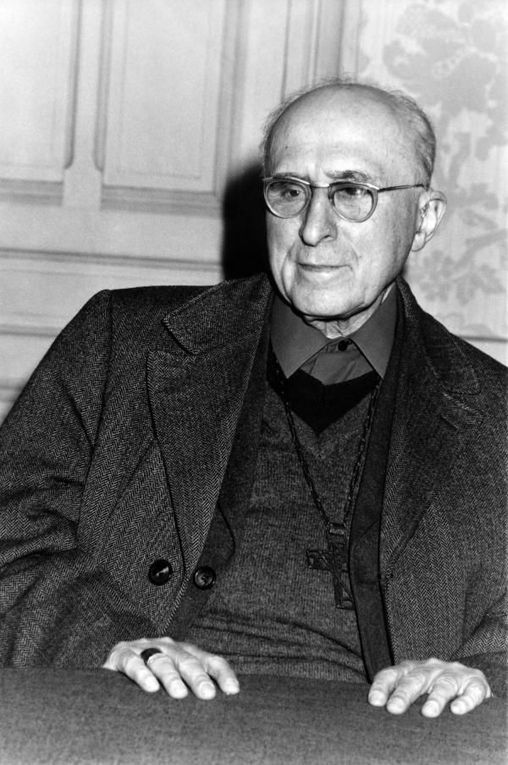
On a cold winter’s day, Father Joseph Ancel recounts that he happened to bump into his brother Alfred at Place Bellecour. Alfred was strolling leisurely out of Rue Auguste Comte and, strangely enough, looked «very sad»:
– What’s the matter with you?
– I can’t believe it myself. Imagine, the cardinal summoned me to ask me, in the name of obedience, to become his auxiliary bishop. I’m counting on you to keep this to yourself. But, you see, I’m quite shaken.
That’s good news! The fact that a priest like you, who lives in the spirit of evangelical poverty at the Prado, is to become a bishop – I’d actually be delighted about that… Don’t you think the episcopate needs your witness?
– ….
Alfred Ancel was genuinely distraught. He had but one wish: to remain in the service of the Prado, which he saw as being in full growth. And it was precisely because Cardinal Gerlier had assured him that he would allow him to continue in his role as Superior that he could not refuse him. In spite of himself, Father Ancel did not go unnoticed within the Church in France. The Archbishop of Paris, Cardinal Emmanuel Suhard, whose influence was so great at the time, had taken note of this modest figure from the Lyon clergy. He had made it known to Cardinal Gerlier that he wished to see him become titular bishop of a diocese. Feeling his own strength waning, Cardinal Suhard was seeking men who would continue the intense missionary work of which he had been one of the pioneers. Alfred Ancel, through his evangelical training at the Prado and his publications on the challenges of pastoral care amongst the working class, seemed to him to be one such man.
Cardinal Gerlier understood his eminent colleague in Paris. But he also understood Alfred Ancel’s personal choice. That is why he had devised this solution—which was accepted by Pius XII himself—of having him appointed to Lyon without removing him from the Prado. When he enthusiastically introduced him to his diocese on 24 February 1947, he wrote in *La Semaine Religieuse*: «This apostle of Jesus Christ—philosopher, theologian and sociologist—who aspires to embody the traits of the True Disciple throughout his life, is first and foremost haunted by the sufferings of the masses: a people de-Christianised, neglected and paganised (…). Was he to abandon the Prado, at the risk of jeopardising such a beneficial expansion? (…). The Supreme Pontiff has deigned to keep Father Ancel at the Prado, where he will remain, without withholding him from the episcopate.»
Cardinal Suhard, making the best of a bad situation, attended in person the consecration of the new bishop, which was celebrated at the Primatial Church of Saint John on 25 March, a date he had chosen because, in the liturgical calendar, it is the Feast of the Annunciation to Mary. Bishop Lebrun of Autun and Bishop Bornet assisted Cardinal Gerlier in the rite of ordination. And three weeks later, Cardinal Suhard wrote to Bishop Ancel:
«Your Excellency and most esteemed Lord,
«Your letter of 12 April conveys to me the joy you felt at my presence at your episcopal consecration. I would like to tell you that I, too, felt that joy above all else. The satisfaction I derived from that consecration stemmed not only from the prospect of an episcopate that is proving fruitful for the Church, but also the consecration of a work which seems to me increasingly useful and providentially prepared for the Catholic Church in our country, France.”.
«How can one fail to admire, above all, the workings of Providence, which made use of that man of God, Father Chevrier, to enable him to bring to fruition—even beyond his own personal aspirations—the full ideal embodied in the work for which he himself laid the foundations? This work was intended to bring to the world the ideal of Christ’s holiness and poverty in the winning over of souls, and it so happens that today, through the formation of a clergy inspired by this vision, the idea is not only coming to the fore, but is also proving increasingly firm and powerful…»
In its report on the ceremony, the independent daily newspaper *La Liberté* concluded by reflecting the general sentiment: «The Church of Lyon has every reason to rejoice; it has exactly the bishop it needs in the times we live in.»
At the Prado, too, there was great jubilation. Aimé Suchet simply said, during the many toasts that followed the coronation banquet: «What surprised us, incidentally, was not that attention had been drawn to our Superior; his merits are all too well known to us… but that the shelter he had voluntarily chosen by coming amongst us had proved ineffective.»
(…)
Alfred Ancel was not the Bishop of Prado
Olivier de Berranger (pp. 143–144)
… Alfred Ancel was not «the Bishop of the Prado», whatever misconceptions might have existed on the subject outside Lyon. But it is fair to acknowledge that his role as bishop, by establishing him as an equal amongst his peers in the Church of France, opened many doors for him. With his personal authority doing the rest, this ordination on 25 March 1947 had repercussions on the history of the Prado – and, indirectly, on that of the evangelisation of the French working class – which are well worth assessing. Bishop Ancel, for his part, was keen to keep his two highly demanding roles distinct, and one wonders where he found the time to carry out so many tasks, ranging from confirmations to countless lectures and meetings with the most diverse groups. His excellent health, his ability to fall asleep as soon as the night light was switched off late at night, and his astonishing flexibility in switching from one task to another do not explain everything. He also had a gift for living in the presence of Christ, of whom he was conscious, wherever he was, that he was a «representative».
The suggestion that Bishop Ancel might leave Lyon to become the titular bishop of a large diocese was put forward on more than one occasion… by others, not by himself. The most serious of the concerns he faced in this regard arose shortly after his appointment, as it coincided precisely with the death of Cardinal Suhard on 30 May 1949. Among the names that had already been circulating since the onset of the latter’s illness as potential replacements in Paris, that of Alfred Ancel was mentioned with such insistence that he felt it necessary to write to Cardinal Gerlier:
«Your Eminence,
«You cannot ignore certain speculations circulating about me regarding Cardinal Suhard’s succession (…). Should you ever hear that my name is being put forward, I would be grateful if you would bring to the attention of the Nunciature, before any more formal steps are taken, certain objections which I believe, in all conscience, I must raise (…). » Here, Father Ancel highlighted his «personal shortcomings». He continued: «I am increasingly convinced that the Prado is God’s work, that Father Chevrier’s message comes from on high, and that the spiritual renewal he sought—in accordance with the Gospel—is a providential means that God has placed at the disposal of his Church so that it may better adapt to contemporary needs. Had Father Chevrier’s message been heeded sooner, it seems to me that this barrier—which now appears insurmountable—would not have arisen between the workers and the Church. Father Chevrier’s mission dates back to 1856. It followed the Communist Manifesto by eight years. Certain parallels are hard to ignore (…).»
Finally, after reminding the Cardinal that the Prado is currently undergoing expansion and telling him that, in his view, no one is yet ready to succeed him, he reveals to his archbishop, for the first time, a plan he has been nurturing: «… I very much hope that, in a few years» time, I will be able to hand over my position at the Prado to others. At that point, I could ask the Supreme Pontiff for permission to join our priests working in the factories. They would like to have a bishop with them. Admittedly, they are pleased with the trust shown in them by the hierarchy. But if they had a bishop with them, their fellow workers would understand better that they belong to the Church. Whilst remaining Auxiliary Bishop of Lyon, I could, if I were able to live amongst them, demonstrate both the unity of the Church and its presence amongst the working class.”
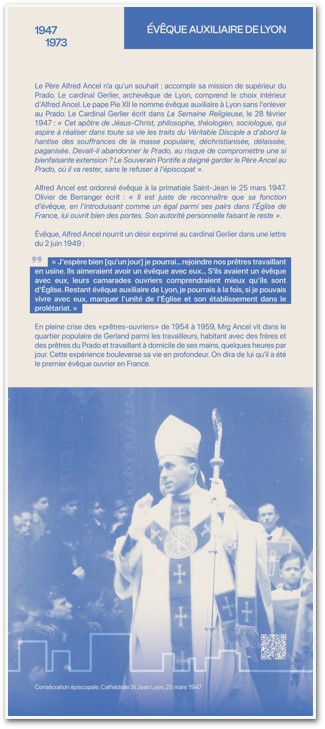
See also an extract from the blog "En manque d’église" – Alfred Ancel and Bishop Pierre-Marie Gerlier
Extract from the blog Missing church. To understand the mission of Christians in the world, it is becoming urgent to study the early days of Catholic Action and the worker priests – Article published on 1 January 2025 by the father Michel Durand, a priest at the Prado.
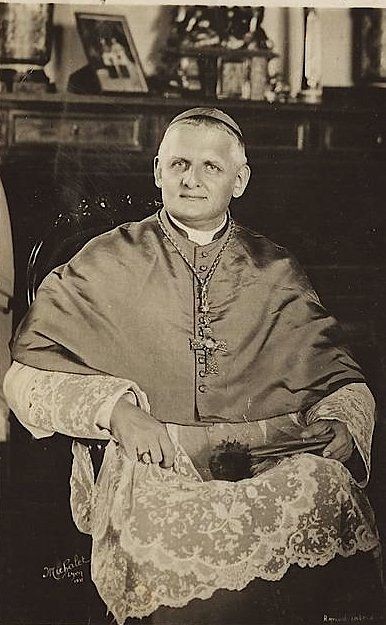
Reading and studying with Christoph Theoblad, followed by video recordings with Cesare Baldi about his book We are the Church can only echo the reflections of the “life review” kind that Goulven’s work will inspire as I interview him for the book: *Michel Durand, a committed priest caught between loyalty and defiance*.
It seems to me that I have always maintained that Christian parish communities (local churches) are not missionary in nature. I was told that, in fact, they were missionary – essentially missionary – and that my accusation did not hold water. Yet today I still observe and maintain that missionary attitudes are lacking in the everyday life of parishes. I see this in the parish in the neighbourhood where I have now lived for over ten years, the parish of Saint-Maurice/Saint-Alban. I know that saying this does not please the parishioners, so I try to explain myself and put forward my arguments; it seems to me that I am not really managing to make myself heard. In short, does this observation not call for a sort of ongoing review of one’s life, as if it were drawing to a close?
If I were to go back to university to embark on a new life on earth, I would study pastoral theology – a practical form of theology that would lead me to delve into history books from the early 20th century. What was said back then? What was the pastoral reality of reaching out to and evangelising people outside the parishes before the 1914–18 war? I go back to the origins of Catholic Action.
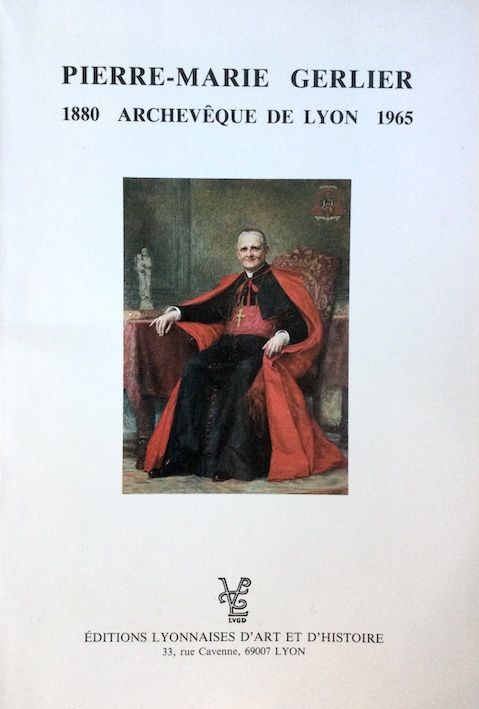
Whilst researching Alfred Ancel, auxiliary bishop of Lyon and superior of the Prado, I read a booklet published in 1987, Éditions Lyonnaises d’Art et d’Histoire, which examines the life of Pierre-Marie Gerlier, Archbishop of Lyon, 1880–1965. It appears to be a lecture given by Régis Ladous, of Jean Moulin University (Lyon III), on the occasion of an exhibition at the Fourvière Museum commemorating Pierre-Marie Gerlier. I have extracted a few pages from this lecture which illustrate the Church’s missionary concern with the emergence of Catholic Action. Whilst today the Church in France (the one I now know) seems to be retreating into worship, or even into its sacristies, it strikes me as important to revisit the history of the workers’ mission, of the Worker-Priests (P.O.), priests in the workplace, and Catholic Action, in order to seriously examine the Church’s mission in this century.
Page 5
«1921: ordained as a priest in the prime of his life and after extensive experience of lay life, Pierre-Marie Gerlier naturally thought of putting the talents he had lavished on the Palais at the service of the Church: swapping his suit for a cassock, he would have liked to devote himself to preaching amongst the diocesan missionaries of Paris. His archbishop, however, recalled that he had been the highly effective president of the ACJF*, and immediately appointed him deputy director of the diocese’s charitable works. One episode stands out from his time in this post: the founding of the Young Christian Workers.
Gerlier only became involved at the end of the process, but his contribution was decisive. It was in 1925 that the JOC was officially launched in Belgium by Father Joseph Cardijn. The following year, he was emulated by Georges Guérin, who had become curate of Clichy. But the ACJF, with its rather bourgeois leadership, had no intention whatsoever of allowing itself to be deprived of its apostolate amongst the working class. At its national congress in 1927, it specifically chose the apostolate amongst young workers as its theme. The risk, therefore, was that two rival organisations would emerge: a French JOC composed exclusively of young workers, modelled on the Belgian example; and a workers’ branch of the ACJF, essentially controlled by the bourgeoisie. This raised the prospect of papal arbitration and an episode as unpleasant as the condemnation of the Sillon in 1910 (see Michel Launay, Reflections on the origins of the J.O.C., in *Mouvements de jeunesse*, Paris 1985, pp. 224, 229, 230).
* Founded by Albert de Mon, of the French Catholic Youth Movement, in 1886.
Pages 11–12
«Another initiative, this time originating at the very heart of the Diocese of Lyon itself: the pastoral revolution launched by Father Laurent Rémillieux in the new parish of Notre-Dame de Saint-Alban, in the east of Lyon: paraliturgical services in French, dialogued Masses, evening Masses, the altar turned «to face the congregation», the abolition of collections during services, and the participation of laypeople in pastoral life: what came to be known as the «community parish». Here again, the initiative predated Gerlier’s arrival in Lyon and did not correspond to the cardinal’s priority objectives. Once again, he discovered, learnt, and decided to support Rémillieux at a time when priests deeply involved in Catholic Action, or even in the JOC, such as Father Rodhain, regarded Latin as sacrosanct, the evening Mass as unthinkable, an altar facing the congregation as suspect and, generally speaking, any liturgical alteration as a source of heresy. Not to mention the Roman Curia… In 1943, the establishment in Lyon of the Centre for Liturgical Pastoral Care formalised a support that was all the more commendable given that Gerlier himself was far from sharing all the ideas of Rémillieux and his disciples. Even as late as 1945, the cardinal, who was personally very cautious on the matter, regarded the celebration facing the congregation (the «upside-down Mass») as «an exceptional and limited practice» (Jacques Gadille, *Histoire des Diocèses, le diocèse de Lyon*, op. cit., p. 297). It was this caution which, generally speaking, saved several initiatives in Lyon from condemnation by Rome and enabled them to succeed or to develop.»
Page 28
The Saints Go to Hell
The emergence of the worker-priests was preceded by a long period of development, which Émile Poulat described in detail (Naissance des prêtres ouvriers, Paris, 1965); but it was the Second World War that enabled the project to come to fruition and take shape. The war led to the transfer to Germany of several hundred thousand French workers: volunteers, those deported for compulsory labour (STO) and those «converted» (prisoners of war who had agreed to be turned into «voluntary» workers).
Added to this situation, from a religious perspective, was a twofold refusal. First, Suhard’s refusal, followed by Gerlier’s, to grant special treatment to priests and seminarians affected by the STO: they were to share the common fate. The Nazi authorities’ refusal to allow French workers in Germany to receive spiritual and moral support from French chaplains. Suhard, followed by Gerlier, therefore decided to break with a centuries-old tradition and authorise priests to carry out their priestly ministry in secret, which obviously obliged them to blend in completely with the rest of the French immigrants and to work full-time in the factories, construction sites and farms of the Reich. It should be added that in prisoner-of-war camps and concentration camps, many priests also found themselves compelled to live out their priesthood in complete departure from the traditional model.
But it was not only within the borders of the Greater Reich that the war gave rise to upheavals and new initiatives. France’s lightning defeat prompted a period of soul-searching that revived the long-standing theme of «France, a mission country», whilst completely transforming the traditional concept of the domestic mission. Here, too, it was Suhard who pioneered the work and founded, in the midst of the war, the Mission de France, followed by the Mission de Paris. But Gerlier followed suit and contributed significantly to its growth thanks to his prestige, his organisational skills, and his talents as a skilful mediator capable of handling difficult and conflict-ridden situations.
For there was a conflict; and the most extraordinary aspect of this affair is that Gerlier should normally have been on the side of the opponents of the worker priests. Indeed, the Mission de France and the Mission de Paris can be defined by a threefold break with the rigidity of a «parish-centred» Catholic Action, with the Sulpician tradition of the priesthood, and with denominational organisations such as the CFTC. Yet Gerlier remained deeply attached to Catholic Action, that is to say, to the collaboration between the laity and the hierarchy within the parish framework. He had been trained by the Fathers of Saint-Sulpice and remained throughout his life a supporter of the priestly life in its most traditional form: thus, the 17th National Eucharistic Congress, held in Lyon in 1959, provided him with the opportunity to celebrate in grand style the centenary of the death of the Holy Curé of Ars. He readily encouraged Catholics to become involved in Christian trade unionism, even though the conflict between the latter and the new missionary approach was so acute that the president of the CFTC, Gaston Tessier, went so far as to bring a defamation case against the worker-priests before the ecclesiastical court. None of this prevented Gerlier from encouraging, in 1946, the arrival of worker-priests in his diocese.
This open-mindedness is no doubt part of what Jean Guitton calls the gift of a «second adolescence» – that ability possessed by exceptional individuals to renew themselves or embrace renewal even when they have reached an advanced age. But one might just as easily highlight the continuity of a certain attitude: Gerlier, who was not particularly dogmatic, never wished to dishearten anyone or discourage any initiative once he sensed the calibre of the pioneers, the hope they carried within them and the necessity of their endeavour. And there was indeed a necessity – indeed, an urgency. In 1946, France was a country where one in four voters voted for the Communists, and where the parties regarded as Marxist (the PCF and the SFIO) held two-thirds of the seats in the National Assembly. In the Lyon metropolitan area, 7 per cent of foremen and skilled workers, and 1.4 per cent of unskilled labourers, practised the Catholic faith regularly or occasionally. It is clear that, on that front, the rank and file had not been reached by Catholic Action or Christian trade unionism, and had only very tenuous links with parish priests.
Authoritative without being authoritarian, Gerlier took pleasure in offering advice and was well informed on these matters by men of the calibre of the Abbé Ancel – whom we shall discuss later – or indeed by the theologians of Fourvière. During and after the war, these men played a vital role in this «widespread intellectual ferment linked to a vague sense of a new cultural situation. One had to be a Christian no longer in opposition to a world that was no longer Christian and had to become so again, but in a world where Christian identity was becoming an increasingly problematic issue». Should one strive to rebuild a Christian society (the thesis of Catholic Action) or focus solely on engaging with a secularised world (the thesis of the worker priests)? Some, with a penchant for logic or little appreciation for the virtues of pluralism, believed that the two positions were radically mutually exclusive. Others, who were pragmatic, pastors first and foremost and endowed with a broad perspective, believed that the most pressing needs must be addressed and that there was room for everyone in the enormous task of evangelisation facing the Church in France.
Gerlier belonged to the latter group, of course; he accepted priests in overalls or work clothes because, for him, there was no need to choose between the two approaches—Catholic Action and the worker priests; his preference lay with the former, but he was well aware, like Suhard, that «the Gospel had to be proclaimed to a revolution» and that the stakes warranted exceptional measures. In the long term, the cardinal remained committed to the ACJF-style strategy. In the short term, he recognised the usefulness of the «worker priests» tactic, provided that it was not presented as an absolute model of priestly life but as an exceptional approach dictated by circumstances.
A cardinal of stormy times, he supported the work of the «worker priests» at a time when, in the midst of the Cold War, a global dispute between the Church in France and the Roman Curia was intensifying. Two dates mark this escalation: the decree of the Holy Office of 1 July 1949, which renewed the condemnation of communism and made it possible to methodically dismantle enterprises that described themselves, or were described by certain informants, as ‘progressive’ ’ (we have seen how the catechist Joseph Colomb was saved at the last minute by Gerlier). The encyclical Humani generis The 1950 edition, for its part, was aimed at exegetes, historians and philosophers, with Fourvière in its sights (Gerlier had to act as a loyal supporter of Father de Lubac, who was banned from teaching for ten years). As can be seen, the «worker priests» movement did not develop in a climate of great serenity, particularly as the ‘media’ seized upon their case; the novel that Gilbert Cesbron devoted to them, The Saints Go to Hell, was a bestseller.
But it was indeed for fundamental reasons, unrelated to the immediate circumstances, that in 1953 Pope Pius XII informed the leaders of the Church in France of his intention to bring the experiment to an end. Gerlier, together with Feltin of Paris and Liénard of Lille, immediately took the train. Having come to Rome specifically to dissuade the Pope, and convinced, moreover, that they would succeed, it was they, on the contrary, who were persuaded. Pius XII «had the logic of a system on his side» or, if one prefers, the logic of a coherent, comprehensive and exclusive conception of the priesthood. This conception rested on two foundations: firstly, the Tridentine conception, which regards the priest as a man apart; and secondly, the militant conception of Leo XIII, the idea of this chaplain-layperson partnership which forms the basis of Catholic Action. At best, the three cardinals saved the future by preventing the very principle of the working priest from being explicitly condemned.
Among the worker priests who refused to comply in 1954 were, with a few exceptions, the teams from Lyon and Saint-Étienne. This was a source of great suffering for Gerlier, and cruel in two respects: «He had hoped that, through them, Christ and the Church might penetrate deeper into the heart of the working world; and, moreover, they were his particularly beloved sons. Without agreeing with them, he refused to impose sanctions, retaining enough trust in them and affection for them to believe patiently that they would one day return.”.
The worker priests were sidelined by the Church when the Diocese of Lyon redrew its boundaries, expanding eastwards and incorporating the large working-class town of Villeurbanne.
In Lyon itself, Gerlier managed not only to secure the future but also to continue the experiment, albeit on a more modest scale, thanks to Father Ancel and his priests at the Prado. A professor of philosophy at the Catholic Institute on Rue du Plat, Alfred Ancel was elected superior of the Prado priests in 1942. Founded in the 19th century by Father Chevrier to evangelise the poor, the Prado community was vigorously taken in hand and developed by Ancel, who, in 1946, sent a few members of the Prado community to work in factories. Gerlier emphatically endorsed this initiative by asking Pius XII, in 1947, to appoint Father Ancel as auxiliary bishop. Bishop Ancel established an inter-parish youth centre in the working-class neighbourhood of Gerland to welcome immigrant workers, as well as a model rehabilitation centre (Jacques Gadille, History of the dioceses: the Diocese of Lyon, Paris 1983, p. 288). Furthermore, he worked to establish the community throughout the world. (In 1965, with more than 700 members, it was present in 76 French dioceses and 14 foreign dioceses).
At the end of 1954, Bishop Ancel was authorised to establish a working community in Gerland which complied – or at least Gerlier managed to persuade Rome that it did – with the papal prohibitions of 1953: no trade union or political involvement and, in the great Lyon tradition of the ‘canuts’, manual work carried out at home. No question of factory work, no association with atheistic communism, and flexible working hours compatible with the performance of traditional priestly duties. It was thus that, together with two priests and two brothers from the Prado, Bishop Ancel became France’s first ‘worker bishop’. To deny him this epithet of ‘worker’ would be to forget that France’s industrial fabric was far from being limited to the world of factories, but was driven by a multitude of small subcontracting workshops – which is precisely what Bishop Ancel’s community was (Emile Poulat, Une Eglise ébranlée, Paris 1980, p. 137).
It was discreet and modest, yet still too conspicuous for certain Roman authorities. It is true that Gerlier, his colleagues in Lille and Paris, and other French bishops did a great deal to bring the matter back to the attention of the highest authorities when, at the end of 1958, they drafted a memorandum emphasising the need for a full-time priestly presence in factories and on building sites. In 1959, the priests of Le Prado were ordered by the Holy Office to cease all manual labour. They complied immediately. It was then that Bishop Ancel stated that the apostolate in Japan (from where he had just returned) seemed to him, despite exceptional difficulties, «less difficult than the apostolate amongst French workers» (Emile Poulat). That left the other aspect of Gerland’s work: welcoming immigrant workers. And, in France in 1959, this was by no means a particularly peaceful undertaking. It provided Gerlier with the opportunity to reaffirm himself as a defender of human rights and also as a great lawyer, skilful at exposing certain police officers whose zeal was somewhat unwarranted.
In the Algerian War
1954 marked the abrupt end of the experiment with priests in factories; it also marked the start of a war which had particular repercussions in the diocese of Lyon, where there were many Algerian workers. From an ecclesiastical point of view, the situation was complicated by the fact that Cardinal Gerlier had not only supported the efforts of Bishop Ancel and his «Pradosians» to organise genuine social assistance for the Algerians: he had also authorised priests to live entirely amongst them; better still: he had expressly delegated them to serve them. «My brothers,» he declared one day from the pulpit of his Primate’s Cathedral, ‘as a bishop, I am accountable to God—who will call me to account—for all the inhabitants of this diocese and indeed for each and every one of them, even if they are Muslims.’.
This statement is in keeping with the soundest doctrine; it also reflects great generosity and a deep understanding of the plight of immigrants. Pierre-Marie Gerlier liked to repeat this remark made by one of them: «What hurts us is not being hungry or cold, but feeling despised.» When nationalist movements such as the FLN took root within the Algerian community in Lyon, the situation for several priests quickly became precarious. During the most difficult periods, the cardinal always supported and defended them vigorously, just as he came to the defence of *Témoignage chrétien* in March 1958, when that newspaper had become the target of all those who envisaged only a military solution for Algeria.
In the following October, a police officer from the Lyon General Intelligence Service informed the press that around fifteen Algerians who had been arrested and questioned had implicated three priests from the Prado. Fathers Carteron, Chaize and Magnin were accused of acting as fund distributors for the FLN. In fact, Father Carteron had merely set up a mutual aid fund for the families of imprisoned Algerians. As for Fathers Chaize and Magnin, they had simply offered hospitality to this initiative by lending one of the Prado’s offices. There was nothing clandestine about this activity, which was fully known to the superiors of the three accused priests, Bishop Ancel and the Cardinal himself.
Whilst Father Magnin was charged with endangering national security, Father Carteron waited until the police investigation had concluded before appearing directly before the investigating judge; and he did so with the approval of his superiors. The fact is that strange things sometimes happened in certain police stations at that time. From Rome, where he was detained by the conclave, Pierre-Marie Gerlier did not merely intervene to bring the proceedings to an end. He went on the counter-attack and denounced the torture: «To substantiate these accusations, certain members of the police — and I say certain members — would not have hesitated to force Muslim suspects to sign statements whose false nature is easy to discern. To achieve this, they reportedly did not shy away from using the most serious forms of violence and abuse (…) I believe I am justified in stating that some of those who suffered such treatment were left in a serious physical and mental state» (H. Hamon and P. Rotman, The porters, Paris 1981, p. 122).