Olivier de Berranger, Alfred Ancel, a man devoted to the Gospel, 1898–1984, Centurion, 1988
Family background (Page 18)
Alfred was born in Lyon, at 26 Place Bellecour, on 22 October 1898. Like his sister, he was baptised at the parish of Saint-Bonaventure a few days later, on the 29th. Marguerite was born in 1902; Joseph, who went on to become a priest, followed her in 1904. Then came Jean, who was born on 29 January 1908, just as Alfred was entering the «Chartreux» school in Croix-Rousse for his secondary education; he died young on 30 March 1932, having himself just been ordained as a priest. Finally, there was Henri, born in 1911, who was to succeed Gustave Ancel as manager of the Villeurbanne factory. One must leaf through this family’s photo album to gain some sense of how their material prosperity was accompanied by a distinctly Lyon-style inner life, a tenacity in the pursuit of endeavour, and Christian sentiments of profound intensity. It was, as a columnist wrote after the death of Father Jean, «one of those families (…) where one believes as naturally as one breathes; there, matters of the soul and of faith are discussed as naturally as anything else in the world».
The choice of the Institut des Chartreux for the education of the four Ancel sons can, moreover, provide us with useful insight into their parents’ mindset… They did not belong to the social Catholicism movement that had emerged around the middle of the century. Admittedly, whilst they were of an ultramontane persuasion, they were, like the vast majority of Catholics in Lyon, regular readers of the conservative daily newspaper Le Nouvelliste, and Mr Ancel agreed to take on the son of the newspaper’s editor, Félix Rambaud, as his son-in-law. But they stood in stark contrast to the Legitimist movement which was then swelling the ranks of Action française.
They had rallied to the Republic without hesitation as soon as Leo XIII had called on the Catholics of France to do so in his famous encyclical letter Amidst all the worries 16 February 1892. It was therefore only natural, given that they belonged to the business-oriented bourgeoisie—who were more «liberal» than the academic bourgeoisie—that they should have sent their sons to the «Chartreux» rather than to the Jesuits.
The Carthusian monastery, on the southern slope of the Croix-Rousse, not far from the Ancel estate on Rue Chazière, had been founded in 1825 by a priest of the «Society of Saint Irenaeus», a priestly institute established by Cardinal Fesch to serve the needs of the «internal mission» within his diocese. As early as 1848, this school had distinguished itself through a gesture of solidarity with the workers, and, «in the subsequent phase, the Carthusians would prove themselves to be deliberately liberal, open to modern ideas and, as a result, sympathetic even to the Republicans themselves». Whilst it is true that this secondary school was, for a time, under the influence of Action Française, this was only during the final years before its condemnation by Pius XI in 1926. However, Alfred Ancel had left the school as early as 1915, having passed his baccalauréat in the arts with flying colours. What might life have been like for a young boarder at the Chartreux at the turn of the century? Studious and even pious, no doubt. Alfred collected top marks in all the subjects taught. He was no stranger to sport and, being of a cheerful disposition, took part in his classmates’ games without hesitation. As Pope Pius X had encouraged children to receive Holy Communion, Alfred and his classmate Georges Finet regularly attended Mass on Wednesdays and Fridays in the school chapel, which had been built to be a replica of the Sainte-Chapelle. They had received their First Communion on the morning of Pentecost, in June 1909. Cardinal Couillé, Archbishop of Lyon, had confirmed them that very afternoon, and in the evening there had been a third ceremony: the consecration of the young communicants to the Blessed Virgin.
All this came so naturally when we were young secondary school pupils from Christian families… Deep down, Alfred Ancel felt no sense of rejection towards the education he had received. It was simply that, in his heart, his ambition for social success took precedence over everything else. His dream, beyond running his father’s factory, was to achieve as much success in life as his academic results led him to expect. That is why, when Father Favier, his form tutor in Year 9, asked him – as he did every one of his pupils: «Tell me, Alfred, what will you do when you grow up? Why not become a priest?», the teenager had replied in the negative, as if the question were utterly preposterous.
Yet it was to the Carthusians that Alfred Ancel was to return to be ordained a priest on 8 July 1923. Two years before his death, he was still celebrating the sacrament of Confirmation there, just as he had done as early as 1947 when, having only just been ordained a bishop, he told the teenagers at his former school: «You belong to the middle class. Never forget the responsibilities that this entails.» He himself never forgot it. He never harboured any resentment towards his background. Everything we know about him allows us to grasp just how much he owed to that background in terms of his upbringing, his character – so similar to that of his paternal grandfather, who was always ready to overlook the faults of those around him – his faith, too, of course, and even the contrasting nuances of his spiritual life. Whilst Alfred Ancel had to break certain ties during his remarkable journey within the Church of Vatican II, and whilst he sometimes baffled his own family with the increasingly incisive choices that the Gospel demanded of him, he never «renounced» them. Right up until the end of his life, his nephews and nieces (of both generations) recall the warmth of his welcome and the affectionate interest with which he listened to them. When, as auxiliary bishop of Lyon and Superior of the Prado, overwhelmed by various duties, he would go up to his brother Henri’s flat in the Croix-Rousse, his brother would invite him to work in the sitting room until mealtime. Then, when the time came, Uncle Alfred would step into the dining room, and there, instantly forgetting all his burdens, he would be seen smiling and fully engaged in family conversation. He would, moreover, eat with a hearty appetite, just as he had when, as a seminarian, his visits to the Croix-Rousse would alarm the cook, who always wondered whether she had prepared enough!
He certainly loved the house in Croix-Rousse, with its shady grounds through which, in his childhood, one could race down the slope via an underpass to the banks of the Saône. But many other memories also bound him, along with his brothers and sisters, to the family holiday homes, either in Quiberon or in the Alpilles, very close to Saint-Rémy-de-Provence.
From time to time, quite a number of cousins from the maternal side would join the Ancel children. We would mainly go to the house in Chaponost during the «short holidays» at All Saints« Day or Candlemas. The closest to Alfred were his cousins of Polish origin on their father’s side: Georges Lewandowski and his sister Annie, and also Nelly Boissonnet, who had been born in the same year as him, although in reality she was his aunt. These older members of the younger generation would sometimes keep the evening conversations going late into the night, as young people are wont to do. They would put on little plays for the sheer pleasure of showcasing budding talents within the family circle. Alfred loved Chaponost. Nelly would remember for the rest of her life the moment when, on the day of his episcopal ordination, her cousin, placing his hand on her shoulder, had simply said: »Chaponost.« Annie Lewandowski, who was barely a year younger than him, was also very fond of her cousin. He would often laugh later on when people spoke of the time when they wanted to »marry off’ him and that young girl full of vitality… who went on to become Prioress General of a congregation of contemplative nuns.
In short, it was a happy adolescence.
Volunteer (Page 24 – Book by Bishop Olivier de Berranger)
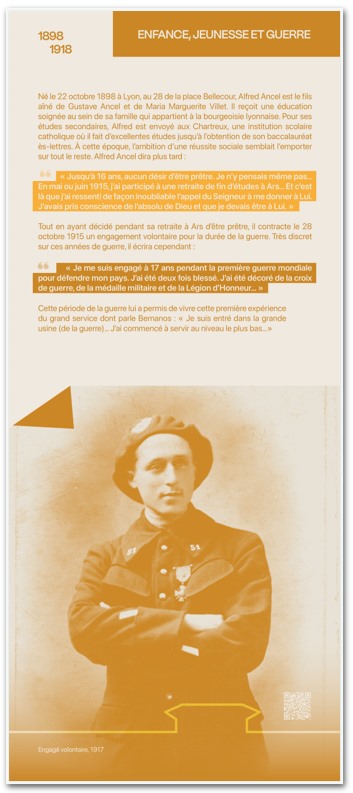
Let us pause for a moment and consider this 17-year-old young man who, amongst others – though the only one of his generation to become a bishop having fought in the 1914 war as a volunteer – took the risk of giving his life to defend his country. He has already reached his full height of 1.73 metres. He has a proud face and a certain playful quality deep in his eyes. He stands tall and, deep within himself, carries the secret of «the absoluteness of God» of which he has become aware. Deep down, it is to God that he surrenders himself. Yet, without saying a word, he knows that such a «surrender» does not preclude giving of himself to others or loving his country. On the contrary, it encompasses and drives both.
«I enlisted at the age of 17 during the First World War to defend my country. I was wounded twice. I was awarded the Croix de Guerre, the Médaille Militaire and the Légion d’Honneur.”.
»Please forgive me for saying all this, but one is so easily accused of anti-militarism that I had to make my position clear…« At the age of 75, Father Ancel recalls this distant past before declaring his »no« to the military dictatorship that took hold in Chile following Allende’s fall. Generally speaking, he rarely boasted about this period of his youth, though he did not disavow it either. When, during the third and fourth sessions of the Second Vatican Council, the important debate on the conditions for world peace took place, he spoke out publicly on two occasions to show how a properly understood patriotism can be reconciled with the necessities of international authority. But he confided to those close to him at the time that, if he had to do it all over again, he would not have got involved, because of the witness a priest must bear to the transcendent and the fundamentally abhorrent nature of war. However, he added, »I was not yet a seminarian at that time”.
The 17-year-old who enlisted was convinced that his country was in the right. Speaking to the seminarians of 1939 about the many French people who, between 1914 and 1918, «made the magnificent sacrifice of their lives», he added this observation, which must have taken shape in his mind between the two wars: «We have witnessed a spiritual resurrection in France that has filled with admiration those who believed our country to be irretrievably lost to secularism.»
But, after the initial burst of enthusiasm that must have followed his enlistment in 1915, what feelings did the young volunteer experience when confronted with reality? We can guess at them from the letters – which, incidentally, are full of humour – that he wrote to Nelly Boissonnet. Although dated, they do not specify a location, due to «military secrecy»:
«Sunday 18 October 1916. My dear old aunt, I have received your kind postcard, which has found its way to me here in the far less pleasant surroundings we find ourselves in. However, people praise the quality of the place and, according to a front-line newspaper, we are in a iron-rich area unlike any other. The treatment may be a little drastic, but everyone who comes out of it is doing well. You asked me for details of our life at the front. For those at the rear, it is shrouded in a certain aura, which, alas, is hardly present here. One wonders how glory can come strolling through this mud and adorn troops teeming with vermin. At first glance, what characterises the “poilu” (pilosus vulgaris, in the natural history of the 20th century), is that he is a grumbler: there is no worse insult one could hurl at him than to call him a patriot. Anything but that, and then there are phrases that come up time and again: “We’ve been sold out to the Germans” or “If the Krauts come, we’ll all surrender…” “If we have to attack, I refuse to leave the trench.” That’s for ordinary days, but on days when it’s raining, when he’s missed his quarter-pint of wine, or when the juice isn’t sweet enough, well, that’s when all hell breaks loose.»
«»Who’s coming with me?»»
«When you hear that for the first time, it comes as a shock; then, when you’ve seen the Krauts attacking and, instead of surrendering, they’re given a proper welcome with rifle fire; when, during the attack, everyone marches in line as if on parade; and when, finally, after much shouting, everything goes exactly to plan – that’s when you realise what the “poilu” is really worth.».
»But that’s hardly what the newspapers are saying."