


Major projects
Olivier de Berranger (Pages 110–112)
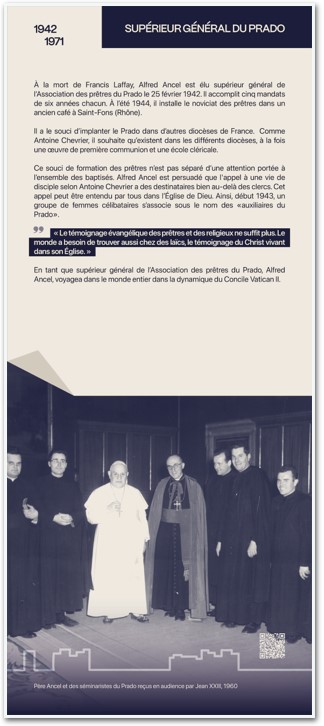
Following the death of Francis Laffay on 15 February 1942, a successor had to be found. As early as 25 February, the 54 electors summoned by Paul Chervier had gathered, and Alfred Ancel was elected. He went on to serve five successive six-year terms at the head of the Prado, where he remained the superior until 1971. Suffice it to say that, for nearly thirty years, his history became inextricably linked with that of the Prado. It is not our intention here to retrace that history. We shall simply seek, on the basis of the projects he set up and the direction he provided, to understand how Alfred Ancel experienced this ministry in the service of the Church as a spiritual struggle. And to this end, we shall confine ourselves essentially to the period preceding his time at Gerland, that is, up to the early 1950s.
When his brother Henri once asked him whether he ever felt any regret at not having had to run their father’s business, Alfred replied: «Oh no! You see, for me, a factory is too small… » Whilst acknowledging the humour in this quip – the sort that sometimes characterised Father Ancel’s repartee – one must certainly also see it as a perfectly sincere admission. A business leader, if he is to prosper, makes plans and must constantly devise new projects. Were Alfred Ancel’s plans—once he had become superior of the Prado—indicative, at least by analogy, of great human ambition? The figures, for their part, were remarkable. To give just two examples, the number of seminarians associated with the Prado stood at around thirty in 1945 but had risen to 195 by 1948; and whilst there were only 67 priests registered with the Society when Father Ancel succeeded Father Laffay, there were already 442 by 1954. Many of the letters sent to the bishops, once the Prado began to expand beyond the Diocese of Lyon, would read like victory reports. It is true that, at the same time, particularly after the war, the Little Brothers and Little Sisters of Jesus and the Missionary Brothers of the Countryside, amongst other similar institutions, also expanded significantly. However, as far as the secular clergy were concerned, even taking into account the establishment of the Mission de France by the Assembly of Cardinals and Archbishops in 1941, there was no surge comparable to that of the Prado.
Although impressive, do these results – which reflect the pressing needs of the moment in a France where the challenge of adapting the Church to post-war society calls for bold innovations – live up to the ambitions set? As early as the summer of 1944, Father Ancel announced to his fellow priests that the Fathers« Novitiate was to be established in Saint-Fons, on the edge of the N7, in the premises of a former café. Then he confided in them: »Shall I tell you what is really on my mind? The future will show whether it is in accordance with God’s will. It seems to me that, in order to truly establish the Prado in the various dioceses, there would need to be, in each one, both a First Communion organisation (or similar initiative) and a seminary. The First Communion society will keep us in the service of the poor, the humble, the dispossessed and sinners; the seminary will constantly and vividly remind us of Father Chevrier’s priestly ideal. Then the Prado communities will be truly strong: they will be founded on the same basis that Father Chevrier had established in Lyon (…). This is a vision for the future; it is, rather, an intention for prayer.”
To understand such projects, it is necessary to view them from the perspective of their founder. The Prado, founded by Antoine Chevrier as a «Providence» intended for the education of adolescents deprived of even a basic religious upbringing and as a breeding ground for poor apostles, was destined to undergo a considerable evolution. One might speak of a genuine «transformation» of an institution, initially embodied in its «works» in Lyon, whilst it was increasingly taking shape within a social transformation and a missionary dynamism that affected the whole of the Church in France.
Dedicated to a multifaceted mission
Olivier de Berranger (Pages 122–124)
What, then, did Alfred Ancel see as the distinctive nature of the «Prado vocation» during the great missionary decades of the post-war period?
When one looks not at his projects, but at the direction he set, one thing stands out for its consistency: this man fought against «Methodism» all his life. He himself uses this term, by which he means a state of mind which, of course, has nothing to do with the Christian denomination of that name. For him, it is a «missionary deviation», and he gives some very specific examples of how it manifests itself:
«One of the signs that one is afflicted with »methodism” is the amount of time one spends thinking about one’s methods. If a priest no longer has time to pray, to say his breviary properly, or to look after his parishioners because he has to think about his methods, there is no doubt about it: the diagnosis is clear. He is afflicted with methodism. Another sign of methodism is authoritarianism in the application of a particular method and exclusivism towards other methods. When a priest is so fixated on celebrating Mass facing the congregation that he can no longer celebrate it any other way, he is surely afflicted. When a priest is so caught up in his neighbourhood meetings and his activists from Specialised Catholic Action that he can no longer see or accept anything from outside, that’s it: he is afflicted (…). Methods are servants; one must use them and never become enslaved by them (…). No method is necessary; none is universal.”
Does this mean that Alfred Ancel scoffs at methods in apostolic work and advocates a dismissive form of relativism? Not at all. It is sectarianism that he is fighting: «Let us never be taken in by theories which undoubtedly contain excellent elements, but which become false as soon as they display totalitarian, exclusive or sectarian pretensions. Let us do God’s work well, and God will do his work.»
This article was written in 1951. But as early as 1926, did Alfred Ancel not say, in his homily on Saint John the Baptist at the Prado Chapel: «You can see what relative importance should be attached to the various works of the apostolate… » On this point, there is an unbroken consistency in his thinking. Experience and circumstances may well alter the scope of his approach and refine his choice of words. His spiritual convictions remain unchanged. For example, at a time when holiday camps were flourishing and had become the seminarians« favourite setting for their apostolic activities, Father Ancel wrote to them: »It is unacceptable for a seminarian to spend several hours preparing a treasure hunt or a mock battle and then to improvise an explanation of the Mass!« When all the priests and nuns were rushing about attending pastoral congresses, he clarified his thinking: »Through our Prado formation, we understand the essence of the priestly apostolate, but we must not for that reason disregard the various methods and techniques suited to current needs (…). Those who, under the pretext of fidelity to the spirit of the Gospel, would seek to disregard modern techniques and methods would demonstrate that they do not truly possess that spirit, and they would risk, as an inevitable consequence, causing the spirit of the Gospel to be disregarded.”
«Endlessly», as he puts it, he returns to Antoine Chevrier’s parable about «the artificial tree and the natural tree», commenting: «Of course, meetings must be prepared, but it is more important to prepare the priest than to prepare the meetings… » And one day – though this was back in 1947 – he came up with another parable of his own:
«To exaggerate slightly, one might formulate the prayer of the neo-Pharisees as follows: »My God, I thank you that I am not like the other Christians, who are formalistic and rigid, nor even like the Pope and the bishops who still concern themselves with Christian schools and other outdated matters… As for me, I live like a poor man and blend in with the masses; I am a living witness and I do not worry about rules—the spirit is enough for me.« And he went on to quote an old story: »It is said that a Russian (he must have been a true revolutionary), realising that his trousers were dirty and torn, in a fit of rage threw them into the fire… and afterwards realised he had no others. The story is surely not true, but what it symbolises has been done more than once.”
This call could be heard by everyone in the Church of God
Olivier de Berranger (Page 124)
As we can see, these Gospel-based guidelines are primarily addressed to priests. Alfred Ancel was, however, firmly convinced that the call to a life of «discipleship» – of which Antoine Chevrier had been a humble yet radiant witness – was intended for people far beyond the clergy alone. As he would go on to affirm in his final book, this call could be heard by everyone in the Church of God: bishops and priests, men and women religious, lay Christians… But it was above all the latter whom he had in mind at that time:
«I say it again today: the Gospel witness of priests and religious is no longer enough. The world also needs to find, amongst the laity, the witness to Christ living in his Church. Indeed, the religious situation in our country – and not only amongst the working class – has deteriorated further over the past century (…). Undoubtedly, there are still remnants of Christianity amongst us: we are aware of them through surveys on faith and religious practice. But we must not allow these undeniable facts to obscure another reality: that of the gradual disappearance of faith and even of the Christian foundation amongst ever-larger sections of the French population, especially amongst young people (…). Our times demand, in a sense, that lay people commit themselves, whilst remaining lay, to the path of evangelical perfection. Our world needs to see a sufficiently large number of lay Christians sharing with everyone the life of marriage, professional work and earthly commitments, whilst truly living according to the spirit of the Beatitudes and manifesting Jesus Christ through their whole lives.»