



A much-loved teacher
Olivier de Berranger (pp. 94–95)
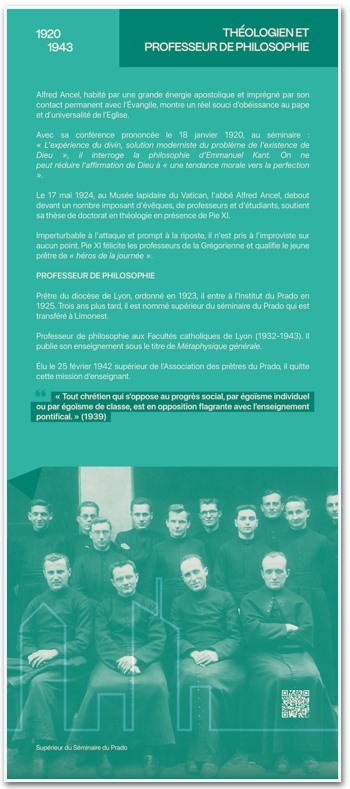
Alfred Ancel had completed his doctorate in scholastic philosophy at the Pontifical Gregorian University on 18 June 1920. He was awarded the degree with first-class honours (summa cum laude), it comes as no surprise to find him working as a professor of philosophy at the Prado Seminary as early as 1928. Alumni from that era still recall his twenty Thomist theses, set out with clarity in a Latin which, whilst not that of Cicero, nevertheless required some students to spend long sessions revising them. Father Ancel did indeed make it a point of honour to follow the Roman directives for seminaries. But he truly came into his own in teaching philosophy at the Catholic Faculties of Lyon, where the rector, Bishop Fleury Lavallée, appointed him as early as October 1932. Until 1943, he was to deliver there, as Cardinal Gerlier would write, «a lively and profound teaching that won over the student body, and whose excellence stemmed both from the teacher’s intellectual integrity and from his constant concern to touch souls ».”.
Father Ancel, who was already kept busy with various duties and often had to work through the night preparing his lectures, proved a great success with his audience. How many of them – such as Henri Lugagne, for example, who went on to become Bishop of Pamiers – would still remember him fondly several decades later… It was not only the students on the philosophy courses who remembered him, for Father Ancel also delivered two major public lectures, which were reprinted several times as small pamphlets: one, in 1941, on «God in the Light of Reason», and the other, in 1942, on «Man in the Light of Reason». Their influence clearly extended far beyond Lyon and the university. But above all, his lectures revealed him to be an orator. And therein lies, first and foremost, the reason for the success of the lectures themselves. Father Ancel never read a text in a neutral, indifferent tone to his audience. He sought to connect with his listeners as if he wished to engage in a friendly conversation with each of them. This was what captivated his students, just as it did the Christian faithful in the parishes who listened to his homilies, or the young women who regularly attended the retreats he preached. Proportionally speaking, one might say of him what Bishop Blanchet wrote of a man whom Alfred Ancel himself recognised as a master of philosophy, Auguste Valensin: «For him, thought must be communicated and must not shy away from the test of dialogue (…). In his view, no knowledge is truly mastered unless even the most uninitiated can benefit from it.»
General Metaphysics
Olivier de Berranger (pp. 95–96)
A voluminous book was published long after its author had stopped teaching, under the title of General Metaphysics. The book was praised in numerous specialist journals and received a number of glowing reviews, but did not have the same impact as it had in its day The Poverty of the Priest. Some saw it primarily as «a magnificent collection of definitions and philosophical theses». Many seminar tutors, who were not always adequately prepared for their role, made it their textbook of choice. But, even more than The Poverty of the Priest, This book, with its austere subject matter, suffered from a serious editorial problem, as it consisted of a hastily compiled collection of pupils’ notes, as Father Ancel explained in the preface. One can imagine that in the early 1950s, Father Ancel had even less time than he had during the war to revisit this work with fresh eyes. The imprecise references to the authors consulted leave readers who have kept abreast of developments in philosophical thought, including Thomism, feeling unsatisfied. This is one of the reasons why this book did not remain on the shelves of personal libraries for long and even began to gather dust quite quickly on the shelves of major seminaries’ libraries.
In these circumstances, one might ask, is it worth discussing this at all? It seemed to us that it was. Indeed, if one wishes to adopt Alfred Ancel’s own perspective, the fact that he, despite everything, undertook the publication of this book in 1952–1953 proves that, although he recognised its serious limitations, he still considered its value to be justified. This book therefore represents the state of his philosophical thought at the moment he reached the full maturity of his years. Moreover, the fairly numerous notes he nevertheless took the time to write in the tranquillity of La Roche during the summer of 1952, whilst they indicate here and there this or that addition that would have needed further development, are particularly interesting because they confirm an overall synthesis. It is therefore from this document, taken as such, that one can gain an insight into the intrinsic coherence of the ideas that inspired Father Ancel throughout his life.
However valuable other existing sources may be for understanding his thinking – unpublished notes or various articles that appeared between 1932 and 1950 – this book is essentially the result of fundamental teaching spanning more than ten years. We must therefore conclude that there are very deep connections – though hidden from those who witnessed only this man’s actions – between the ideas he developed there and the entire scope of his subsequent activities. Indeed, we believe that it is only by grasping, to some extent, the driving force behind his thought that one can hope to form a critical assessment of his activities. Undoubtedly, as one of his most benevolent critics wrote in 1954, comparing Father Ancel to Saint Bonaventure—who became Minister General of the Friars Minor and later a bishop: «Is there not some drawback in putting questions to a philosopher who no longer has the leisure to philosophise?» But one must reply that Alfred Ancel, even in his teaching, loved dialogue above all else, as he repeated to his students on 6 December 1932 before beginning a course on Theodicy: «It seems to me that scholasticism requires close collaboration between teacher and students. Objections, requests for clarification: a conversation rather than a lecture.»
It is in this spirit that we wish to offer here a brief reflection on the content of *General Metaphysics*, and thereby perhaps contribute a little to an understanding of the purpose of existence.