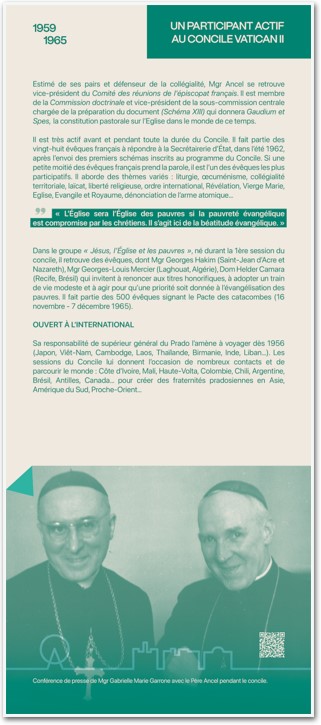



Bishop Ancel’s addresses at the Council
Olivier de Berranger (pp. 217–220)
(Bishop Alfred Ancel is) driven by an apostolic desire to engage in dialogue with non-Christians…
His written statement of 26 November 1963 is highly significant in this regard:
«In our text (on ecumenism), what is said about non-Christians – apart from Jews – is extremely brief. Just six lines of a very general nature are devoted to them, even though there are two billion of them worldwide. Moreover, human relations between Catholics and non-Christians are becoming increasingly important with each passing day, even in regions that were once predominantly Christian…»
Father Ancel went on to say that there could be no question of falling into indifferentism, for one offends the truth by regarding all opinions as equally valid. He then devoted a long paragraph to the respect due to non-Christian religions. In this respect, he broke with pre-conciliar thinking: seventeen such paragraphs had been included, but none dealt with this vast issue. Father Ancel then, quoting a report by Bishop de Smedt of Bruges, which had made a strong impression, called for the necessary dialogue with non-believers to be taken seriously: «I have met several atheists who did not really reject God or true religion, but only false concepts about God or the counter-testimonies of certain Christians, which we too must reject. I have even known some who, through the way they lived their lives, helped me to become a better Christian. In them, of course, this was a gift from God (…). An atheist communist said to me: “If you want us to believe in the spiritual, you must prove it to us through your lives.” And another: “What I hold against you Christians is not that you are Christians, but that you are not Christian enough” (…) The title of this outline could be retained as it is, provided that a distinction is made between ecumenism in the strict sense and ecumenism in the broader sense…»
This «distinction», whatever its author may have thought of it, was misleading in that it obscured the primary and original meaning of the term and risked perpetuating ambiguity. This is a point that may be noted as a certain limitation in someone who, unlike many other Council Fathers less confident in their theological knowledge, made virtually no use of any particular «expert» when drafting his personal contributions. Nevertheless, his contribution to the dialogue with non-believers and the emphasis in his text on respect for believers of other religions were a very positive contribution which would help, amongst other things, to advance the project of separate declarations on «non-Christian religions» on the one hand and «religious freedom» on the other.
At the end of the first session, Bishop Ancel, together with Bishop Guerry and Bishop Huyghe, Bishop of Arras, was one of the eleven French bishops to speak publicly on the draft document dealing with the Church. But whilst the first among them to speak on this subject, Cardinal Liénart, had emphasised a theology of the Church as Mystery, and whilst Bishop Guerry had initiated the Council’s fundamental reflection on episcopal collegiality, Bishop Ancel’s address, summarised by one of the finest commentators on these proceedings, might at first glance have seemed rather simplistic: «For Bishop Ancel, the contradictions between authority and freedom, primacy and collegiality, legalism and the spirit will be resolved by a return to the Gospel. It is not enough to say that the opposition is merely apparent, or that the realities are complementary. The Church’s charter is laid out in the Gospel. (…) We must not, therefore, set a community of love against a legal society, but rather strip the legal element of whatever might, in the eyes of believers or non-believers, distort the true face of the Church.»
Overly simplistic? To tell the truth, in this address delivered on the eve of the close of the first session, Bishop Ancel intended first and foremost to support the speech that Cardinal Lercaro, Archbishop of Bologna, had given the previous day. The Cardinal had spoken at length about poverty, a sign of the Incarnation, and about the evangelisation of the poor as a sign of the Kingdom. The earlier address by Cardinal Montini, Archbishop of Milan, who had masterfully highlighted the theme of the Church indwelt by Christ and communicating Him to the world as the «central theme» of the Council, had caught his attention to a lesser extent. Bishop Ancel insisted that the Gospel sources of the Church should be more clearly highlighted, for this, he said, would provide a firmer foundation for the exercise of authority within the Church as a form of humble service. And he concluded:
«It is not in vain that the Holy Gospel is solemnly displayed in the Council hall every day. It is not enough to regard it merely as a book on spirituality, nor as a simple illustration of dogmatic theses: rather, we must accept it as the very source of doctrine, for in truth it is just that.”.
During the second session, Bishop Ancel addressed the Assembly on only three occasions, but when he spoke on 24 October 1963, he did so on behalf of five cardinals and sixty-five French bishops. Once again, the amendment (tabled in chapter six of the draft document on the Church then under discussion) emphasised the Gospel foundation. This time, however, it concerned the lay apostolate. At a time when the debate was dragging on, Bishop Ancel did not take a stance on any of these major theological issues: the priesthood of the faithful or the question of charisms, etc. He delivered a sort of homily to the Assembly in which, quoting more than twenty verses from the New Testament, he sought to show that the apostolate for the laity was not a contemporary innovation, since it had begun in the early Christian communities.
In short, it was like a new chapter of *The True Disciple* applied to the laity… Reading Father Ancel’s countless pages, in which the Gospel shines through in every line, one begins to understand why he wrote the following to Father Haubtmann at Christmas 1964: «Personally, I am no exegete, and I know that exegetes find it somewhat difficult to accept this use of the Bible (my own), but whilst we may need to turn to exegetes for the meaning of the texts, I do not believe that the use of Scripture is solely their preserve». However, for Alfred Ancel – as indeed for Antoine Chevrier – «Scripture» meant above all the Gospels and the Pauline Epistles. For Bishop Ancel, the Acts of the Apostles must also be included. As for the Old Testament, he rarely referred to it. No doubt he drew little inspiration from it because he had not earlier undertaken a comprehensive study of its «key ideas», as Albert Gelin – who was a friend of his – liked to expound them at the Faculty of Theology of the Catholic Institute in Lyon?
Be that as it may, his address on 24 October met with the «approval of the lay listeners» who had recently been admitted to the Council’s assemblies.
The mystery of the Church in her relationship with Christ, «Light of the Nations»
Olivier de Berranger (Page 221)
Bishop Ancel, whilst he took a less active part in the debate, was by no means idle. Before speaking out on two occasions – once in writing and once orally – on the central issue of episcopal collegiality, he was one of those who practised it tirelessly. Just as, during the first session, he had, for example, taken part in the meetings organised between the French and the Germans, so too did he pass through Florence before travelling to Rome in October 1963, accompanied by Bishop Garrone, Bishop Marty and Bishop Veuillot. This was a meeting organised to facilitate an exchange with the Italian bishops, which would have a most positive effect on the subsequent progress of the Council’s work. Furthermore, a highly international group had formed as early as 1962 around Cardinal Lercaro, Archbishop of Bologna, who was striving to raise awareness within the Council of the realities of the Third World and the demands of evangelical poverty within the Church.
Even before proposing his amendments on the issue of collegiality, Bishop Ancel had spoken on 2 October, shortly after Cardinal Gracias, to discuss the Church’s relationship with the Kingdom of God. In his account of the event, Antoine Wenger emphasises that the speaker was «known to bishops throughout the world because of his experience as a working-class bishop»: «True to the approach he had shown at the first session, he would emerge throughout the Council as a conciliator and a moderator, inviting all sides to find common ground in authentic fidelity to the Gospel and in a sincere openness to our times. »
Indeed, Bishop Ancel explicitly quoted Cardinal Florit, Archbishop of Florence, in his address on 2 October. He wished to highlight, once again drawing on the Gospel, the «essential differences» that should be found within the Church, as compared with earthly societies: «The Church has nothing in common with societies that are closed in on their own ends, nor with a society that seeks to dominate the various nations by its own strength.» The Kingdom of God is a kingdom of peace which, through the power of the Holy Spirit, extends to the ends of the earth. That is why Christ said to his disciples: «Do not be afraid, little flock; it has pleased your Father to give you the Kingdom» (Luke 12:32).