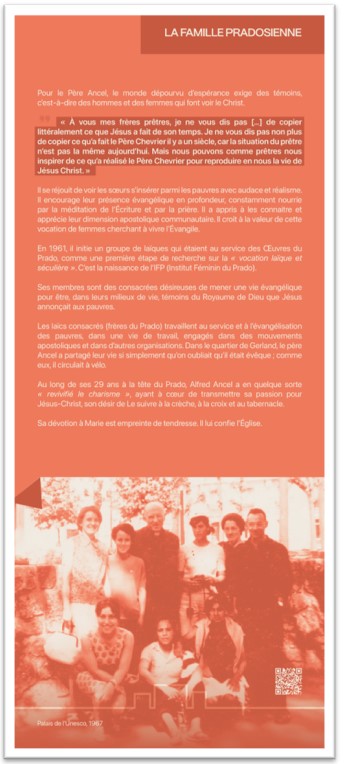



Please feel free to visit the various websites of the Prado Family:
- Priests and consecrated laypeople (brothers), click
- Fraternity of Deacons and Their Wives, click here
- The Sisters of the Prado, click here
- The’Prado Women’s Institute (IFP), click here
- The lay people, click here
And also Wikipedia, click here
Please take the time to watch the videos below on the topic «Laypeople in the Pradosian family»:
The videos can also be accessed directly via the following links:
- Laypeople in the Prado family (Meeting of 5 November 2019), click here
- Lay people of the Prado: From a fluid and undefined position to a community of committed lay people. With the participation of the Lay Coordination Group, meeting in Limonest, including Edmonde Tschupp and Evelyne Morio-Carré, click here
- Laypeople of the Prado: From an uncertain and undefined position to a community of committed laypeople (continued), click here
Video testimonials from residents of Prado who knew Father Alfred Ancel well
- Regis Charre, A priest and member of the Prado Secular Institute speaks about his dealings with Father Alfred Ancel. »Memories’, click here.
- Pierre Boisnard, A consecrated layperson and member of the Prado Secular Institute speaks about his interactions with Father Alfred Ancel. Memories, click here.
- Monique Lecœur, a Prado nun: «Alfred Ancel, superior of the Prado and auxiliary bishop of Lyon, was like a brother to me», click here.
- Bruno Bibollet: «I remember two faces that left a deep impression on me: that of Father Alfred Ancel and that of Dom Hélder Câmara», click here.
Following Bruno Bibollet’s account, Father Ancel’s perspective on Dom Helder Camara
Olivier de Berranger (pp. 306–308)
February 1968
Bringing his second visit to Latin America to a close, Father Ancel was back in Recife on 18 February: after flying over Uruguay and Paraguay, he had to cross the whole of the east of the country – a nine-hour flight. He once again led a retreat for around thirty priests, joined by two Brothers from Taizé who were in Olinda: «the most devoted in adoration of the Blessed Sacrament», he remarked. He also noted, during the discussions, the «very good contributions» from an A.C.O. chaplain who emphasised the need to «put popular piety at the service of evangelisation». On the evening of 22 February, Father Ancel met with Christian activists from rural areas who told him about the 50,000 sex workers in Recife: many very young girls who had come from the countryside because of the hunger there. Two days later, in Tuparetama, in the state of Pernambuco, Father Ancel found himself drawn into watching the Carnival parade. Here is the brief description he gave of it: «It is organised by the mayor: talcum powder being thrown about, music, dancing, a lorry crammed with children.» We shall learn no more; it is true that Father Ancel could not see colours…
On 27 February, Father Ancel visited Dom Helder for the second time. Dom Helder informed him of his decision to leave his bishop’s palace to live amongst his people. Father Ancel noted the words of the Archbishop of Olinda and Recife: «He respects those who have chosen the path of violence; but a violent revolution cannot succeed today: the army would crush it; the people are not yet politically aware; we must first empower the people; the revolution would not be capable of governing the country. But,» he told me, «we have no right to abandon our people. We are faced with an established disorder. If a lay person were to say what I am saying, they would be put in prison. I have not yet been put in prison. »I am not attacking anyone, but I am denouncing injustice…« And Father Ancel concluded: »One cannot help but be impressed by this man who wishes to be nothing but a man of God. He certainly possesses a prophetic charisma. One does not see in him any precise pastoral direction. He is more one who senses, sees and acts, than one who thinks, guides and organises. His faith and hope, coupled with boundless charity (he speaks ill of no one), are deeply invigorating. « Moreover, Dom Helder encouraged his visitor to give a public lecture on »The Church’s mission in temporal affairs’. But as Bishop Ancel spoke in French, there was a small audience. His host, however, insisted on being present and said to the listeners: “The hierarchy must intervene in social matters. We cannot leave the laity to their own devices.”
Very close to the conference venue, there was a favela that the police had wanted to demolish. Here, as in Bogotá, a priest – Padre Alessandro, a «prophet of yesteryear» from Italy, as Father Ancel writes of him – had intervened, and, for the time being, the residents had not been evicted.