



The void of suffering
December 1983
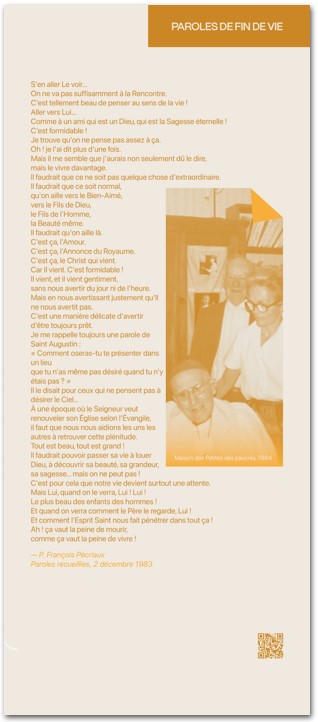
François Pécriaux asks Father Ancel to say a few words regarding the letter from the elderly and the sick
Fr Ancel: When God shapes his disciples, suffering plays a part in their lives, as do other things.
I believe we will never fully understand the extent to which Jesus Christ, when he chose someone as a disciple, would take care of them, training them to do what he himself wanted.
When we talk about training, we always have a certain plan in mind, to a greater or lesser extent. We want to train someone so that they can do something. When it comes to a disciple of Christ, of course, Jesus is training someone to do something, but not in the usual way. It is not primarily a question of skill; it is a matter of transmission. Jesus is the Word of God. Jesus is the Life of God, and consequently, when he prepares someone, it is always with this in mind: to pass on life.
Life is always relative to a person; it is always relative to the way that person acts. So, when Jesus calls us to be his disciples, he must first draw us out of ourselves, so that it is no longer us, but Him.
There is always an aspect of Jesus’ teaching that appears negative. Jesus does not teach us using what we already know. And I see this particularly in relation to suffering. Jesus does not teach us through some fine theory about suffering, so that we might teach others how to suffer. Jesus begins by breaking us down, by stripping away our theories, so that we know nothing any more; only then does he step in. But knowing nothing any more is very painful; it is a contrast between what we think we know and what we do not know. It is a process of stripping away. I do not think it is possible to train a disciple without this stripping away.
What is he stripping us of? As much as he can – everything. He no longer wants it to be us; he wants it to be him. So there is a period of emptiness. We don’t know; we don’t know what we’re doing; we don’t know what we’re meant to do.
So, given what I’ve just said, there’s only one way to prepare oneself to teach others about suffering: to be willing to let oneself be stripped bare completely; then it is He who will do it.
And how will he do that? I think he’ll first show us the emptiness of suffering. It brings nothing, it’s of no interest whatsoever; it’s empty. To suffer is to feel that you’re being destroyed, to feel that you can no longer do anything. It’s to feel that you’re a wretch.
Ultimately, to teach about suffering is to teach about poverty, and to do that one must have at least a faint inkling of the richness of poverty. What is the point of suffering? There is no point. What is the point of poverty? There is no point. And through this ‘nothingness’, something passes. Not just something, but someone passes – it is God.
We have too many ideas about God. Saint Paul believed only in Jesus Christ and in Jesus Christ crucified. There was nothing else, and that was his wealth.
I do feel as though I’m rambling, and yet that is what suffering is. To be empty. Not knowing what one is doing, not knowing where one is going, but being open, being open to the One who ushers in the Kingdom of Heaven. So that, too, is absurd; it makes no sense, and yet it is true, it is true.
When we no longer know what we’re doing, when we no longer know what the point of it all is, and when we’re still willing to be there, then God can make use of us; he can make use of us in his own way. I don’t know how to explain suffering. St Paul spoke of the folly of the Cross, and yet it is the wisdom of God. So, this calls on us to accept being empty; it calls on us to accept that there is nothing we can do. It calls on us to surrender ourselves completely, knowing that God works with nothing.
And what does it do? We can’t explain it, and yet it does.
And when he trains people to endure suffering, he really does train them. How? I don’t know. To do what? I don’t know. But he really does train them.
And that is why suffering is so closely linked to poverty. Helplessness, nothingness: we come close to adoration. God: everything; us: nothing, and it is He who does everything.
It may all sound absurd, what I’m saying; I don’t even really know how to explain it. If I were asked to repeat what I’ve said, I wouldn’t be able to, but for me, suffering, adoration, God and poverty all hang together. And then there’s effectiveness—but effectiveness, not at all in the usual sense of the word: effectiveness, in the sense that God does with someone, and within someone, what He Himself wishes to do, and often we know nothing of it.
François: L‘Given the very intense experience you’re going through right now, if you could go back 40 or 50 years, what would you take away from it?’
Father Ancel: Nothing. I could neither understand what I am explaining now, nor do it, because suffering is God’s work. So we can speak, but we do not really know what we are saying. We can speak. Some may find meaning in it; others, nothing. I don’t know. I don’t know.
François: What you’ve just said is, in a way, an answer: for me, there’s a connection between suffering, poverty, simplicity, God and worship. I believe this holds true even in periods of life when we’re less plagued by suffering.
Father Ancel: Yes, I think that’s true, but only if we let it happen, because, deep down, whatever we say about suffering amounts to nothing. What’s important is to let it take hold of us, and that’s what’s so terrible: we don’t understand it at all, we don’t understand it at all. There is a sort of absurdity to suffering, to the madness of the cross. So we don’t even dare to talk about it; it seems absurd. Yet we sense that there is a richness there which is, in fact, a light.
It’s absurd, what I’m saying… When I started speaking, I had absolutely no idea what I was going to say. It just came out like that – I was going to say: foolishly. But it doesn’t matter. I’m under no illusions: in what I say, there’s nonsense, there’s vanity, there’s a bit of everything – and even God – and we must embrace it all. And ultimately, the key word when it comes to suffering is «yes»: acceptance.
Suffering is so profound. It cannot be fully grasped in all its detail. One must open oneself up to it. And yet one never opens oneself up completely, because one does not want to. One is afraid. Suffering is terrible. The Cross is terrible, and yet one feels that it is necessary.
There is one more thing I would like to say. There is one thing we would like to receive in our suffering, which I have not received. Yet I long for it with all my heart. It is the joy of Easter, that joy which no one could ever take away from us.
Father Ancel: I can’t explain it, and yet I feel that it exists.
François: That is perfect joy.
Father Ancel: So, I think there’s only one thing for it: we must ask for it. We must ask for it. I don’t know if we’ll receive it, but we must ask. We must ask for the joy of Easter.
François: It’s a bit like St Francis’s ‘perfect joy’.
Father Ancel: I think there’s something to that. I don’t know if he was able to express it exactly as he felt it. But that’s it; it’s along those lines – along the lines of absurdity, along the lines of abundance, along the lines of poverty. I don’t know. And the more we say, ‘I don’t know’, the closer we come to worship, and worship is the joy of those who worship in spirit and in truth. Suffering is so rich! But I’ll stop here, because, quite simply, I can’t take any more. I’d like you to read me the Beatitudes…
François: Matthew 5: When Jesus saw the crowds, he went up the mountain. He sat down, and his disciples came to him. Then he began to teach them, saying:
Blessed are the poor in spirit,
for the kingdom of heaven belongs to them…
Father Ancel: He used to tell everyone…
François:
Blessed are the meek,
For they will inherit the earth.
Blessed are those who mourn,
for they will be comforted.
Blessed are those who hunger and thirst for righteousness.
for they will be satisfied
Blessed are the merciful,
for they will be shown mercy.
Blessed are the pure in heart,
for they will see God.
Father Ancel: See God. See God! Show us your face, and we shall be saved…
To see God, to see only God, in himself, just as Jesus saw him on the mountain. In God’s works, to look at the flowers of the field… In all people, since each has been made in the image of God. To see God… to see only God. For this, we need to be pure, and that is a gift from God. Do not worry. God’s gifts are gifts: they are not earned. It is He… Thank you in advance… I do not know what you will give us. I know that you are good. Blessed are the pure in heart, for they shall see God…
François:
Blessed are the peacemakers,
for they will be called children of God.
Blessed are those who are persecuted for righteousness’ sake,
for the Kingdom of Heaven belongs to them.
Blessed are you if you are insulted, persecuted or slandered in any way for my sake: rejoice and be glad, for your reward in heaven will be great. That is indeed how the prophets of old were persecuted.
Father Ancel: It’s beautiful! We don’t understand a thing, but we can sense that there’s an incredible richness to it… When we speak, we’re always afraid of putting on an act… It’s true, since he’s the one who said it…
Yes, you are marvellous, our God; you are beautiful, the most beautiful of all the children of men; you are the beauty of holiness; you are the splendour and the joy of God.
I’m sorry, I’m stammering. And yet I’d like to love you, even though I’ve never known how. Who knows if this desire has been there for a month? I’d like to love you; I’d like you never to be offended. I’d like everyone to focus solely on you, on your beauty, on your greatness, on You.
Letters from Former Patients and Those Currently Ill, No. 26, Christmas 1983